September 8, 1805

Mountains to the left and right

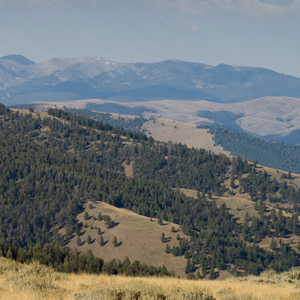
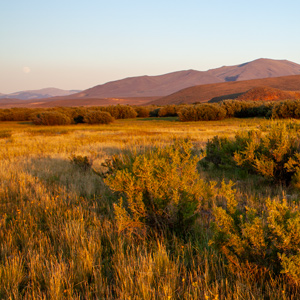
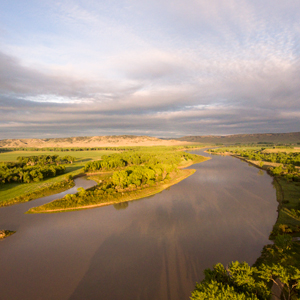
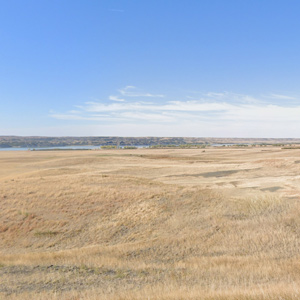
The expedition proceeds north through the Bitterroot valley with the snow-capped Bitterroot Mountains to the west and the mostly barren Sapphire mountains to the east. They find two Indian horses and a colt. They also find a new pest—brittle prickly pears.

In St. Louis, the Governor of Upper St. Louis, James Wilkinson, plans expeditions to the Yellowstone River and Sante Fe.

At Monticello in Virginia, President Jefferson writes about the mineral specimens that Lewis sent from Fort Mandan.

OPEN


August 26, 1805

Past the Great Divide

With the help of the Lemhi Shoshones, Lewis has the last of the baggage carried over Lemhi Pass. At Cameawait’s village, he adds to his worries when he receives Clark’s letter with bad news about crossing the Bitterroot Mountains. He has the men dance for the amusement of the villagers, and this will be his last journal entry for the year.

Clark and his small group move up the Lemhi River camping at a small village where they can obtain some fish. He directs his men to mend their moccasins and be ready to hunt early in the next morning.

In St. Louis, James Wilkinson dictates that only American traders be permitted up the Missouri and that all Indian trade goods be made in the United States.

OPEN


August 10, 1805

End of the navigable river

Lewis and his scouts reach the forks of the Beaverhead River and then explore two Indian roads to determine which one will lead to the Shoshones.

Far from the river’s end, Clark and the others manage thirteen difficult river miles, but only four miles by land.

The Native American delegates sent to St. Louis on the expedition’s barge wait for permission to continue to Washington City.

OPEN


July 28, 1805

Sacagawea's capture

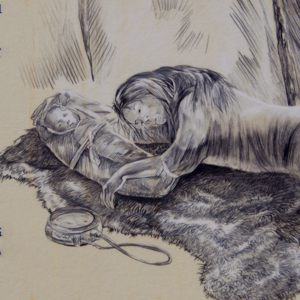
At the headwaters of the Missouri, the expedition takes a rest day. The captains learn of Sacagawea’s capture as a young child, and Lewis remarks on how she “would be perfectly content anywhere”. A shade bower is built for Clark, and Pvt. Whitehouse is busy making clothes for the party.

In a lengthy report to Thomas Jefferson, James Wilkinson discusses the new Indian factory at Camp Belle Fontaine and encourages the President to allow Pierre Chouteau to take Native delegations to Washington City.

OPEN


July 26, 1805

Charbonneau nearly drowns

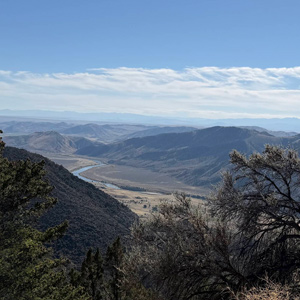
Above the Missouri River headwaters, Clark and two others climb a mountain to survey the Jefferson River. While crossing that river, Clark saves Charbonneau from drowning.

On the Missouri River several miles to the north, Lewis and the main party work the boats past “Howard” Creek where they suffer from barbed grass and prickly pears. Even Seaman is “in a rack of pain.”

OPEN


June 27, 1805

Sightseeing at the falls

At the Great Falls of the Missouri, Sgt. Ordway’s group detours from the portage route to view the falls and Giant Springs. Sgt. Gass reports hail stones as large as seven inches. At the upper camp, Pvts. Whitehouse and Frazer sew hides that will cover the iron-framed boat, Drouillard and Pvt. J. Field ambush a grizzly bear, and Seaman barks at bears all night.

Near Kaskaskia, James Wilkinson takes his oath of office as Governor of Louisiana Territory and asks the Secretary of War what should be done with the many Natives that have come to St. Louis.

OPEN


June 15, 1805

Sacagawea deteriorates

Below the Great Falls of the Missouri, Sacagawea’s health deteriorates, and Charbonneau asks to return home. For the enlisted men, towing the boats becomes increasingly difficult. Several miles ahead and unaware of Sacagawea’s condition, Lewis fishes and counts the scuta on a prairie rattlesnake.

Elsewhere, Pierre Chouteau ships Lewis’s Fort Mandan specimens from St. Louis to Washington City via New Orleans, and the expedition’s barge (keelboat) arrives at Fort Massac.

OPEN


May 28, 1805

Judith River oasis

The enlisted men tow the boats twenty miles to reach the fertile Judith River Basin. Lewis finds the change in scenery reviving. Several Native American items are found floating down the river, and they worry the owners are not far ahead.

In St. Louis, military commander James Bruff proposes a mission for the expedition’s old barge.

OPEN


April 19, 1805

Grounded by winds

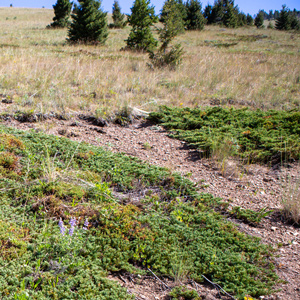
The wind being high, the captains decide to remain another day at their present camp below present Williston, North Dakota. Lewis describes the area’s beaver and collects a specimen of creeping juniper.

In Washington City, Secretary of War Henry Dearborn orders James Wilkinson to establish a factory near St. Louis to manufacture and store Indian trade goods.

OPEN


April 7, 1805

Leaving Fort Mandan

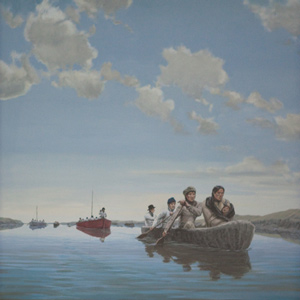
The permanent party—under Capts. Lewis and Clark—leaves Fort Mandan in six dugout canoes and two larger pirogues bound for the Pacific Ocean. They make it only as far as Mitutanka, one of the Knife River Villages. The return party—under Cpl. Warfington—takes the barge and one canoe down the Missouri headed for St. Louis.

In Washington City, James Wilkinson writes to James Madison, United States Secretary of State, accepting his appointment as Governor of Louisiana Territory.

OPEN


March 12, 1805

Charbonneau quits

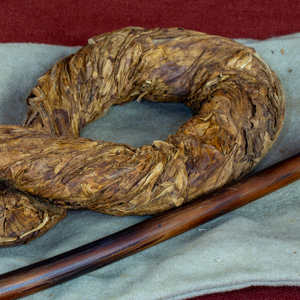
At Fort Mandan, Hidatsa interpreter Toussaint Charbonneau quits, and two men go to a Hidatsa village to trade for tobacco.

In St. Louis, Commandant James Bruff forwards President Jefferson a speech made by a Kaskaskia chief that foments war against the Osage.

In Washington City, Spanish Minister Yrujo complains that President Jefferson‘s Western expeditions are intruding on Spanish territory.

OPEN


March 11, 1805

Charbonneau's corruption

At Fort Mandan below the Knife River Villages, the captains accuse Hidatsa interpreter Toussaint Charbonneau of acting in the interests of local fur traders and give him an ultimatum.

In Washington City, President Jefferson commissions James Wilkinson as Territorial Governor of Louisiana.

In St. Louis, Pierre Chouteau—U.S. Agent for Indian affairs west of the Mississippi River—informs Jefferson of an alliance against the Osage—a complication arising from the captains sending a delegation of Osage to Washington City.

OPEN


March 2, 1805

North West Company news

At Fort Mandan, Canada-based trader François-Antoine Larocque visits with a fresh supply of trade goods and news of the death of Simon McTavish, the principal director of the North West Company.

From St. Louis, fur trader and merchant Pierre Chouteau writes President Jefferson to tell him news of the Lewis and Clark Expedition.

In Kaskaskia, Illinois, the captain’s intended peace between the Osage and their many neighbors appears to be falling apart.

OPEN


July 17, 1804

A day at 'Bald Pated' Prairie

The expedition spends the day at a “Bald Pated Prairie” near the present Iowa-Missouri border. The Missouri’s current is measured using a log line, reel, and ship, mosquitoes come and go with the wind, and tumors trouble several of the enlisted men and engagés.

In Washington City, Secretary of War Henry Dearborn gives instructions to Pierre Chouteau—a recently appointed Indian Agent for Upper Louisiana.

OPEN


June 19, 1804

Clearing a channel

The expedition sails several miles up the Missouri River, but later in the day the enlisted men and engagés must clear the channel of driftwood and tow the boats. At camp near the mouth of present the Crooked River in Missouri, Lewis issues mosquito netting.

In Philadelphia, German polymath Alexander von Humboldt—returning from his Mexican and Cuban expedition—writes to Secretary of State James Madison seeking funding for another expedition.

OPEN


May 16, 1804

St. Charles arrival

The boats set out early, pass the coal beds of Charbonier Bluff, and reach St. Charles, an early French settlement on the Missouri River. Many citizens come out to see the event and socialization commences.

Still in St. Louis, Lewis authorizes Amos Stoddard, the commandant of Upper Louisiana Territory, to act as his agent concerning any Indian delegations and engagés sent to St. Louis.

From Washington City, the Secretary of War Henry Dearborn asks Capt. Amos Stoddard to continue as Civil Commandant of Upper Louisiana.

OPEN


May 4, 1804

Officer of the Day

The day is rainy at winter camp across from the mouth of the Missouri. In his journal, Sgt. John Ordway records detachment orders for Officer of the Day and leaving camp. Lewis continues working in St. Louis.

From Washington City, Secretary of War Henry Dearborn tells Captain Amos Stoddard that Major James Bruff will soon arrive to replace him.

OPEN


March 26, 1804

Finding Simon Girty

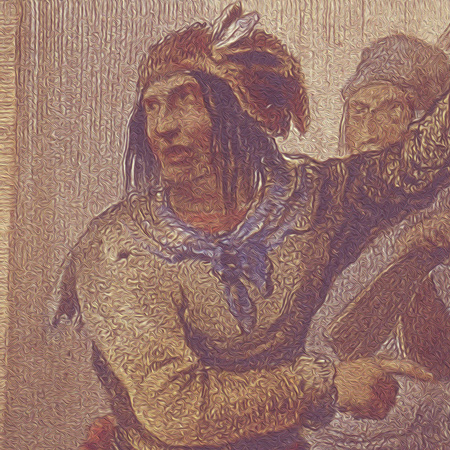
Lewis sends Thomas Jefferson Osage orange cuttings from Pierre Chouteau’s garden and in one of the Indian camps near the mouth of the Missouri, Clark meets Simon Girty, an infamous American traitor.

OPEN