History
Mássika (Sauk) and Wakusásse (Fox)
Karl Bodmer (1809–1893)
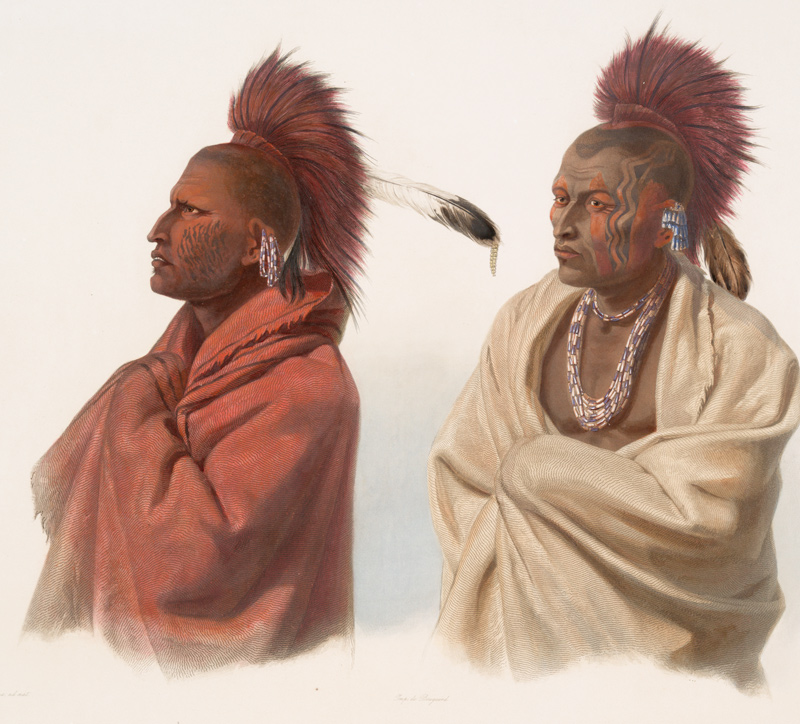
Courtesy New York Public Library Digital Collections[1]Rare Book Division, The New York Public Library. “Mássika, Sáki Indianer. Mássika, Indien Saki. Mássika, Saki Indian; Wakusásse, Musquake Indianer. Wakusásse, Indien Musquake (Renard). … Continue reading
To outsiders in 1803, the Sauk and Fox people living on the Mississippi River in Illinois, Iowa, and Wisconsin were seen as one people.[2]Moulton, Journals, 2:181n1. They were a close alliance, not a single tribe, but were nevertheless given United States federal recognition as the Sac and Fox. Further distinctions emerged as the alliance changed and today, there are three federally recognized Sac and Fox tribes.
At time of European contact, the Fox were living on the Wolf River in present-day Wisconsin having migrated there from Michigan and perhaps Northwest Ohio to avoid the invasive Iroqouis. The Sauk migrated to the Green Bay area during the Iroqouis incursions, but their post-contact migration patterns often differed from the Fox.
Both peoples spoke the Sauk-Fox-Kickapoo dialect of Algonquian and had similar cultures and economies. Both combined hunting with horticulture and gathering. They also traded furs and mined lead.[3]Charles Callender, Handbook of North American Indians: Northeast Vol. 15, ed. Bruce G. Trigger (Washington, D.C.: Smithsonian Institution, 1978), 636–672.
Black Hawk
Múk-a-tah-mish-o-káh-kaik, Black Hawk, Prominent Sac Chief
George Catlin (1796–1872)
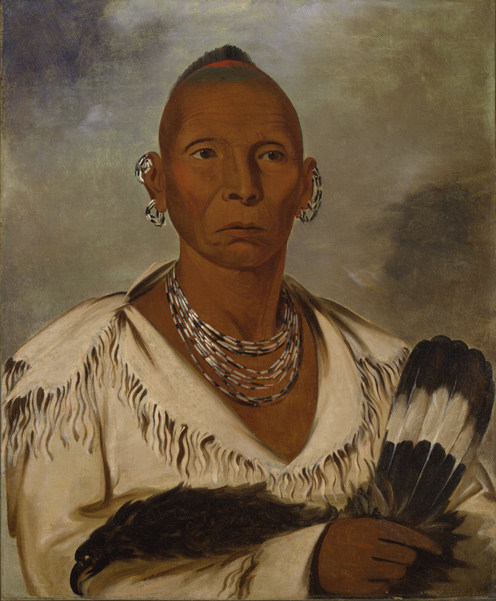
Courtesy Smithsonian American Art Museum. Public domain.
About Black Hawk, Catlin wrote:
This man, whose name has carried a sort of terror through the country where it has been sounded, has been distinguished as a speaker or counsellor rather than as a warrior . . . . When I painted this chief, he was dressed in a plain suit of buckskin, with strings of wampum in his ears and on his neck, and held in his hand his medicine-bag, which was the skin of a black hawk, from which he had taken his name, and the tail of which made him a fan . . . .[4]George Catlin, Letters and Notes on the Manners, Customs, and Condition of the North American Indians, reprint (Edinburgh: John Grant, 1926) 2:239.
While the Lewis and Clark expedition struggled up the Missouri River in 1804, the new territorial governor of Indiana, William Henry Harrison, negotiated a treaty with the Sauk and Fox ceding their lands east of the Mississippi for goods and an annual annuity. The treaty was quickly disputed as not being authorized by the whole of the Potawatomis. The dispute led to a political split among the Sauk.
In 1832, a brief war, the Black Hawk War, was fought by those who still did not accept the original 1804 treaty. Throughout the conflict, William Clark was Superintendent of Indian Affairs and sought ways to prevent violence. Despite those efforts, the war ended in tragedy for the Sauk with heavy casualties. Only a small group of Sauk residing in Iowa participated in the war, but all of them were seen as guilty and forced to cede more of their lands. Black Hawk and two others were imprisoned at Jefferson Barracks, and Clark successfully lobbied for their released. [5]This simple version of the Black Hawk War is more fully explained in Jay Buckley, William Clark: Indian Diplomat (Norman: University of Oklahoma Press, 2008), chapter 7 and Callender, 651–653.
Toponymy
The Fox name for themselves is Meskwaki meaning Red-Earths. Their current English name was translated from the French renard, the name of one of their groups or clans that was mistakenly applied to the entire people. In the “Estimate of the Eastern Indians,” they are listed as “Renars or Foxes.”
Fox: Renard, Renarz, Renars or Foxes
Meskwaki: Meshkwahkihaki, Mechecaukis, Mechecouakis, Meskwaki, Mesquakie, Mesquaki, Miscouaguis, Misquachki, Muskwaki, Musquakies
The Sauk call themselves Asaki-waki (asa•ki•waki). Their common name was derived from the French forms of an Algonquian word.
Sauk: Sac and Saki with variants Sachi, Satzi, Saquis, Saugies, Saukeas, Sakes, Sawkeys, Sacks, Saxes.
Expedition journalists used these spellings: Sauckee, Saukee, O Sau-kee. On 20 June 1804, Clark spells the town of Sauk Prairie as Saukee Prairie.[6]Callender, 645–646, 654–655.
Selected Encounters
March 12, 1804
St. Louis speech
In St. Louis, Dehault Delassus delivers a speech to several Indians informing them of the transfer of Upper Louisiana from Spain to the United States. Meriwether Lewis witnesses the event.
March 25, 1804
Bad mosquitoes
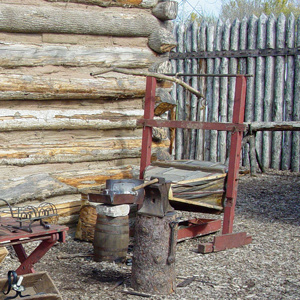
Men collect honey and complete various errands around winter camp at the River Dubois—present Wood River. Clark orders food for two dozen Sauk Indians and reports that the mosquitoes are bad.
May 5, 1804
Sauk and Kickapoo visitors
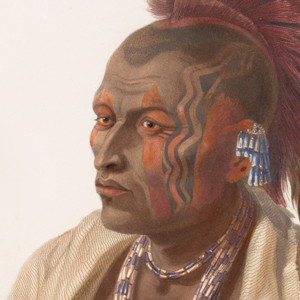
In St. Louis, Lewis prepares for departure up the Missouri River. Across the Mississippi at Camp River Dubois, Clark receives Sauk and Kickapoo visitors.
May 17, 1804
St. Charles court martials
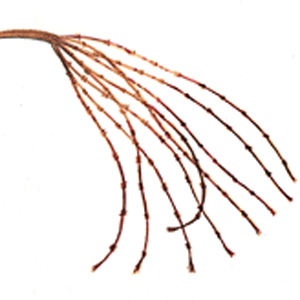
In St. Charles, Pvts. Hugh Hall, William Werner, and John Collins misbehave the previous night and today face a court martial. Some visiting Kickapoos tell Clark that the Sauk and Osage are at war—something the captains have been trying to prevent. Lewis continues in St. Louis.
June 5, 1804
Passing the Manitou
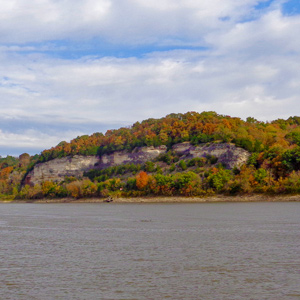
South of present Lupus, Missouri, the enlisted men and engagés struggle to move the boats past sandbars and channels clogged with driftwood. They pass a pictograph of a Manitou, York gathers cress to supplement their diet, and a scout finds fresh signs of a Sauk war party. They meet two French traders coming down in a raft.
June 13, 1804
The mouth of the Grand
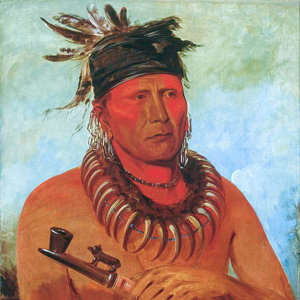
The enlisted men and engagés move the boats nine miles up the Missouri passing sandbars, shoals, and an abandoned Missouria village. They camp at the mouth of the Grand River where Clark and Lewis climb a hill for the view and make lunar observations late into the night.
June 15, 1804
Malta Bend hazards
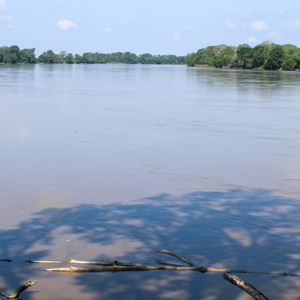
All day, the enlisted men and engagés struggle to move the boats around the Missouri River hazards. Submerged logs and crumbling banks add to the danger. They make 12¼ miles camping near abandoned Osage and Missouria villages at present Malta Bend.
June 17, 1804
Rope Walk Camp
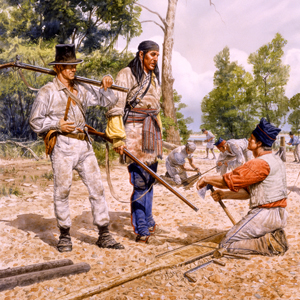
Near present Waverly, Missouri, the expedition travels one mile to Rope Walk Camp—a better site for making rope and oars. The engagés ask the captains for more food and instead receive a rebuke. Clark complains about the numerous ticks and mosquitoes, and several men suffer from boils and dysentery.
June 20, 1804
York nearly blinded
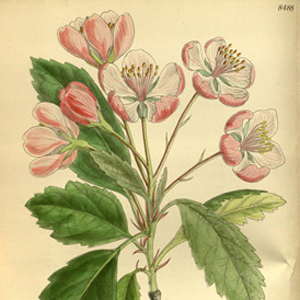
On the red pirogue, Pvt. Whitehouse says he and the engagés have difficulty rowing against the current—at one point having to walk the boat upstream. On another boat, Sgt. Ordway sees crab apple trees on the shore. At camp near present Lexington, Missouri, York is nearly blinded when one of the men throws sand in his eyes.
June 28, 1804
The Kansa People
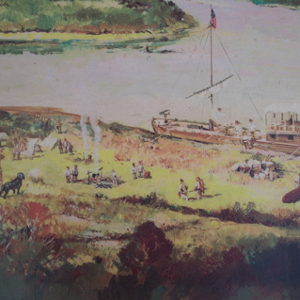
The expedition remains another day at the mouth of the Kansas River where Lewis determines its latitude. He also writes about the river, while Clark describes the Kansa People.
June 12, 1805
Searching for the Falls
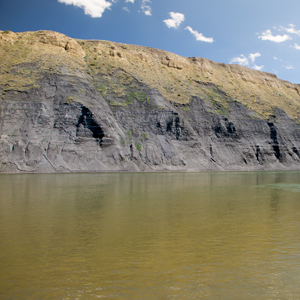
Lewis hikes over the plains in search of the Great Falls of the Missouri, and he sees the Rocky Mountain Front. He has an encounter with a grizzly bear, describes two types of cottonwood trees, and then goes fishing.
Clark takes the boats up the Missouri past black clay bluffs and rattlesnakes nearly reaching present Fort Benton. Sacagawea remains ill.
After the arrival of the barge in St. Louis, some of its many Native passengers return home and others prepare to leave for Washington City.
June 27, 1805
Sightseeing at the falls
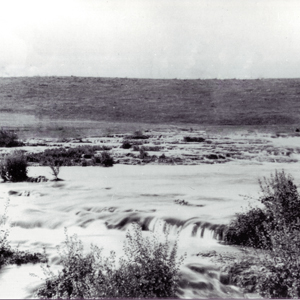
At the Great Falls of the Missouri, Sgt. Ordway’s group detours from the portage route to view the falls and Giant Springs. Sgt. Gass reports hail stones as large as seven inches. At the upper camp, Pvts. Whitehouse and Frazer sew hides that will cover the iron-framed boat, Drouillard and Pvt. J. Field ambush a grizzly bear, and Seaman barks at bears all night.
Near Kaskaskia, James Wilkinson takes his oath of office as Governor of Louisiana Territory and asks the Secretary of War what should be done with the many Natives that have come to St. Louis.
Notes
| ↑1 | Rare Book Division, The New York Public Library. “Mássika, Sáki Indianer. Mássika, Indien Saki. Mássika, Saki Indian; Wakusásse, Musquake Indianer. Wakusásse, Indien Musquake (Renard). Wakusásse, Musquake Indian.” New York Public Library Digital Collections. Accessed February 3, 2019. http://digitalcollections.nypl.org/items/510d47da-c428-a3d9-e040-e00a18064a99. |
|---|---|
| ↑2 | Moulton, Journals, 2:181n1. |
| ↑3 | Charles Callender, Handbook of North American Indians: Northeast Vol. 15, ed. Bruce G. Trigger (Washington, D.C.: Smithsonian Institution, 1978), 636–672. |
| ↑4 | George Catlin, Letters and Notes on the Manners, Customs, and Condition of the North American Indians, reprint (Edinburgh: John Grant, 1926) 2:239. |
| ↑5 | This simple version of the Black Hawk War is more fully explained in Jay Buckley, William Clark: Indian Diplomat (Norman: University of Oklahoma Press, 2008), chapter 7 and Callender, 651–653. |
| ↑6 | Callender, 645–646, 654–655. |
Experience the Lewis and Clark Trail
The Lewis and Clark Trail Experience—our sister site at lewisandclark.travel—connects the world to people and places on the Lewis and Clark Trail.

Discover More
- The Lewis and Clark Expedition: Day by Day by Gary E. Moulton (University of Nebraska Press, 2018). The story in prose, 14 May 1804–23 September 1806.
- The Lewis and Clark Journals: An American Epic of Discovery (abridged) by Gary E. Moulton (University of Nebraska Press, 2003). Selected journal excerpts, 14 May 1804–23 September 1806.
- The Lewis and Clark Journals. by Gary E. Moulton (University of Nebraska Press, 1983–2001). The complete story in 13 volumes.
This site is provided as a public service by the

Lewis and Clark Trail Alliance
with additional funding from the following: