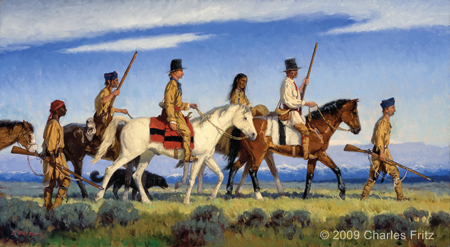
The expedition proceeds north through the Bitterroot valley with the snow-capped Bitterroot Mountains to the west and the mostly barren Sapphire mountains to the east. They find two Indian horses and a colt. They also find a new pest—brittle prickly pears.
In St. Louis, the Governor of Upper St. Louis, James Wilkinson, plans expeditions to the Yellowstone River and Sante Fe.
At Monticello in Virginia, President Jefferson writes about the mineral specimens that Lewis sent from Fort Mandan.
All Cold and Wet
by Yellowstone Public Radio[1]Originally aired weekdays by Yellowstone Public Radio during the Bicentennial observance of 2003-2006. Narrated by Hal Hansen. Scripts by Whit Hansen and Ed Jacobson. Produced by Leni Holliman. © … Continue reading
A Broad Valley
we Set out eairly and proceeded on down this creek which is now verry large. passed over Smooth plain no timber except along the bank of the creeks. Saw Snow on the mount to our left. high barron hills to our right.
—John Ordway
Lucky Hunters
Having travelled 20 miles, we encamped and our hunters came in, one of whom [George Drouillard] had killed a deer, and another had caught two mares and a colt, which he brought with him.
—John Ordway
Brittle Prickly Pear
Opuntia fragili
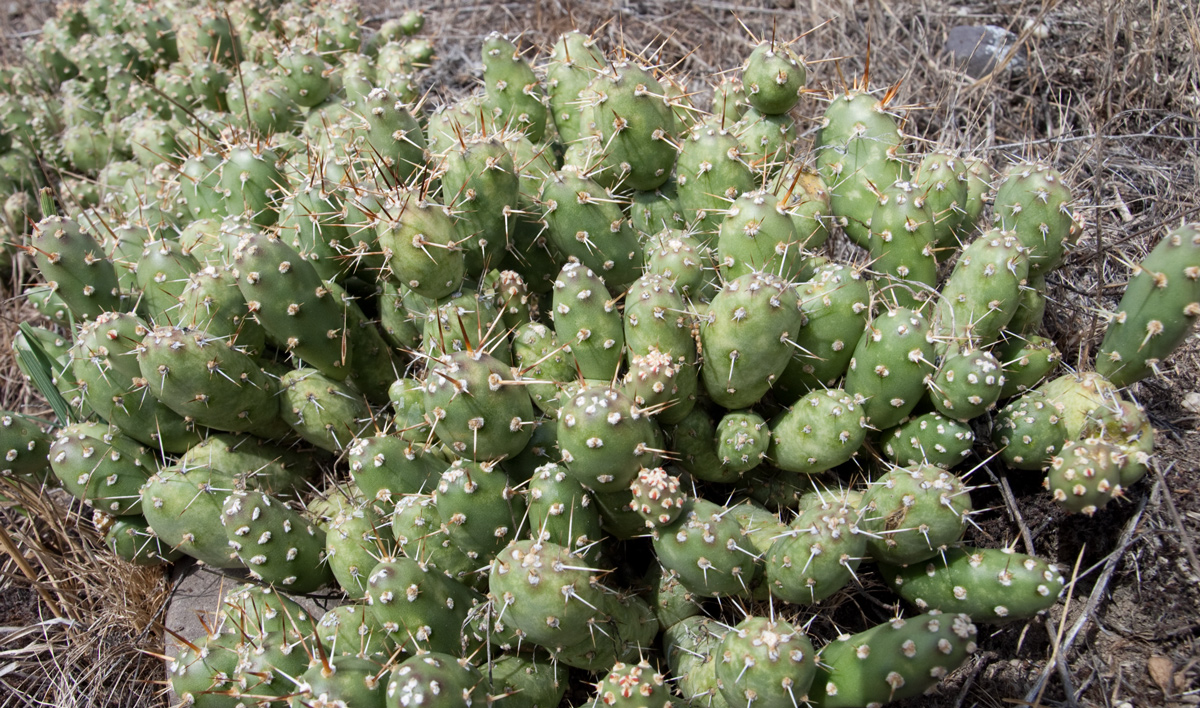
© 9 September 2009, Bitterroot River valley, by Kristopher K. Townsend. Permission to use granted under the Creative Commons Attribution-Share Alike 4.0 International license.
I observe great quantities of a peculiar Sort of Prickly peare grow in Clusters ovel & about the Size of a Pigions egge with Strong Thorns which is So birded [bearded] as to draw the Pear from the Cluster after penetrateing our feet.
—William Clark
Weather Diary
Weather at rise
Wind at Weather at 4 P.M. Wind at 4 P.M. cloudy N E cloudy after rain N E Mountains Covered with Snow to the S. W. a singular kind of Prickly Pears.
—Meriwether Lewis[2]To assist the reader, the editor of this web page has omitted the date column and spelled out some abbreviations.
Wilkinson’s New Expeditions
St. Louis Septr. 8th 1805—
Sir [Henry Dearborn],
I have equipt a Perogue out of my Small private means, not with any view to Self interest, to ascend the missouri and enter the River Piere jaune, or yellow Stone, called by the natives, Unicorn River, the same by which Capt. Lewis I since find expects to return and which my informants tell me is filled with wonders . . . .
I have also engaged a bold adventurer, who served under me during the late Indian War, and is now a Pensioner of the U. S.—(McClelan) to look at St Afee in person pending the Winter—He will take his departure from the Panis [Pawnee] Towns on the River Plate.—
With perfect respect I am, Sir, Your Obedient Servt.
Ja Wilkinson[3]Clarence E. Carter, The Territorial Papers of the United States (Washington, DC: United States Government Printing Office, 1948), 13:196–200, digitized by Google books.
Lewis’s Mineral Specimens
Writing in third person from Monticell, Thomas Jefferson writes to Samuel Latham Mitchell regarding the mineral specimens sent from Fort Mandan by Meriwether Lewis:
He expects on his return to Washington . . . to find there a great collection of the chemical subjects of Louisiana, which Capt. Lewis has sent, with a desire to forward them to the Phil. society at Philadelphia: from whom we are to hope to learn their contents.
Monticello Sep. 8 05.[4]Letters of the Lewis and Clark Expedition with Related Documents: 1783-1854, 2nd ed., ed. Donald Jackson (Urbana: University of Illinois Press, 1978), 259–60.
Notes
| ↑1 | Originally aired weekdays by Yellowstone Public Radio during the Bicentennial observance of 2003-2006. Narrated by Hal Hansen. Scripts by Whit Hansen and Ed Jacobson. Produced by Leni Holliman. © 2003 by Yellowstone Public Radio. |
|---|---|
| ↑2 | To assist the reader, the editor of this web page has omitted the date column and spelled out some abbreviations. |
| ↑3 | Clarence E. Carter, The Territorial Papers of the United States (Washington, DC: United States Government Printing Office, 1948), 13:196–200, digitized by Google books. |
| ↑4 | Letters of the Lewis and Clark Expedition with Related Documents: 1783-1854, 2nd ed., ed. Donald Jackson (Urbana: University of Illinois Press, 1978), 259–60. |
Experience the Lewis and Clark Trail
The Lewis and Clark Trail Experience—our sister site at lewisandclark.travel—connects the world to people and places on the Lewis and Clark Trail.
This page was funded in part by the Lewis and Clark National Historic Trail, U.S. National Park Service.
Discover More
- The Lewis and Clark Expedition: Day by Day by Gary E. Moulton (University of Nebraska Press, 2018). The story in prose, 14 May 1804–23 September 1806.
- The Lewis and Clark Journals: An American Epic of Discovery (abridged) by Gary E. Moulton (University of Nebraska Press, 2003). Selected journal excerpts, 14 May 1804–23 September 1806.
- The Lewis and Clark Journals. by Gary E. Moulton (University of Nebraska Press, 1983–2001). The complete story in 13 volumes.
This site is provided as a public service by the

Lewis and Clark Trail Alliance
with additional funding from the following: