Pierre Chouteau, Sr. (1758–1849)
Clarence Hoblitzelle (1897)
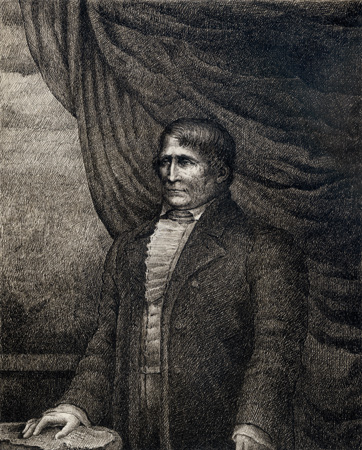
Courtesy Missouri History Museum, N22207.
Pierre Chouteau (10 October 1758–10 July 1849) and his half-brother Auguste[1]Pierre was christened Jean Pierre but seldom used his full name. Auguste is sometimes referred to as René Auguste, the same name as his father, the co-founder of St. Louis. William E. Foley and C. … Continue reading were already pivotal figures in the St. Louis fur trade when the Lewis and Clark Expedition arrived in 1803. They primarily traded with the Osage, and during the expedition’s winter stay in St. Louis, Pierre organized the first delegation of Missouri-based Native Americans to travel to Washington City.
Pierre’s influence did not diminish after the expedition left St. Louis. He witnessed the controversial treaty negotiation on 3 November 1804, between William Henry Harrison and the Sauk and Fox—a treaty that led to the infamous Black Hawk War of 1832.[2]Letters of the Lewis and Clark Expedition with Related Documents: 1783–1854, ed. Donald Jackson (Urbana: University of Illinois Press, 1978), 247n5; Charles Callender, Handbook of North American … Continue reading In 1808, he became the American agent and commissioner of the Osage. Pierre, Auguste, and their direct descendants would be involved in 56 treaties with various Nations.[3]List compiled from William Foley and David Rice and Paul Edmond Beckwith, Creoles of St. Louis (St. Louis: Nixon-Jones Printing Co., 1893) by Stan Hoig, The Chouteaus: First Family of the Fur Trade … Continue reading
Pierre’s role in fostering relations and negotiating treaties with various tribes helped pave the way for further exploration and settlement in the region. His contributions to the fur trade and his diplomatic efforts exemplified a legacy that shaped the early history of St. Louis and its interactions with Native American tribes.
The entire Chouteau family’s legacy is chronicled in various historical documents and books, such as those written by William E. Foley and C. David Rice, as well as Stan Hoig, which provide an in-depth look at their contributions to the fur trade and their lasting impact on St. Louis.
Related Pages
The Mineral Specimens
The three collections
by John W. Jengo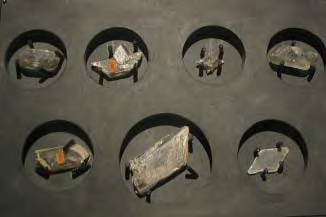
Although not nearly as celebrated as their botanical and zoological work, Lewis and Clark collected a multitude of mineralogical specimens throughout the expedition.
February 18, 1804
An Osage delegation
by Kristopher K. Townsend
From Wood River, Lewis works with St. Louis fur trader Pierre Chouteau to send a delegation of Osage to Washington City. In a letter, Lewis encourages Chouteau to take the group himself.
February 20, 1804
Working in St. Louis
by Kristopher K. Townsend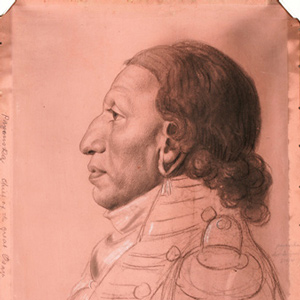
Based on his letter of 18 February, Lewis likely follows through on his promise to join Clark in St. Louis today. There, he helps Pierre Chouteau organize an Osage delegation bound for Washington City.
April 21, 1804
Chouteau's Osage delegation
by Kristopher K. Townsend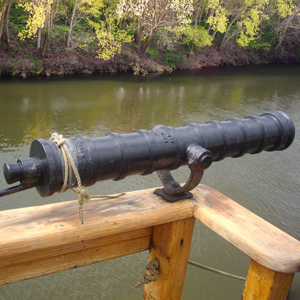
At Camp River Dubois, a cannon is heard from up the Missouri River. Soon after, a salute is fired to greet Pierre Chouteau and 22 Osage People. The captains place Sgt. Ordway in charge and travel with the delegation to St. Louis.
May 2, 1804
Flags, nets, and shirts
by Kristopher K. Townsend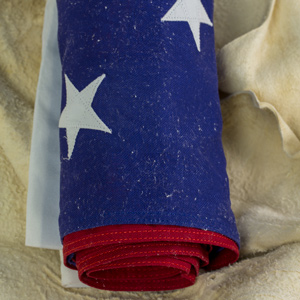
In St. Louis, Lewis writes Clark regarding seven French engagés and the enlisted men’s pay. He sends flags, mosquito netting, and shirts to Camp River Dubois where the barge is rolled over and several men are drunk.
May 3, 1804
Chouteau's Osage delegation
by Kristopher K. Townsend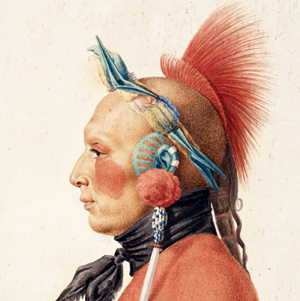
In St. Louis and Camp River Dubois, Lewis and Clark write letters of introduction for Pierre Chouteau who will soon take an Osage delegation to Washington City. At winter camp, the bottom of the barge is inspected, influential trader Manuel Lisa visits, and Sgt. Floyd brings letters to Clark.
May 18, 1804
Shifting the cargo
by Kristopher K. Townsend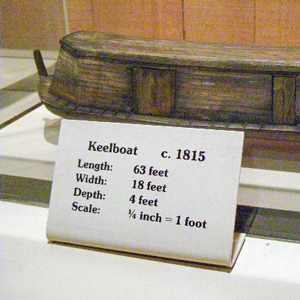
At St. Charles, Clark has the enlisted men shift each boat’s load to the front so that they will handle better. Drouillard leaves for St. Louis with a message for Lewis. More supplies are purchased, and some of the men pass the evening dancing with St. Charles ladies.
May 31, 1804
At the Osage
by Kristopher K. Townsend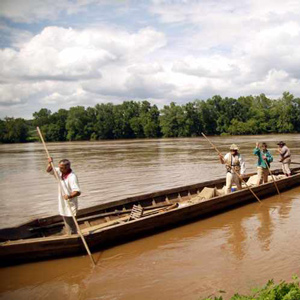
In present Missouri, the expedition struggles against a strong current before stopping at the mouth of the Osage River. The captains try to determine the precise location of this important tributary by taking celestial observations late into the night. Lewis also collects a specimen of wild ginger.
July 17, 1804
A day at 'Bald Pated' Prairie
by Kristopher K. Townsend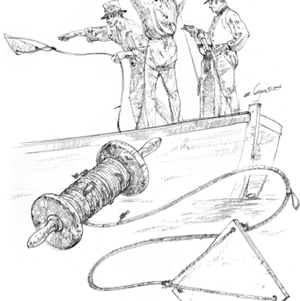
The expedition spends the day at a “Bald Pated Prairie” near the present Iowa-Missouri border. The Missouri’s current is measured using a log line, reel, and ship, mosquitoes come and go with the wind, and tumors trouble several of the enlisted men and engagés.
In Washington City, Secretary of War Henry Dearborn gives instructions to Pierre Chouteau—a recently appointed Indian Agent for Upper Louisiana.
February 15, 1805
Pursuing Sioux robbers
by Kristopher K. Townsend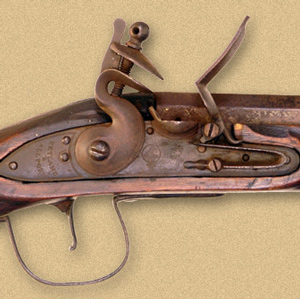
Lewis, twenty volunteers, and a few Knife River villagers leave Fort Mandan in pursuit of the Sioux who stole horses yesterday. After a 30-mile march, they spend the night at an abandoned village.
In St. Louis, fur merchant, Indian agent, and friend of the expedition, Pierre Choureau suffers from a devastating housefire.
March 11, 1805
Charbonneau's corruption
by Kristopher K. Townsend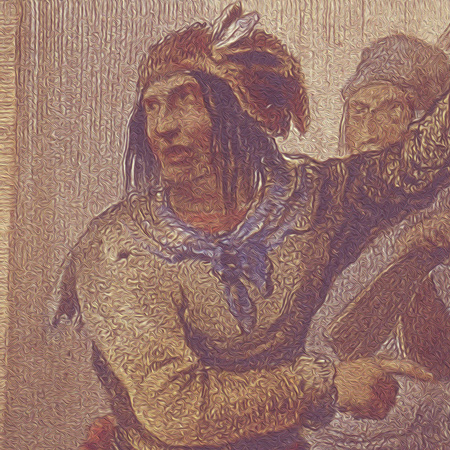
At Fort Mandan below the Knife River Villages, the captains accuse Hidatsa interpreter Toussaint Charbonneau of acting in the interests of local fur traders and give him an ultimatum.
In Washington City, President Jefferson commissions James Wilkinson as Territorial Governor of Louisiana.
In St. Louis, Pierre Chouteau—U.S. Agent for Indian affairs west of the Mississippi River—informs Jefferson of an alliance against the Osage—a complication arising from the captains sending a delegation of Osage to Washington City.
May 20, 1805
"Sâh-câ-gar me-âh or bird woman's River"
by Kristopher K. Townsend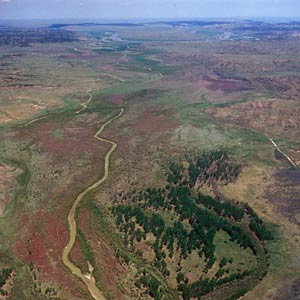
The captains name a creek Blowing Fly after the blowflies that often congregate on raw meat and open wounds. At the mouth of the Musselshell, they explore and take celestial observations. A tributary of the Musselshell is named “Sâh-câ-gar me-âh [Sacagawea] or bird woman’s River”.
Elsewhere, the barge, that headed down the Missouri from Fort Mandan on 7 April 1805, arrives in St. Louis.
May 22, 1805
Grouse Creek
by Kristopher K. Townsend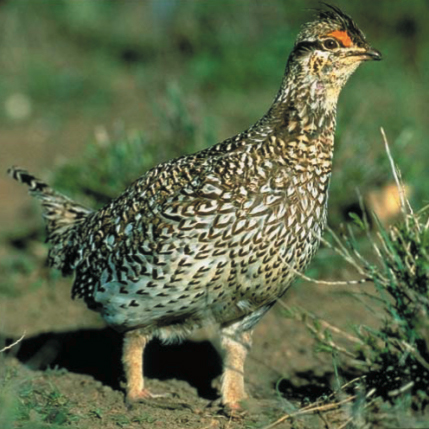
After a wind delay, the enlisted men tow the boats sixteen miles up the Missouri along present Charles M. Russell National Wildlife Refuge. They pass “grows Creek,” named for the many grouse seen there, and then stop early to render oil from a grizzly bear.
In St. Louis, Pierre Chouteau asks Illinois Governor William Henry Harrison about the numerous Indian delegates that have recently arrived on the expedition’s barge.
June 12, 1805
Searching for the Falls
by Kristopher K. Townsend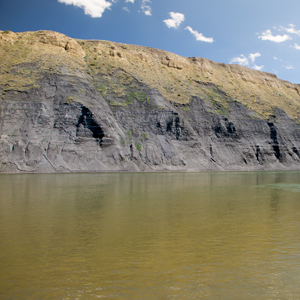
Lewis hikes over the plains in search of the Great Falls of the Missouri, and he sees the Rocky Mountain Front. He has an encounter with a grizzly bear, describes two types of cottonwood trees, and then goes fishing.
Clark takes the boats up the Missouri past black clay bluffs and rattlesnakes nearly reaching present Fort Benton. Sacagawea remains ill.
After the arrival of the barge in St. Louis, some of its many Native passengers return home and others prepare to leave for Washington City.
June 15, 1805
Sacagawea deteriorates
by Kristopher K. Townsend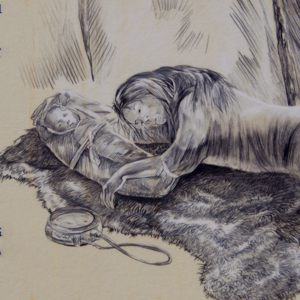
Below the Great Falls of the Missouri, Sacagawea’s health deteriorates, and Charbonneau asks to return home. For the enlisted men, towing the boats becomes increasingly difficult. Several miles ahead and unaware of Sacagawea’s condition, Lewis fishes and counts the scuta on a prairie rattlesnake.
Elsewhere, Pierre Chouteau ships Lewis’s Fort Mandan specimens from St. Louis to Washington City via New Orleans, and the expedition’s barge (keelboat) arrives at Fort Massac.
June 27, 1805
Sightseeing at the falls
by Kristopher K. Townsend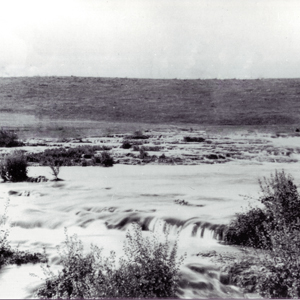
At the Great Falls of the Missouri, Sgt. Ordway’s group detours from the portage route to view the falls and Giant Springs. Sgt. Gass reports hail stones as large as seven inches. At the upper camp, Pvts. Whitehouse and Frazer sew hides that will cover the iron-framed boat, Drouillard and Pvt. J. Field ambush a grizzly bear, and Seaman barks at bears all night.
Near Kaskaskia, James Wilkinson takes his oath of office as Governor of Louisiana Territory and asks the Secretary of War what should be done with the many Natives that have come to St. Louis.
July 28, 1805
Sacagawea's capture
by Kristopher K. Townsend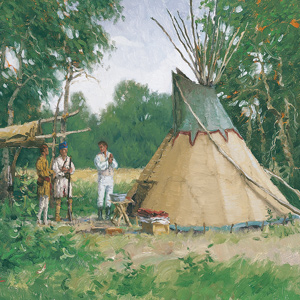
At the headwaters of the Missouri, the expedition takes a rest day. The captains learn of Sacagawea’s capture as a young child, and Lewis remarks on how she “would be perfectly content anywhere”. A shade bower is built for Clark, and Pvt. Whitehouse is busy making clothes for the party.
In a lengthy report to Thomas Jefferson, James Wilkinson discusses the new Indian factory at Camp Belle Fontaine and encourages the President to allow Pierre Chouteau to take Native delegations to Washington City.
September 3, 1806
News from home
by Kristopher K. Townsend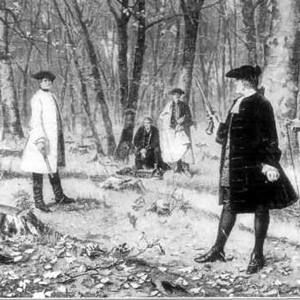
Moving down the Missouri, they meet a group of traders who tell them that Jefferson is again president and that Alexander Hamilton died in a duel with Aaron Burr. They camp above present Sioux City, Iowa.
September 23, 1806
St. Louis homecoming
by Kristopher K. Townsend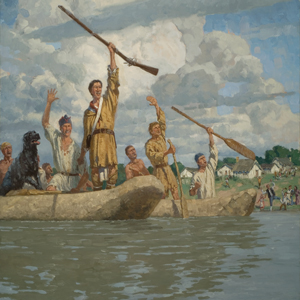
Around noon, the expedition celebrates its St. Louis homecoming. The captains work on letters to President Jefferson and Clark’s brother Jonathan telling of their findings.
The Charbonneaus in St. Louis
by Robert J. Moore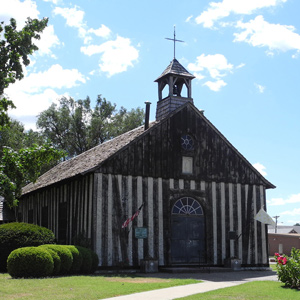
In 1809, Toussaint, Sacagawea, and Jean Baptiste Charbonneau traveled to St. Louis. Jean Baptiste’s baptism began a new era in his life, is father would try to become a farmer, and Sacagawea would become sickly.
Notes
| ↑1 | Pierre was christened Jean Pierre but seldom used his full name. Auguste is sometimes referred to as René Auguste, the same name as his father, the co-founder of St. Louis. William E. Foley and C. David Rice, The First Chouteaus: River Barons of Early St. Louis (Urbana: University of Illinois Press, 1983), ix. |
|---|---|
| ↑2 | Letters of the Lewis and Clark Expedition with Related Documents: 1783–1854, ed. Donald Jackson (Urbana: University of Illinois Press, 1978), 247n5; Charles Callender, Handbook of North American Indians: Northeast Vol. 15, ed. Bruce G. Trigger (Washington, D.C.: Smithsonian Institution, 1978), 651–653. |
| ↑3 | List compiled from William Foley and David Rice and Paul Edmond Beckwith, Creoles of St. Louis (St. Louis: Nixon-Jones Printing Co., 1893) by Stan Hoig, The Chouteaus: First Family of the Fur Trade (Albuquerque: University of New Mexico Press, 2008), 261–264. |
Experience the Lewis and Clark Trail
The Lewis and Clark Trail Experience—our sister site at lewisandclark.travel—connects the world to people and places on the Lewis and Clark Trail.

Discover More
- The Lewis and Clark Expedition: Day by Day by Gary E. Moulton (University of Nebraska Press, 2018). The story in prose, 14 May 1804–23 September 1806.
- The Lewis and Clark Journals: An American Epic of Discovery (abridged) by Gary E. Moulton (University of Nebraska Press, 2003). Selected journal excerpts, 14 May 1804–23 September 1806.
- The Lewis and Clark Journals. by Gary E. Moulton (University of Nebraska Press, 1983–2001). The complete story in 13 volumes.
This site is provided as a public service by the

Lewis and Clark Trail Alliance
with additional funding from the following: