At the headwaters of the Missouri, the expedition takes a rest day. The captains learn of Sacagawea‘s capture as a young child, and Lewis remarks on how she “would be perfectly content anywhere”. A shade bower is built for Clark, and Pvt. Whitehouse is busy making clothes for the party.
In a lengthy report to Thomas Jefferson, James Wilkinson discusses the new Indian factory at Camp Belle Fontaine and encourages the President to allow Pierre Chouteau to take Native delegations to Washington City.
The Madison, the Jefferson, and the Gallatin
by Yellowstone Public Radio[1]Originally aired weekdays by Yellowstone Public Radio during the Bicentennial observance of 2003-2006. Narrated by Hal Hansen. Scripts by Whit Hansen and Ed Jacobson. Produced by Leni Holliman. © … Continue reading
Our Captains’ Hide Lodge
12″ x 14″ oil on board
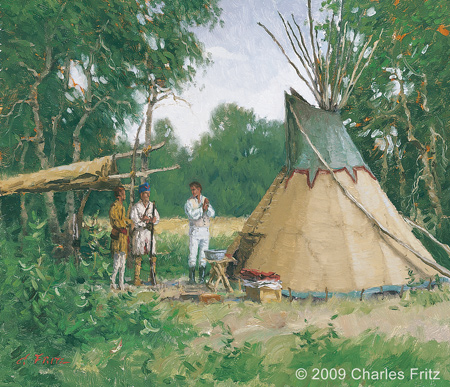
© 2009 by Charles Fritz. Used by permission.
Sacagawea’s Capture
Our present camp is precisely on the spot that the Snake [Lemhi Shoshone] Indians were encamped at the time the Minnetares [Hidatsas] of the Knife R. first came in sight of them five years since. from hence they retreated about three miles up Jeffersons river and concealed themselves in the woods, the Minnetares pursued, attacked them, killed 4 men 4 women a number of boys, and mad prisoners of all the females and four boys, Sah-cah-gar-we-ah or Indian woman was one of the female prisoners taken at that time
—Meriwether Lewis
Sacagawea’s Contentment
I cannot discover that she shews any immotion of sorrow in recollecting this events, or of joy in being again restored to her native country; if she has enough to eat and a few trinkets to wear I believe she would be perfectly content anywhere.—
—Meriwether Lewis
Naming the Three Forks
we called the S. W. fork, that which we meant to ascend, Jefferson’s River in honor of Thomas Jefferson. the Middle fork we called Madison’s River in honor of James Madison, and the S. E. Fork we called Gallitin’s River in honor of Albert Gallitin [Albert Gallatin].
—Meriwether Lewis
The Captain’s Leather Lodge
the day proving warm, I had a small bower or booth erected for the comfort of Capt. C. our leather lodge when exposed to the sun is excessively hot.
—Meriwether Lewis
Whitehouse, Chief Tailor
the men at Camp has employed themselves this day in dressing Skins, to make cloathing for themselves. I am employed makeing the chief part of the cloathing for the party.
—Joseph Whitehouse
Weather Diary
State of the thermometer at rise
Weather at Wind at State of the Thermometer at 4 P.M. Weather at 4 P.M. Wind at 4 P.M. State of the river 49 [above 0] fair after rain S W 90 [above 0] fair N. E. raise ½ in. —Meriwether Lewis[2]To assist the reader, the editor of this web page has omitted the date column, merged the “State of the river” columns, and spelled out some abbreviations.
The Belle Fontaine Cantonment
St. Louis July 27th 1805.
Sir,
I have determined on the ground for the cantonment of the Troops and the Erection of the Factory, on the right Bank of the Missouri, about one and an half leagues from its confluence with the Mississippi . . . . I have found Several Springs of pure water, and one of them alone Sufficient to Supply a camp of one thousand Men, we have here elevated ground, a choice of Fountain or Missouri water (and I think the last the best in nature) an abundance of timber and fuel, and a secure harbour for our boats . . . . we shall commence on the Buildings for the Factory—
With great consideration & respect I am Sir Your obed Sert.
Ja: Wilkinson[3]Clarence E. Carter, The Territorial Papers of the United States (Washington, DC: United States Government Printing Office, 1948), 13:164–68, digitized by Google books.
Pierre Chouteau Recommended
Wilkinson’s lengthy report to Thomas Jefferson continues:
I consider after close examination the appointment of Pere Chouteau a very judicious one, not only on account of his capacity for the Conduct of Indian affairs, and his general influence among the Nations acquainted with this place, but for the universal confidence which himself and his Brother enjoy, with all ranks and distinctions of People in this Country . . . . He calculates with great confidence on your permiting him to visit you the ensuing Autumn, with the cheifs who propose to wait on the President, and I hope he may be indulged . . . .[4]Ibid.
Experience the Lewis and Clark Trail
The Lewis and Clark Trail Experience—our sister site at lewisandclark.travel—connects the world to people and places on the Lewis and Clark Trail.
Plan a trip related to July 28, 1805:


Three Forks of the Missouri is a High Potential Historic Site along the Lewis and Clark National Historic Trail managed by the U.S. National Park Service. The site a Montana State Park.
Notes
| ↑1 | Originally aired weekdays by Yellowstone Public Radio during the Bicentennial observance of 2003-2006. Narrated by Hal Hansen. Scripts by Whit Hansen and Ed Jacobson. Produced by Leni Holliman. © 2003 by Yellowstone Public Radio. |
|---|---|
| ↑2 | To assist the reader, the editor of this web page has omitted the date column, merged the “State of the river” columns, and spelled out some abbreviations. |
| ↑3 | Clarence E. Carter, The Territorial Papers of the United States (Washington, DC: United States Government Printing Office, 1948), 13:164–68, digitized by Google books. |
| ↑4 | Ibid. |