The boats set out early, pass the coal beds of Charbonier Bluff, and reach St. Charles, an early French settlement on the Missouri River. Many citizens come out to see the event and socialization commences.
Still in St. Louis, Lewis authorizes Amos Stoddard, the commandant of Upper Louisiana Territory, to act as his agent concerning any Indian delegations and engagés sent to St. Louis.
From Washington City, the Secretary of War Henry Dearborn asks Capt. Amos Stoddard to continue as Civil Commandant of Upper Louisiana.
Arrival at St. Charles
by Yellowstone Public Radio[1]Originally aired weekdays by Yellowstone Public Radio during the Bicentennial observance of 2003-2006. Narrated by Hal Hansen. Scripts by Whit Hansen and Ed Jacobson. Produced by Leni Holliman. © … Continue reading
Historic St. Charles
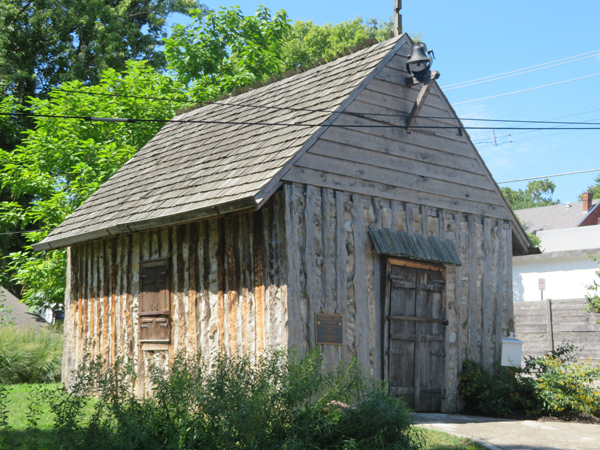
Derived from an original photo © 2021 by Robert Heacock. Used by permission.
Charbonier Bluff
A fair morning, Set out at 5 oClock passed the Coal hill (Call by the natives Carbonear [Charbonier]) this hill appears to Contain great quantytes of Coal, and also ore of a rich appearance haveing greatly the resemblance of Silver
—William Clark
St. Charles Arrival
Arrived Opposit St Charles at 12 oClock, this Village is at the foot of a Hill from which it takes its real name Peeteite Coete [Petite Côte] or the little hill, it contains about 100 indefferent houses, and abot 450 Inhabetents principally frinch, those people appear pore and extreemly kind, the Countrey around I am told is butifull. interspursed with Praries & timber alturnetly and has a number of American Settlers
—William Clark
Regarding St. Charles, Nicholas Biddle recorded the following observations learned from his April 1810 interview of William Clark:
This village like all those of the Illinois country has a common field in the neighborhood which is enclosed by one fence & subdivided into lots of which each inhabitant has the usufruct . . . .
. . . the inhabitants subsist chiefly by Indian trade & by hunting, so that their industry is chiefly confined to their gardens which are in good order.[2]“The Nicholas Biddle Notes” in Letters of the Lewis and Clark Expedition with Related Documents: 1783–1854, ed. Donald Jackson (Urbana: University of Illinois Press, 1978), 2:508.
Detachment Orders
the Commanding officer is full assured that every man of his detachment will have a true respect for their own Dignity and not make it necessary for him to leave St. Charles—for a more retired Situation—
W. C.
—Orderly Book, recorded by John Ordway
Dinner with Duquette
I was invited to Dine with a Mr. Ducett this gentleman was once a merchant from Canadia, from misfortunes aded to the loss of a Cargo Sold to the late Judge Turner he has become Somewhat reduced, he has a Charming wife an eligent Situation on the hill Serounded by orchards & a excellent gardain.
—William Clark
Lewis’s Agent
Before heading up the Missouri, Meriwether Lewis gives power of Attorney to Amos Stoddard with specific instructions for sending Indian delegations to Washington City.
[16 May 1804]
Sir [Amos Stoddard]:
. . . . .
First, That at all times when any party of Indian chiefs should present themselves at St. Louis, with sufficient evidence of my having invited them to that place with a view of their being sent on to the City of Washington, you will please to provide them with the means. . . .
A deputation from a large band of the Siou [Sioux] and Awayăs Iowa] nations, residing on the river Demoin, may be shortly expected to arrive here with this view; they have been invited to this place by me thro’ the Agency of Mr. [Lewis] Crawford for the purpose of going on to the seat of the General Government . . . .
Meriwether Lewis Capt.
1st U.S. Regt. Infty.[3]Lewis to Stoddard, Letters, 1:189–91.
Weather Diary
arrived at St. Charles
—Meriwether Lewis
Capt. Stoddard’s New Orders
War Department May 16th 1804
Amos Stoddard
Sir . . . . on reflection, it appears that as Civil Commandant you must continue untill an appointment can be sent by Governor Claiborne to Majr. Bruff, and of course you will perform the duties specially appertianing to a Civil Commandant untill further orders, and Majr. Bruff will have the Command of the Troops & Garrisons in upper Louisiana & its vicinity—
I am &c
Henry Dearborn[4]Clarence E. Carter, The Territorial Papers of the United States (Washington, DC: United States Government Printing Office, 1948), 13:23, digitized by Google books.
Experience the Lewis and Clark Trail
The Lewis and Clark Trail Experience—our sister site at lewisandclark.travel—connects the world to people and places on the Lewis and Clark Trail.
Plan a trip related to May 16, 1804:



Today, the Charbonier Bluff is a High Potential Historic Site along the Lewis and Clark National Historic Trail. The site is owned by the St. Louis County Department of Parks and managed by the Missouri Department of Conservation.
Today, the St. Charles Historic District is a High Potential Historic Site along the Lewis and Clark National Historic Trail managed by the U.S. National Park Service.
Notes
| ↑1 | Originally aired weekdays by Yellowstone Public Radio during the Bicentennial observance of 2003-2006. Narrated by Hal Hansen. Scripts by Whit Hansen and Ed Jacobson. Produced by Leni Holliman. © 2003 by Yellowstone Public Radio. |
|---|---|
| ↑2 | “The Nicholas Biddle Notes” in Letters of the Lewis and Clark Expedition with Related Documents: 1783–1854, ed. Donald Jackson (Urbana: University of Illinois Press, 1978), 2:508. |
| ↑3 | Lewis to Stoddard, Letters, 1:189–91. |
| ↑4 | Clarence E. Carter, The Territorial Papers of the United States (Washington, DC: United States Government Printing Office, 1948), 13:23, digitized by Google books. |
This page was funded in part by the Lewis and Clark National Historic Trail, U.S. National Park Service.
Discover More
- The Lewis and Clark Expedition: Day by Day by Gary E. Moulton (University of Nebraska Press, 2018). The story in prose, 14 May 1804–23 September 1806.
- The Lewis and Clark Journals: An American Epic of Discovery (abridged) by Gary E. Moulton (University of Nebraska Press, 2003). Selected journal excerpts, 14 May 1804–23 September 1806.
- The Lewis and Clark Journals. by Gary E. Moulton (University of Nebraska Press, 1983–2001). The complete story in 13 volumes.
This site is provided as a public service by the

Lewis and Clark Trail Alliance
with additional funding from the following: