At Station Camp near the mouth of the Columbia, some Clatsops and Lower Chehalis visit. Additionally, the wife of Chinook chief Delashelwilt brings six young females to camp. Clark describes Chinookan head flattening and woven mats and hats.
In Washington City, Secretary of War Henry Dearborn orders Louisiana Territory Governor and Commander of the U.S. Army, James Wilkinson, to cancel his plans to build a fort on the Platte River.
Where to Put Winter Camp
by Yellowstone Public Radio[1]Originally aired weekdays by Yellowstone Public Radio during the Bicentennial observance of 2003-2006. Narrated by Hal Hansen. Scripts by Whit Hansen and Ed Jacobson. Produced by Leni Holliman. © … Continue reading
Painting a hat – Nakoaktok (1915)
Edward S. Curtis (1868–1952)
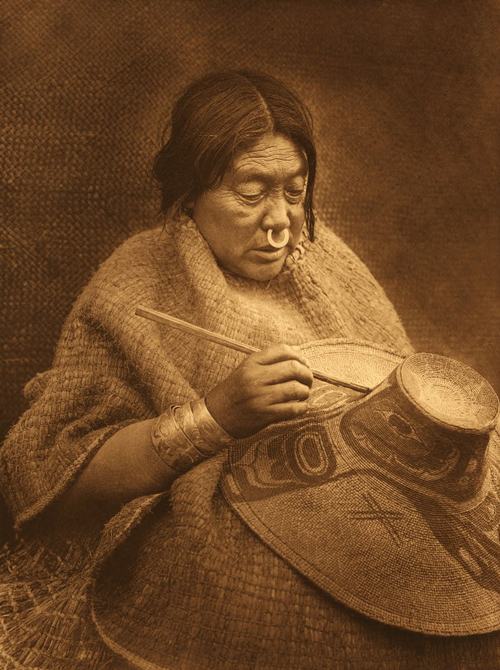
The North American Indian volume 10, plate 329.
Sacagawea’s Blue Coat
we gave the Squar a Coate of Blue Cloth for the belt of Blue Beeds we gave for the Sea otter Skins purchased of an Indian.
—William Clark
Clatsop and Lower Chehalis Visitors
Several Indians Visit us to day of different nations or Bands Some of the Chiltz [Lower Chehalis] Nation who reside on the Sea Coast near Point Lewis, Several of the Clotsops [Clatsops] who reside on the opposit Side of the Columbia imediately opposit to us, and a Chief from the Grand rapid to whome we gave a Medal.
—William Clark
Six Young Women
An old woman & wife to a Cheif of the Chinnooks [Chinooks] came and made a Camp near ours She brought with her 6 young Squars I believe for the purpose of gratifying the passions of the men of our party
—William Clark
Chinookan Indian Women
the womin of the Chinnook Nation have handsom faces low and badly made with large legs & thighs which are generally Swelled from a Stopage of the circulation in the feet (which are Small) by maney Strands of Beeds or curious Strings which are drawn tight around the leg above the anckle, their leges are also picked with different figures . . . . all those are Considered by the natives of this quarter as handsom deckerations
—William Clark
Flattened Heads
The Men are low homely and badly made, Small Crooked legs large feet, and all of both Sects have flattened heads— The food of this nation is principally fish & roots the fish
—William Clark
Woven Mats and Hats
We purchased Cramberies Mats verry netely made of flags and rushes, Some roots, Salmon and I purchased a hat made of Splits & Strong grass, which is made in the fashion which was common in the U States two years ago also Small baskets to hold Water made of Split and Straw
—William Clark
Weather Diary
Day of the month Wind State of the Weather 21st S E clouday after rain rained all last night untill 1 P. M and Cleared away and was Cloudy without rain
—Meriwether Lewis[2]Some abbreviations have been spelled out.
Wilkinson’s Plan Canceled
War Deptmt. Nov: 21, 1805.
Jas. Wilkinson
SirYour ordering a detachment to the River Plat, especially with a view of establishing a Military Post at the distance from 600 to 800 miles from St Louis, is very much to be regretted. Indeed, it was not believed you would undertake the execution of such distant projects without the express approbation of the President of the U. S.—You will, without delay, send orders for the immediate return of the Detachment;—and in future consider the establishment of distant posts as under the immediate direction of the President as expressed in my letter of the 2d. Inst.—
I presume that the title of the land, on which you have fixed the Cantonement & Factory on the Missouri, is clearly in the United States—
I need not remind you, General, that no public workmen are to be employed, on any pretext, for the accommodation of any individual, other than those immediately and exclusively attached to the Army, excepting only the buildings for the Factory.
[Henry Dearborn][3]Clarence E. Carter, The Territorial Papers of the United States (Washington, DC: United States Government Printing Office, 1948), 13:290, digitized by Google books.
Wilkinson’s Defense
Due to the time it took for letters to travel between St. Louis and Washington City, Wilkinson would not explain his decision to establish a fort on the Platte until 30 December:If respect is to be attached to the Mission of Capt. Lewis, or to the Engagements he may have made.—If the successful Issue of the gallant Enterprize in which He is engaged, is considered of national importance, or if we are bound to regard his personal safety as an Object of public Interest, then I trust I have barely done my duty, in attempting to convey the Otto & Riccari Chiefs to their respective Nations; But if I have done wrong by designing at the Same time, to make a small provisional depot (on the principles expressly declared in my communications) of which Government might or might not avail itself, Then I cannot sufficiently express my sorrow, & I hope my Conduct may be ascribed to my Zeal for the promotion of a Step, which I considered deeply Interesting to the United States.


Middle Village-Station Camp is a High Potential Historic Site along the Lewis and Clark National Historic Trail managed by the U.S. National Park Service. The site provides interpretation and is part of the Lewis and Clark National and State Historical Parks.
Notes
| ↑1 | Originally aired weekdays by Yellowstone Public Radio during the Bicentennial observance of 2003-2006. Narrated by Hal Hansen. Scripts by Whit Hansen and Ed Jacobson. Produced by Leni Holliman. © 2003 by Yellowstone Public Radio. |
|---|---|
| ↑2 | Some abbreviations have been spelled out. |
| ↑3 | Clarence E. Carter, The Territorial Papers of the United States (Washington, DC: United States Government Printing Office, 1948), 13:290, digitized by Google books. |
Experience the Lewis and Clark Trail
The Lewis and Clark Trail Experience—our sister site at lewisandclark.travel—connects the world to people and places on the Lewis and Clark Trail.
This page was funded in part by the Lewis and Clark National Historic Trail, U.S. National Park Service.
Discover More
- The Lewis and Clark Expedition: Day by Day by Gary E. Moulton (University of Nebraska Press, 2018). The story in prose, 14 May 1804–23 September 1806.
- The Lewis and Clark Journals: An American Epic of Discovery (abridged) by Gary E. Moulton (University of Nebraska Press, 2003). Selected journal excerpts, 14 May 1804–23 September 1806.
- The Lewis and Clark Journals. by Gary E. Moulton (University of Nebraska Press, 1983–2001). The complete story in 13 volumes.
This site is provided as a public service by the
Lewis and Clark Trail Alliance
with additional funding from the following: