The expedition spends the day at a “Bald Pated Prairie” near the present Iowa-Missouri border. The Missouri’s current is measured using a log line, reel, and ship, mosquitoes come and go with the wind, and tumors trouble several of the enlisted men and engagés.
In Washington City, Secretary of War Henry Dearborn gives instructions to Pierre Chouteau—a recently appointed Indian Agent for Upper Louisiana.
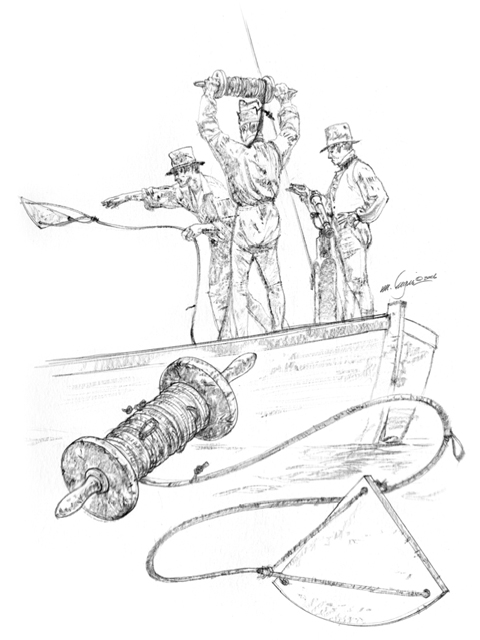
Log Line, Reel, and Ship
© Michael Haynes, https://www.mhaynesart.com. Used with permission.
Hunting and Fishing
we delay at this place for to hunt & take observations &-C— Several men out hunting eairly this morning—through the aforesaid Ball pated prarie. Capt Lewis Rhode out hunting also, the hunters killed 4 Deer to day
—John OrdwayGutrich [Goodrich] caught two verry fat Cat fish
—William Clark
Astronomical Observations
Captains Lewis & Clark both took Observations, and found it to lay in Latitude 40° 29″ 54 North
—Joseph Whitehouse
Using the Log Line, Reel, and Ship
The Common Current taken with a Log runs 50 fathen in 40″— Some places much Swifter in 30″ and even 20 Seconds of time—
—William Clark
These measurements convert to 5.1, 6.8, and 10.2 miles per hour.
Swarms of Mosquitoes
a puff of wind brought Swarms of Misquitors, which disapeared in two hours, blown off by a Continuation of the Same brees.
—William Clark
Troublesome Tumors
Several of the party much aflicted with tumers of different Kinds, Som of which is verry troublesom and dificuelt to cure.
—William Clark
Chouteau’s New Instructions
WAR DEPARTMENT July 17th 1804
Instructions to Peter Chouteau
Sir.
The President of the United States having appointed you an Agent of Indian Affairs for upper Louisiana: You will consider it your duty to use all prudent and possible means in your power for conciliating and establishing the friendship and good will of the several Indian Nations and tribes residing in that part of Louisiana which lies to the Northward & westward of the river Arkansa—
. . . you will endeavor to cultivate a pacific & friendly disposition generally among all the red people who may be placed under your care & superintendance and inculcate upon their minds the propriety and usefulness of a gradual introduction of the arts of civilization, especially the arts of agriculture and domestic manufactures, for which purpose you will from time to time furnish such of them with ploughs, hoes axes, spinning wheels, looms and other necessary materials, as will engage to make use of them, you will procure a suitable Character as a Blacksmith for the Osage Indians . . . .
Respectfully Your Humble Servant—
[Henry Dearborn][1]Clarence E. Carter, The Territorial Papers of the United States (Washington, DC: United States Government Printing Office, 1948), 13:31–33, digitized by Google books.
Experience the Lewis and Clark Trail
The Lewis and Clark Trail Experience—our sister site at lewisandclark.travel—connects the world to people and places on the Lewis and Clark Trail.
Plan a trip related to July 17, 1804:

Notes
| ↑1 | Clarence E. Carter, The Territorial Papers of the United States (Washington, DC: United States Government Printing Office, 1948), 13:31–33, digitized by Google books. |
|---|