The wind being high, the captains decide to remain another day at their present camp below present Williston, North Dakota. Lewis describes the area’s beaver and collects a specimen of creeping juniper.
In Washington City, Secretary of War Henry Dearborn orders James Wilkinson to establish a factory near St. Louis to manufacture and store Indian trade goods.
Too Windy for Canoes
by Yellowstone Public Radio[1]Originally aired weekdays by Yellowstone Public Radio during the Bicentennial observance of 2003-2006. Narrated by Hal Hansen. Scripts by Whit Hansen and Ed Jacobson. Produced by Leni Holliman. © … Continue reading
Creeping Juniper
Juniperus horizontalis
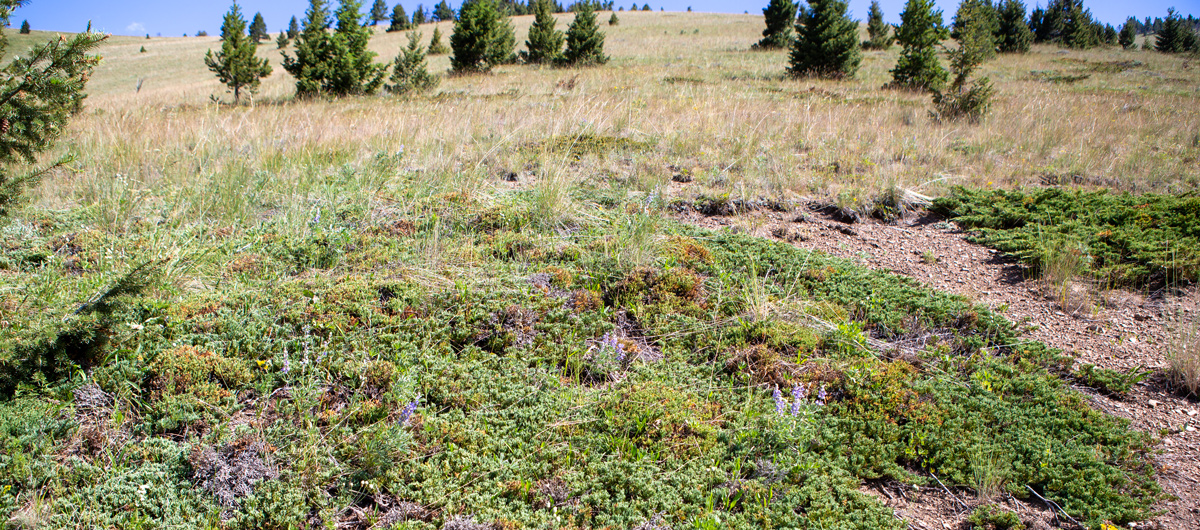
Lewis and Clark Pass, Montana, 1 July 2015. © by Kristopher K. Townsend. Permission to use granted under the Creative Commons Attribution-Share Alike 4.0 International license.
Creeping Juniper Specimen
Observed considerable quantities of dwarf Juniper on the hill sides (see specimen No. 4)
—Meriwether Lewis[2]This is one of the specimens ruined in a cache above the Great Falls. Other specimens of this plant were sent back on the barge (called the ‘boat’ or ‘barge’ but never the … Continue reading
Strong Winds
The wind blew So hard this morning from N. W. that we dared not to venture our canoes on the river.—
—Meriwether Lewis
Sgt. Gass Explores
While we lay here, I went out to the hills, which I found very high, much washed by the rain, and without grass. I saw a part of a log quite petrified, and of which good whetstones—or hones could be made.— I also saw where a hill had been on fire, and pumice stone around it. There is a great quanitity of hysop in the vallies.
—Patrick Gass
Blooming Plums
the Praries appear to green, the cotton trees bigin to leave, Saw some plumb bushes in full bloom, those were the plumb bushes which I have Seen for Some time.
—William Clark
Missouri River Beaver
The beaver of this part of the Missouri are larger, fatter, more abundant and better clad with fur than those of any other part of the country that I have yet seen; I have remarked also that their fur is much darker.—
—Meriwether Lewis
Weather Diary
State of Thermometer at rise
Weather Wind at State of Thermometer at 4 P.M. Weather Wind at 4 P.M. State of the River 45 [above 0] cloudy N. W. 56 [above 0] cloudy N. W. wind violent. The trees have now put forth their leaves. the goosbury, current, servisbury, and wild plumbs are in blume.
—William Clark and Meriwether Lewis[3]To assist the reader, the editor of this web page has omitted the date column, clarified the “State of the River” information, and spelled out some abbreviations.
The Indian Trade
War Departmt. April 19, 1805
Jas. WilkinsonSir,
In relation to the civil functions of your office, as Governor of the Territory of Louisiana, you will receive instructions . . . . [Y]ou will please to ascertain as early as practicable, the most suitable site, for the Factory, or Indian trading House, about to be established in that Country;—in doing which, it will be necessary to take into view, the accommodation of the Osages & other Missouri Indians, as well as those situated on the immediate waters of the Mississippi.
[Henry Dearborn][4]Clarence E. Carter, The Territorial Papers of the United States (Washington, DC: United States Government Printing Office, 1948), 13:116–17, digitized by Google books.
Experience the Lewis and Clark Trail
The Lewis and Clark Trail Experience—our sister site at lewisandclark.travel—connects the world to people and places on the Lewis and Clark Trail.
Plan a trip related to April 19, 1805:

Notes
| ↑1 | Originally aired weekdays by Yellowstone Public Radio during the Bicentennial observance of 2003-2006. Narrated by Hal Hansen. Scripts by Whit Hansen and Ed Jacobson. Produced by Leni Holliman. © 2003 by Yellowstone Public Radio. |
|---|---|
| ↑2 | This is one of the specimens ruined in a cache above the Great Falls. Other specimens of this plant were sent back on the barge (called the ‘boat’ or ‘barge’ but never the ‘keelboat’). See Moulton, ed. Herbarium, specimen 84. |
| ↑3 | To assist the reader, the editor of this web page has omitted the date column, clarified the “State of the River” information, and spelled out some abbreviations. |
| ↑4 | Clarence E. Carter, The Territorial Papers of the United States (Washington, DC: United States Government Printing Office, 1948), 13:116–17, digitized by Google books. |