At Fort Mandan, Canada-based trader François-Antoine Larocque visits with a fresh supply of trade goods and news of the death of Simon McTavish (1751–1804), the principal director of the North West Company. He also tells of that company’s merger with the XY Company.
From St. Louis, fur trader and merchant Pierre Chouteau writes President Jefferson to tell him news of the Lewis and Clark Expedition.
In Kaskaskia, Illinois, the captain’s intended peace between the Osage and their many neighbors appears to be falling apart.
River Ice Breaking Up
by Yellowstone Public Radio[1]Originally aired weekdays by Yellowstone Public Radio during the Bicentennial observance of 2003-2006. Narrated by Hal Hansen. Scripts by Whit Hansen and Ed Jacobson. Produced by Leni Holliman. © … Continue reading
Fort William

© 2017 by Kristopher K. Townsend. Permission to use granted under the Creative Commons Attribution-Share Alike 4.0 International license.
Above: David Thompson‘s map and Simon McTavish’s portrait hang in the great hall of Fort William—the Northwest Company’s inland headquarters starting in 1803. In 1805, it was called Fort Kaministiquia.
North West Company News
Mr. La Rocque [François-Antoine Larocque] a Clerk of the N W Company visit us, he has latterly returned from the Establishments on the Assinniboin River with Merchindize to tarade with Indians— Mr. L informs us the N, W. & X Y Companies have joined, & the head of the N W. Co. is Dead Mr. McTavish of Monteral,—
—William Clark
Trading Implements of War
the Savages continue to visit us in Order to git their impliments of War made. they bring us in pay corn and beans dryed meat & persimblans &.C.—
—John Ordway
Daily Tasks
This day we had fine Clear weather. the Men are all employed in Cutting, wood, and Repairing & mending their Cloathes, dressing Deer & Elk Skins & making of mockasins &ca.—
—Joseph Whitehouse
Weather Diary
State of Ther. at rise
Weather wind at State of Thermt. at 4 OClock Weather at 4 Ock Wind at 4 OClock State of the River 28 [above 0] fair N E. 36 [above 0] fair N E rise 1 ½ in. the snow has disappeared in many places the river partially broken up— Mr. Larocque visits us—
—Meriwether Lewis[2]To assist the reader, the editor of this web page has omitted the “Day of Month 1805” column and spelled out some abbreviations.
Three Kaskaskias (cropped)
George Catlin
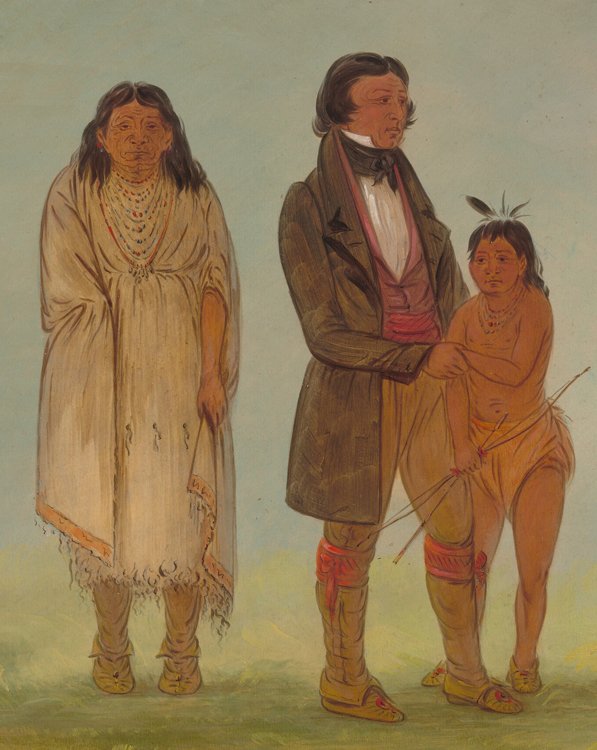
Oil on card mounted on paperboard, 18 3/4 x 25 1/8 in. National Gallery of Art, Paul Mellon Collection, www.nga.gov/artworks/50411-kaskaskia-chief-his-mother-and-son.
Of this portrait, Catlin wrote: “Káskáskia . . . Kee-món-saw (The Little Chief); chief of the tribe, now reduced to three persons, the chief, his aged mother, and his little son.”[3]George Catlin, “Souvenir of the N. American Indians: as they were in the nineteenth century” (London: 1850).
Chouteau’s News
St. Louis, 2 Mch. 1805
Dear Sir [Thomas Jefferson],
The news I received indirectly about Captain Lewis and conveyed to you in my last letter has been confirmed. A merchant from here who spent the winter in the Omahas‘ village sent a message saying Captain Lewis had arrived without any untoward incidents, before the ice, and settled approximately 50 leagues above the Mandans. I expect to receive letters from him soon via some St. Louis men who accompanied him and were to return after leaving him there.
Pre. Chouteau[4]Pierre Chouteau to Thomas Jefferson, 2 March 1805, Founders Online, National Archives, founders.archives.gov/documents/Jefferson/01-45-02-0622, accessed 1 February 2026. [Original source: The Papers … Continue reading
Rumors of War
Kaskaskias March 2d. 1805
Brother[:] The Chikasaw, Creeks, Maskokoe [Mascouten], Choctaw, Okapa [likely Kickapoo], are all Joined together, to Carry War against the Osage Nation, Which are very Bad Indians, and are every day Injuring us, I have Joined them and invitting all the Nations of Wabash, Delaware, Chawnees [Shawnees], Piankaskas [Piankeshaw], Miamis, Pouttewatemies [Potawatomis], Ottawas, Osakees [Sauk], and Yourself in the Illinois River, Invite you to Join us, that we may Carry Destruction to that Bad Nation of Indians the Osage.
Macouissa or Decouagne[5]Clarence E. Carter, The Territorial Papers of the United States (Washington, DC: United States Government Printing Office, 1948), 13:104, digitized by Google books.
Jean Baptiste Ducoigne was born of a French father and a Tamaroa mother in 1750. In 1800 he led a merger of the Kaskaskia, Cahokias, and Tamaroas to enable their survival and became known as a chief of the Kaskaskias. He liked to live like a white settler which made him unpopular among other nations.[6]Frederick Webb Hodge, Handbook of American Indians North of Mexico, Vol. 1 (Washington: Smithsonian Institute, 1912), 405; “Kaskaskia, Illinois”, Wikipedia, … Continue reading For more on the Kaskaskia Nation, see The Illinois Tribes.
Experience the Lewis and Clark Trail
The Lewis and Clark Trail Experience—our sister site at lewisandclark.travel—connects the world to people and places on the Lewis and Clark Trail.
Plan a trip related to March 2, 1805:


Fort Mandan is a High Potential Historic Site along the Lewis and Clark National Historic Trail managed by the U.S. National Park Service. The North Dakota Department of Parks and Recreation manages a modern reconstruction and the Lewis and Clark Interpretive Center located at US Hwy 83 and ND Hwy 200A.
Knife River Indian Villages National Historic Site is a High Potential Historic Site along the Lewis and Clark National Historic Trail managed by the U.S. National Park Service. A unit of the National Park System, the site is located at 564 County Road 37, one-half mile north of Stanton, North Dakota. It has exhibits, trails, and a visitor center.
Notes
| ↑1 | Originally aired weekdays by Yellowstone Public Radio during the Bicentennial observance of 2003-2006. Narrated by Hal Hansen. Scripts by Whit Hansen and Ed Jacobson. Produced by Leni Holliman. © 2003 by Yellowstone Public Radio. |
|---|---|
| ↑2 | To assist the reader, the editor of this web page has omitted the “Day of Month 1805” column and spelled out some abbreviations. |
| ↑3 | George Catlin, “Souvenir of the N. American Indians: as they were in the nineteenth century” (London: 1850). |
| ↑4 | Pierre Chouteau to Thomas Jefferson, 2 March 1805, Founders Online, National Archives, founders.archives.gov/documents/Jefferson/01-45-02-0622, accessed 1 February 2026. [Original source: The Papers of Thomas Jefferson, vol. 45, 11 November 1804 to 8 March 1805, ed. James P. McClure et al. (Princeton: Princeton University Press, 2021), 610–615.] |
| ↑5 | Clarence E. Carter, The Territorial Papers of the United States (Washington, DC: United States Government Printing Office, 1948), 13:104, digitized by Google books. |
| ↑6 | Frederick Webb Hodge, Handbook of American Indians North of Mexico, Vol. 1 (Washington: Smithsonian Institute, 1912), 405; “Kaskaskia, Illinois”, Wikipedia, en.wikipedia.org/wiki/Kaskaskia,_Illinois accessed 3 February 2026. |