Kristopher Townsend
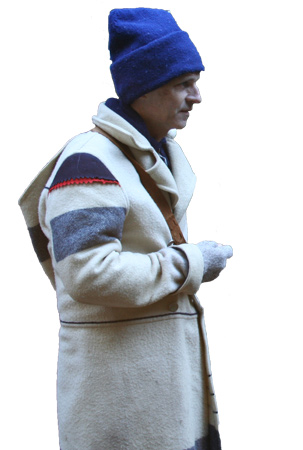
From the Pacific Northwest Living Historians at Lewis and Clark National Historic Park, Fort Clatsop.
Since 2016, Kristopher K. Townsend has been the webmaster and editor of this site, Discovering Lewis & Clark®. He has been actively photo-documenting the Lewis and Clark Trail since 1995. He attempts as closely as possible to re-create scenes as described in the journals including the same time of year, natural state, location, and weather. He has contributed numerous photos throughout the Discovering Lewis & Clark website.
Kris taught several years as a tenured instructor at Spokane Falls Community College. His courses included Internet programming and other information technology and computer science courses. During that time, he was also the series editor and an author of a popular college textbook series on Office Technology.
Shortly after the advent of the World Wide Web, he managed a web server featuring digital photos, digital video, and articles created by his Glenwood Heights Primary students. Topics included historical sites of Clark County (Washington State), wildflowers and birds of Clark County, and how-to videos for school’s physical education program.
Contributions to this Site
July 16, 1805
The first gate
by Kristopher K. Townsend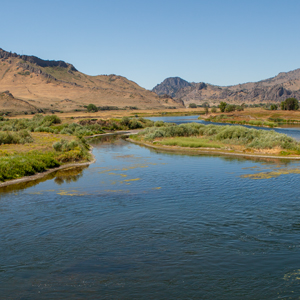
Some 30 miles SW of the Great Falls of the Missouri, the expedition reaches their ‘first gate’ of the Rockies—Tower Rock. Traveling ahead of the boats, Lewis climbs up it to get a better view. Both captains see recent signs of Indians, and they hope a Shoshone encounter is imminent.
July 15, 1805
Leaving the Falls of the Missouri
by Kristopher K. Townsend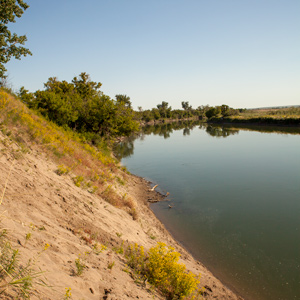
After laboring since 2 June 1805 to move beyond the Great Falls of the Missouri, the expedition is finally moving again. They make about 26 river miles passing high sand banks, a fort mountain, and blooming prickly pears. Lewis’s dog Seaman helps hunt.
July 14, 1805
Launching the new canoes
by Kristopher K. Townsend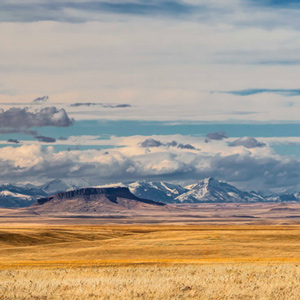
Near their canoe camp at present Ulm, Montana, Lewis remarks on the view of “Fort Mountain”—known today as Square Butte. Sgt. John Ordway’s detachment arrives with the remaining dugouts and baggage, two new canoes are launched, and all is made ready for departure.
In Washington City, Lewis’s letters and Clark’s journals—sent from Fort Mandan on 6 April 1805—reach President Jefferson.
July 13, 1805
Leaving the Great Falls
by Kristopher K. Townsend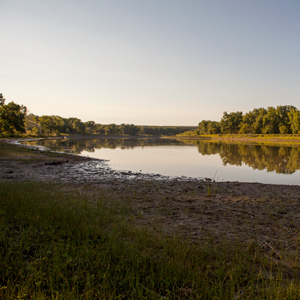
Lewis and the last of his crew leave the White Bear Islands above the Great Falls of the Missouri. Traveling by land, Lewis, Pvt. Lepage, and Sacagawea pass by a Blackfeet Sun Dance lodge. At the canoe camp near present Ulm, Clark has “an emensity of meat” dried to make pemmican, and everyone is tormented by mosquitoes.
July 12, 1805
Hewing two new canoes
by Kristopher K. Townsend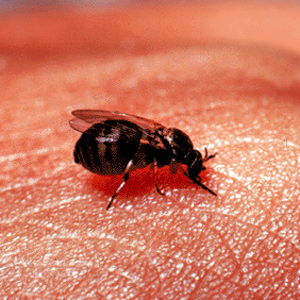
At his canoe camp near present Ulm, Montana, Clark has the enlisted men hew two new dugout canoes from cottonwood logs. The old canoes are sent back to Lewis at the upper portage camp above the Great Falls of the Missouri. There, mosquitoes and eye gnats are “extreemly troublesome”.
July 11, 1805
Artillery of the Rockies
by Kristopher K. Townsend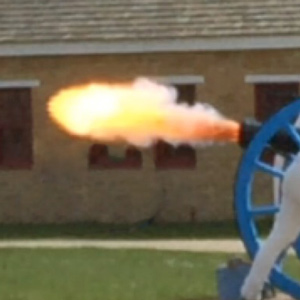
At camp above the Great Falls of the Missouri, Lewis reports strange booms like cannon and several enlisted men move tools and baggage to Clark’s canoe camp near present Ulm, Montana. Pvt. Whitehouse steps on a rattlesnake, and mosquitoes and gnats bother everyone.
July 10, 1805
A new canoe camp
by Kristopher K. Townsend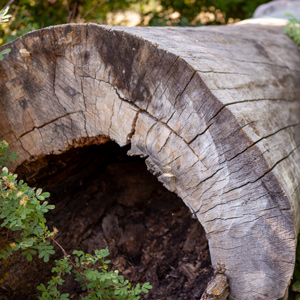
Below present Ulm, Montana, Clark finds two suitable trees to make new canoes. Some 25 river miles downstream—about 11 miles by land—Lewis has the iron-framed boat taken apart and then goes fishing.
In Washington City, Thomas Jefferson shares news of the expedition with Lewis’s brother Reuben.
July 9, 1805
Sinking the iron-framed boat
by Kristopher K. Townsend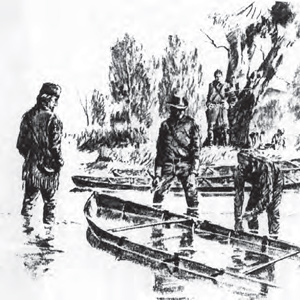
Above the Great Falls of the Missouri, the iron-framed boat is finally put into the river. They find the boat too leaky, and it is intentionally sunk to make disassembly easier. The captains initiate a plan to build two new dugout canoes. Lewis collects a specimen of blue flax—new to science and one of his namesake species.
In Natchez, Mississippi, fellow explorer William Dunbar writes President Jefferson about a new idea to determine longitude using a meridian circle.
July 8, 1805
Sealing the iron-framed boat
by Kristopher K. Townsend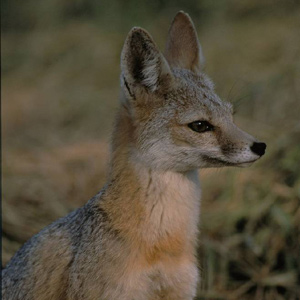
At camp above the Great Falls of the Missouri, the iron-framed boat cover is sealed with a mixture of tallow, beeswax, and charcoal. Lewis describes the swift fox and thirteen-lined ground squirrel—both new to science.
In New Orleans, Governor William Claiborne reports on the health of the prairie dog sent there from Fort Mandan.
July 7, 1805
New clothes
by Kristopher K. Townsend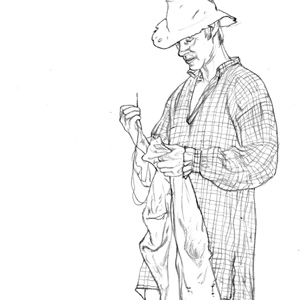
Another day is spent above the Great Falls of the Missouri waiting for the iron-framed boat cover to dry. Several enlisted men make leather and sew new clothes. Clark gives York a dose of tarter emetic to induce vomiting, and Lewis has one of the men make bags from wolf hides.
July 6, 1805
Hail delays progress
by Kristopher K. Townsend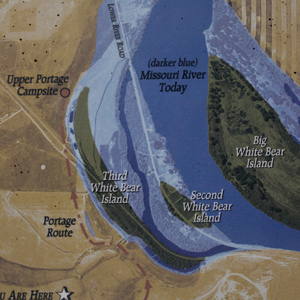
At their camp above the Great Falls of the Missouri, rain and hail wet the shell of the iron-framed boat delaying progress.
In New Orleans, the Louisiana governor, William C. C. Claiborne, receives Lewis’s specimens—including a live prairie dog—shipped from Fort Mandan in early April.
July 5, 1805
Holes appear
by Kristopher K. Townsend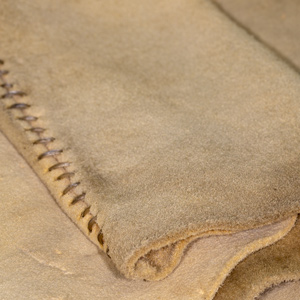
Above the Great Falls of the Missouri, the cover of the iron-framed boat dries, and the holes in its stitching increase in size. Lewis hopes to seal the seams with charcoal and beeswax. A small group visits the falls and brings back bison tongues and brains.
July 4, 1805
Ardent spirits
by Kristopher K. Townsend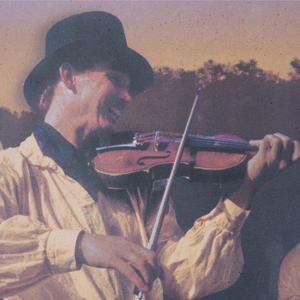
Above the Great Falls of the Missouri, the iron-framed boat is fully assembled and placed over fires to dry. Lewis hears mysterious booms that sound like artillery fire, and in the evening, everyone celebrates Independence Day with “ardent Spirits”, fiddle, and dance.
July 3, 1805
Sewing and hunting
by Kristopher K. Townsend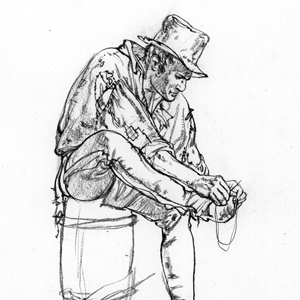
Above the Great Falls of the Missouri, the enlisted men sew new moccasins, Lewis laments that they will soon be leaving buffalo country, and Sgt. Gass and Pvt. McNeal visit the falls. Stitches loosen, and large holes appear in the hides covering the iron-framed boat.
July 2, 1805
Last of the portage
by Kristopher K. Townsend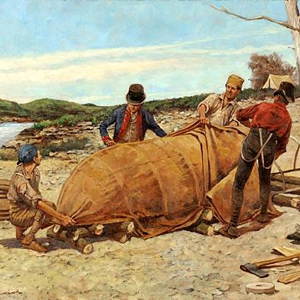
At the portage around the Falls of the Missouri, one group brings in the last of the baggage while others assemble the iron-framed boat. George Drouillard and the captains hunt grizzly bears, and a pack rat—found under some baggage—becomes Lewis’s latest scientific specimen.
July 1, 1805
The last canoe
by Kristopher K. Townsend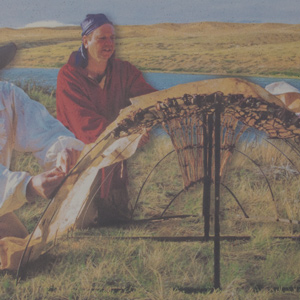
At the Falls of the Missouri, Clark’s detail brings the last dugout to the White Bear Islands, but the enlisted men are too tired to retrieve the baggage left at the six-mile stake. Meanwhile, hides are sewn onto the iron-framed boat’s eight sections. Others make waystrips, render tallow, or build a tar pit. Grizzly bears threaten and mosquitoes are troublesome.
June 30, 1805
Recovery and repair
by Kristopher K. Townsend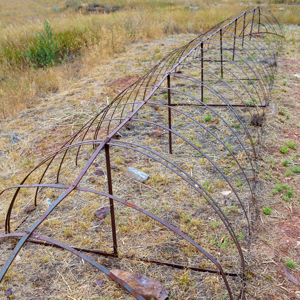
At the camp above the Great Falls of the Missouri, everyone is busy with various tasks except for the men hurt in yesterday’s hailstorm. Scattered baggage is collected and carried forward, and two men search for the compass lost in yesterday’s flash flood. The cover of the iron-framed boat’s is complete, and Lewis speculates about where they will spend the winter.
June 29, 1805
A flash flood
by Kristopher K. Townsend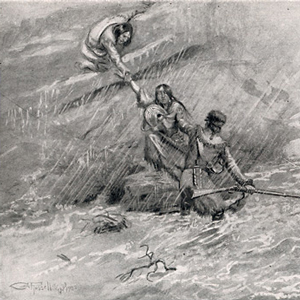
Along the portage around the Great Falls of the Missouri, hail and rain disrupt the day’s work. Baggage is left on the plain, men are bruised and bloody, and Sacagawea and her baby Jean Baptiste are nearly swept away in a flash flood. Clark’s group remains at Box Elder Creek unable to cross its swollen waters. Meanwhile, Lewis visits Giant Springs.
June 28, 1805
The final stage begins
by Kristopher K. Townsend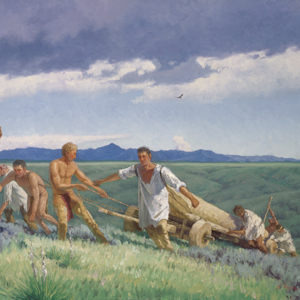
At the Great Falls of the Missouri, the last of the personnel begin to move from the lower portage camp. They get as far as Box Elder Creek and encamp. At the upper camp, work on the iron-framed boat continues and grizzly bears threaten.
June 27, 1805
Sightseeing at the falls
by Kristopher K. Townsend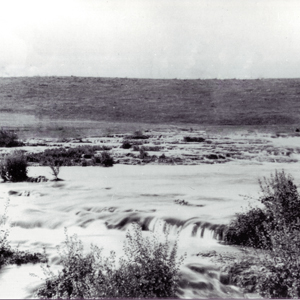
At the Great Falls of the Missouri, Sgt. Ordway’s group detours from the portage route to view the falls and Giant Springs. Sgt. Gass reports hail stones as large as seven inches. At the upper camp, Pvts. Whitehouse and Frazer sew hides that will cover the iron-framed boat, Drouillard and Pvt. J. Field ambush a grizzly bear, and Seaman barks at bears all night.
Near Kaskaskia, James Wilkinson takes his oath of office as Governor of Louisiana Territory and asks the Secretary of War what should be done with the many Natives that have come to St. Louis.
June 26, 1805
Suet dumplings
by Kristopher K. Townsend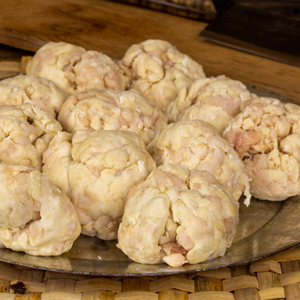
At the Great Falls of the Missouri, a large group struggles to cart two dugout canoes around the falls. They hoist sails to give them an assist. At the lower camp, Clark has men render bison tallow and cache heavy items. At the upper camp, Lewis assigns men to hunt and work on the iron-framed boat. Pvt. Whitehouse suffers from heat exhaustion, and as a special treat, Lewis makes suet dumplings for the tired crews.
June 25, 1805
Clark's cup of coffee
by Kristopher K. Townsend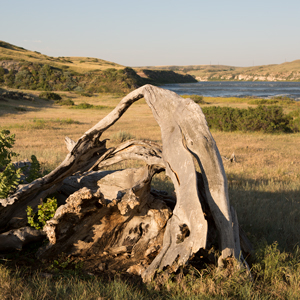
Below the Great Falls of the Missouri, Clark delegates the cooking to Charbonneau and enjoys a morning cup of coffee. Before night, two more dugout canoes are hauled up the portage hill. At camp above the falls, Drouillard and Pvt. Frazer bring in 800 pounds of dried meat, and a grizzly bear harasses Pvt. Joseph Field.
In Washington City, President Jefferson shares news of expedition with Massachusetts Representative William Eustis—a future nemesis of Meriwether Lewis.
June 24, 1805
Sailing on dry land
by Kristopher K. Townsend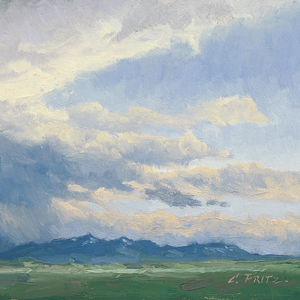
At the Great Falls of the Missouri, severe weather passes over, and there is enough wind that on the portage route, sails are employed to move two dugout canoes. At the camp above the falls, Sgt. Gass and Pvt. Shields have difficulty finding suitable wood for the iron-framed boat. Below the falls, the last canoe is taken out of the water.
June 23, 1805
Portage route adjustments
by Kristopher K. Townsend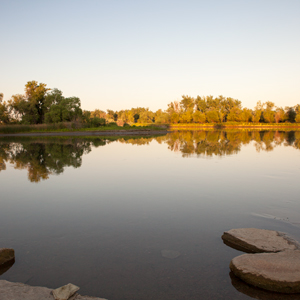
Above the Great Falls of the Missouri, Lewis establishes an area to assemble the iron-framed boat, and the dugout canoe—abandoned the previous night—is brought in. On the way back to the lower camp, Clark adjusts the portage route. Prickly pears make walking difficult, and the men suffer from fatigue and sore feet.
June 22, 1805
Portaging the first dugout
by Kristopher K. Townsend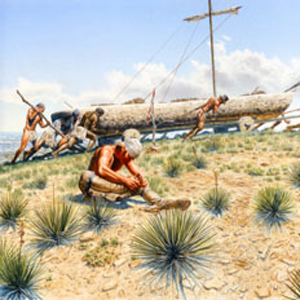
At the Great Falls of the Missouri, nearly all the enlisted men haul the first dugout canoe across the long portage route. The wagon needs frequent repairs, and after dark, they abandon the heavy boat and hike the remaining ½ mile to the White Bear Islands encampment. There, Lewis describes the western meadowlark.
June 21, 1805
The portage begins
by Kristopher K. Townsend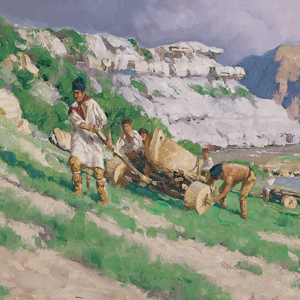
The portage around the Great Falls of the Missouri begins in earnest as enlisted men carry cargo to the plain high above present Belt Creek. They cart one dugout up the steep slope and then load it with the iron-framed boat, tools, and other items needed to establish a camp above the falls.
June 20, 1805
Planning the portage
by Kristopher K. Townsend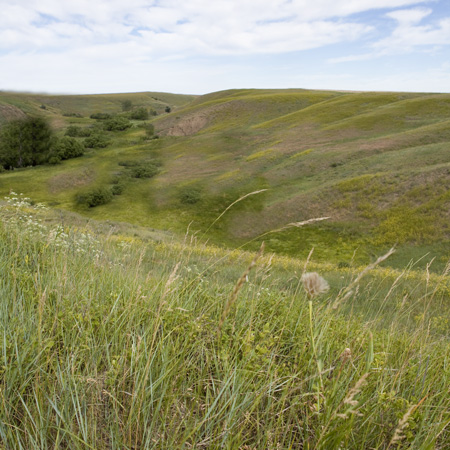
At the Great Falls of the Missouri, Clark plans a route to portage the dugout canoes. He is stumped as to where to cross present Box Elder Creek, and he reports loud cannon-like noises from the north.
At Lower Portage Camp, Lewis has the enlisted men build up a store of dried bison meat, and Sacagawea continues to recover.
June 19, 1805
Sacagawea relapses
by Kristopher K. Townsend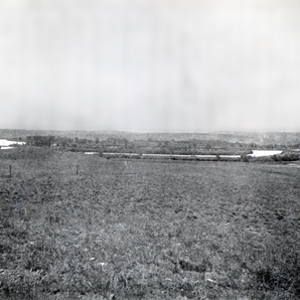
At Lower Portage Camp below the Great Falls of the Missouri, the enlisted men prepare to portage the boats, and Sacagawea relapses. After dark, Seaman alarms the men with his barking.
At the White Bear Islands above the falls, Clark determines to find the best route to haul the heavy dugout canoes.
June 18, 1805
Viewing the falls
by Kristopher K. Townsend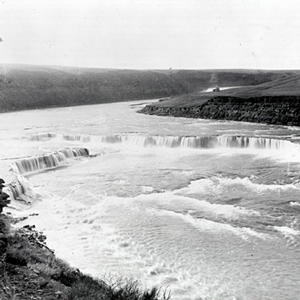
At the Great Falls of the Missouri, Clark finishes measuring and mapping waterfalls and continues to the end of the portage where he sees many bison crossing the river. Numerous grizzly bears are there, and one attacks Pvt. Willard.
At Lower Portage Camp, the white pirogue is beached, the iron-framed boat is inspected, and Sacagawea continues to recover.
Back home, news of the expedition’s winter at Fort Mandan and the return of the barge (keelboat) reaches Portsmouth, New Hampshire.
June 17, 1805
Preparing the portage
by Kristopher K. Townsend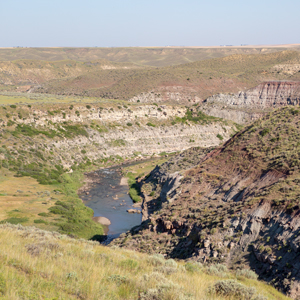
Clark leaves Lower Portage Camp to map the Falls of the Missouri and survey a route for a portage around them. At camp, five dugout canoes are walked up Belt Creek and then taken out of the water to dry. Six men prepare wheels for the carts that they will use to move the heavy boats over land. Lewis needs more hides for the iron-framed boat, and Sacagawea’s health improves.
June 16, 1805
Sulphur Springs cure
by Kristopher K. Townsend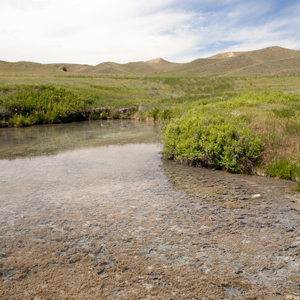
Below the Great Falls of the Missouri, Clark establishes a base camp—later known as Lower Portage Camp. Lewis returns from his scouting trip, and he treats Sacagawea with cinchona bark, opium, and water from Sulphur Springs. Two scouts return with unfavorable news about the upcoming portage.
June 15, 1805
Sacagawea deteriorates
by Kristopher K. Townsend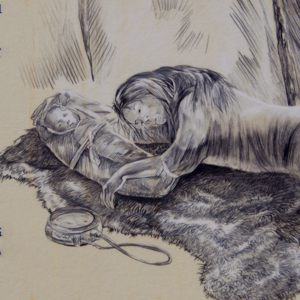
Below the Great Falls of the Missouri, Sacagawea’s health deteriorates, and Charbonneau asks to return home. For the enlisted men, towing the boats becomes increasingly difficult. Several miles ahead and unaware of Sacagawea’s condition, Lewis fishes and counts the scuta on a prairie rattlesnake.
Elsewhere, Pierre Chouteau ships Lewis’s Fort Mandan specimens from St. Louis to Washington City via New Orleans, and the expedition’s barge (keelboat) arrives at Fort Massac.
June 14, 1805
More and more falls
by Kristopher K. Townsend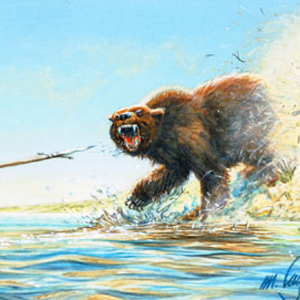
At the Great Falls of the Missouri, Lewis finds more and more waterfalls. He fights with prickly pears and one combative grizzly bear. Many miles downriver, the enlisted men struggle to move the boats against the swift current. Clark describes cliffs of “much hard slate” and mentions that Sacagawea’s illness is “Somewhat dangerous”.
June 13, 1805
"sublimely grand specticle"
by Kristopher K. Townsend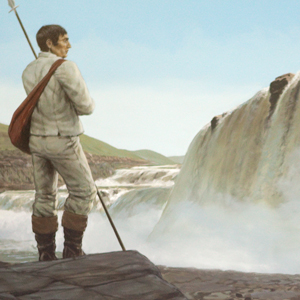
Lewis reaches the Grand Fall of Missouri and marvels at its ‘sublimely grand spectacle’. Several miles downriver, Clark gives Sacagawea a dose of salts as a purgative and the enlisted men move the boats 13 miles up the river.
Near the mouth of the Ohio at Fort Massac, General James Wilkinson has questions about the delegation of Native Peoples who recently arrived aboard the expedition’s barge (keelboat).
June 12, 1805
Searching for the Falls
by Kristopher K. Townsend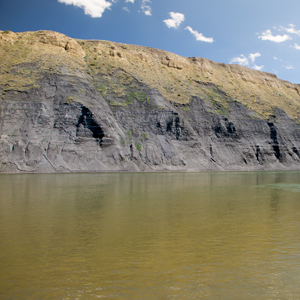
Lewis hikes over the plains in search of the Great Falls of the Missouri, and he sees the Rocky Mountain Front. He has an encounter with a grizzly bear, describes two types of cottonwood trees, and then goes fishing.
Clark takes the boats up the Missouri past black clay bluffs and rattlesnakes nearly reaching present Fort Benton. Sacagawea remains ill.
After the arrival of the barge in St. Louis, some of its many Native passengers return home and others prepare to leave for Washington City.
June 11, 1805
Lewis scouts ahead
by Kristopher K. Townsend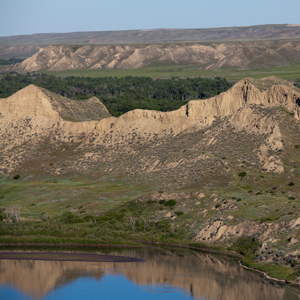
Lewis sets out to find the Great Falls of the Missouri. His group stops near Vimy Ridge to hunt and fish, where he becomes too ill to continue. He makes a healing decoction from the local black chokecherry trees, and Pvt. Goodrich catches several dozen sauger and goldeye fish.
Back at Decision Point, Clark finishes a cache and bleeds Sacagawea, who is ill.
June 10, 1805
Hiding the red pirogue
by Kristopher K. Townsend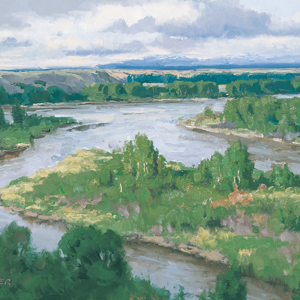
At the mouth of the Marias, the boats are emptied, and any cargo no longer critical to their survival is set aside to be cached. Pvt. Shields impresses Lewis by fixing his air gun. After hiding the red pirogue on an island near Decision Point, Sacagawea becomes ill.
June 9, 1805
The southern fork
by Kristopher K. Townsend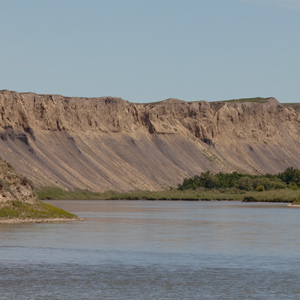
At Decision Point, the captains use their maps, intelligence gathered from Indigenous informants, and their own observations to decide they will continue up the southern fork (the Missouri). All the enlisted men think the northern fork (the Marias) is the correct way to go. They dig a cache, prepare to abandon the red pirogue, and pass the night in song and dance.
June 8, 1805
Return to Decision Point
by Kristopher K. Townsend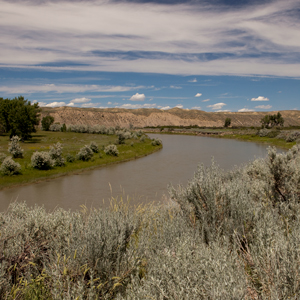
Lewis names the river that he has been exploring “Maria’s River” [Marias] and speculates on its political and commercial value. After his party returns to Decision Point, the captains attempt to reconcile their maps with what they have learned from their recent scouting trips of the Missouri and Marias branches.
June 7, 1805
Lewis's narrow escape
by Kristopher K. Townsend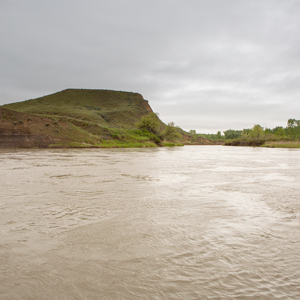
On the Marias River, Lewis and Pvt. Windsor slip on rain-soaked gumbo and nearly fall over a cliff. They find shelter from the rain in an old “Indian stick lodge”.
At Decision Point at the mouth of the Marias, Clark and the others worry as they wait for Lewis’s return.
June 6, 1805
The true Missouri
by Kristopher K. Townsend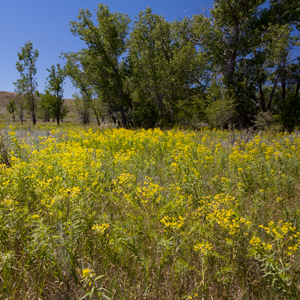
The expedition is divided into three groups on this day. Clark follows the Teton River back to the Decision Point base camp. There, he tells everyone that he had explored the true Missouri River.
Far to the north, Lewis attempts to raft down the Marias River also convinced that the north fork is the true Missouri River.
June 5, 1805
Scouting rivers
by Kristopher K. Townsend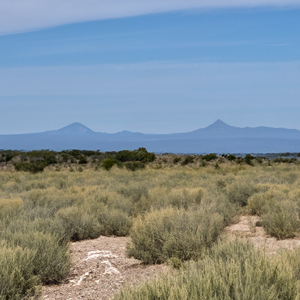
The expedition is split into three separate groups on this day. On the Marias River, Lewis sees the Sweet Grass Hills and is astonished by the dry soil.
Clark measures the width of the Missouri, and his men kill three grizzly bears. They turn back towards Decision Point via the Teton River valley where they see abundant wildlife.
At the main camp at Decision Point, the enlisted men make leather and Pvt. Goodrich fishes.
June 4, 1805
Decision Point explorations
by Kristopher K. Townsend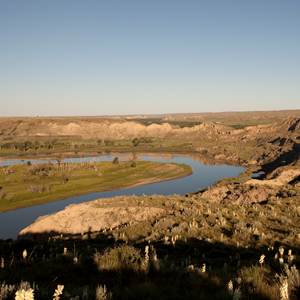
Not knowing which river to take, the captains lead scouting parties up the Marias and Missouri rivers. On the Marias, Lewis finds the prickly pears troublesome. Clark notices the Missouri is rapid and crowded with islands and gravel bars. At base camp below Decision Point, Pvt. Joseph Field barely escapes from a grizzly bear.
June 3, 1805
Which river?
by Kristopher K. Townsend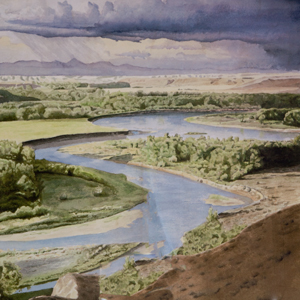
From atop Decision Point, the view of the Missouri and swollen Marias River confuses everyone as to which is the main river. To help the captains decide, scouts are sent up each river. Camp is moved to the north side of the Missouri, and many of the enlisted men recover from having to tow the boats the past few days.
June 2, 1805
Marias River arrival
by Kristopher K. Townsend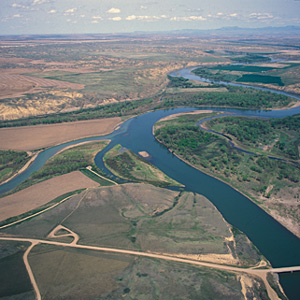
After a stormy night, the enlisted men tow the boats 18 miles up the Missouri. A grizzly bear chases Drouillard and Charbonneau while Lewis and several other hunters collect hides to cover the iron-framed boat. Late in the day, they reach the mouth of the Marias River.
June 1, 1805
Leaving the Breaks
by Kristopher K. Townsend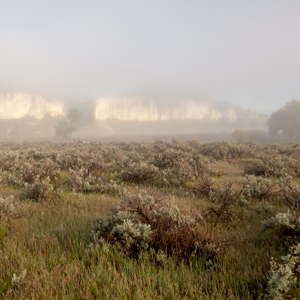
After a cloudy morning encamped at Eagle Creek, the enlisted men tow the boats through the last stretches of the Upper Missouri River Breaks. They see distant mountains and blooming currants, chokecherries, and prickly pears.
May 31, 1805
Scenes of visionary enchantment
by Kristopher K. Townsend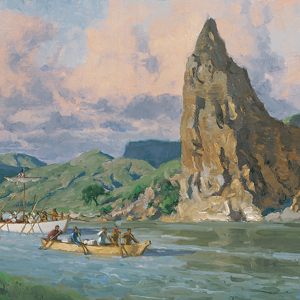
The day brings endless ‘scenes of visionary enchantment’ as the enlisted men struggle to move the boats through the White Cliffs area of the Upper Missouri River Breaks. When a tow rope breaks, Lewis once again mentions the white pirogue’s ‘evil genie’. After passing Citadel Rock and Grand Natural Wall, they camp at present Eagle Creek where Lewis notices a distinctive species of pine.
May 30, 1805
The White Cliffs
by Kristopher K. Townsend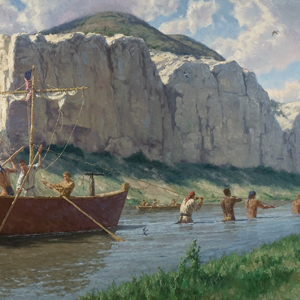
In the White Cliffs of the Upper Missouri River Breaks, the enlisted men struggle to tow the boats from slippery and narrow banks. Lewis tests the humidity by measuring the evaporation rate, and Pvt. Whitehouse describes an empty Atsina camp.
May 29, 1805
A bison terrorizes camp
by Kristopher K. Townsend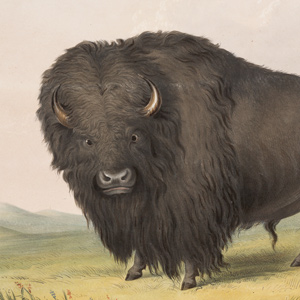
In the Judith Basin, a frightened bison runs amok damaging York’s gun and the white pirogue’s swivel gun. Lewis’s dog Seaman saves the day by chasing it away from camp. They continue up the Missouri camping above the “slaughter river”—present Arrow Creek—where numerous dead bison have washed ashore.
May 28, 1805
Judith River oasis
by Kristopher K. Townsend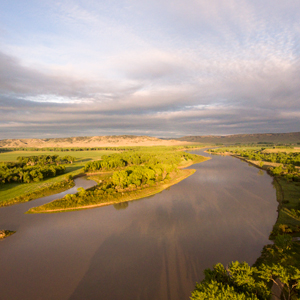
The enlisted men tow the boats twenty miles to reach the fertile Judith River Basin. Lewis finds the change in scenery reviving. Several Native American items are found floating down the river, and they worry the owners are not far ahead.
In St. Louis, military commander James Bruff proposes a mission for the expedition’s old barge.
Experience the Lewis and Clark Trail
The Lewis and Clark Trail Experience—our sister site at lewisandclark.travel—connects the world to people and places on the Lewis and Clark Trail.

Discover More
- The Lewis and Clark Expedition: Day by Day by Gary E. Moulton (University of Nebraska Press, 2018). The story in prose, 14 May 1804–23 September 1806.
- The Lewis and Clark Journals: An American Epic of Discovery (abridged) by Gary E. Moulton (University of Nebraska Press, 2003). Selected journal excerpts, 14 May 1804–23 September 1806.
- The Lewis and Clark Journals. by Gary E. Moulton (University of Nebraska Press, 1983–2001). The complete story in 13 volumes.
This site is provided as a public service by the

Lewis and Clark Trail Alliance
with additional funding from the following: