At the Great Falls of the Missouri, Clark finishes measuring and mapping waterfalls and continues to the end of the portage where he sees many bison crossing the river. Numerous grizzly bears are there, and one attacks Pvt. Willard.
At Lower Portage Camp, the white pirogue is beached, the iron-framed boat is inspected, and Sacagawea continues to recover.
Back home, news of the expedition’s winter at Fort Mandan and the return of the barge (keelboat) reaches Portsmouth, New Hampshire.
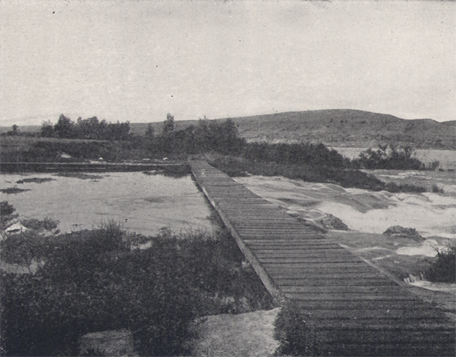
Crooked Falls

Photographer unknown, Montana Historical Society Archives.
Clark at the Falls
Crooked Falls
we Set out early and arrived at the second great Cataract a[t] about 200 yds above the last of 19 feet pitch— this is one of the grandest views in nature and by far exceeds any thing I ever Saw, the Missouri falling over a Shelveing rock for 47 feet 8 Inches with a Cascade &c of 14 feet 7 Inches above the Shoot for a ¼ mile
—William Clark
Giant Springs
for Olin D. Wheeler, The Trail of Lewis and Clark. See also Wheeler’s “Trail of Lewis and Clark”.
Giant Springs
we proceeded on up the river a little more than a mile to the largest fountain or Spring I ever Saw, and doubt if it is not the largest in America Known, this water boils up from under th rocks near the edge of the river and falls imediately into the river 8 feet
—William Clark
Buffalo Crossing
Saw a gange of Buffalow Swiming the river above the falls, Several of which was drawn in to the rapids and with dificuelty mad Shore half drowned, we killed one of those Cows & took a[s] much meat as we wished.
—William Clark
Grizzly Attacks Willard
one man A Willard going for a load of meat at 170 yards distance on an Island was attact by a white bear and verry near being Caught
—William Clark
Lewis at Lower Portage Camp
Elixir of Vitriol

Historical interpretation by the Lewis and Clark Honor Guard of Great Falls. Photo © 2017 by Kristopher K. Townsend. Permission to use granted under the Creative Commons Attribution-Share Alike 4.0 International license.
Preparing a Cache
I now scelected a place for a cash and set tree men at work to complete it, and employed all others except those about the waggons, in overhawling airing and repacking our indian goods ammunicion, provision and stores of every discription which required inspection.
—Meriwether Lewis
Inspecting the Iron-framed Boat
examined the frame of my Iron boat and found all the parts complete except one screw, which the ingenuity of Sheilds [Shields] can readily replace
—Meriwether Lewis
Sacagawea Recovering
The Indian woman is recovering fast she set up the greater part of the day and walked out for the fist time since she arrived here; she eats hartily and is free from fever or pain. I continue same course of medecine and regimen except that I added one doze of 15 drops of the oil of vitriol today about noon.
—Meriwether Lewis
Weather Diary
State of the thermometer at rise
Weather Wind at State of the thermometer at 4 OC. P.M. Weather Wind at 4 OC. P. M. State of river 48 [above 0] cloudy S. W. 64 [above 0] fair after cloudy S. W. fallen ½ in. —Meriwether Lewis[1]To assist the reader, the editor of this web page has omitted the date column, merged the “State of the river” columns, and spelled out some abbreviations.
News of the Expedition
BY THE LAST MAILS.
LEXINGTON, JUNE 18, 1805.
LOUISIANA.THE party of discovery, under the command of Capt. Lewis and Clark, left the mouth of the Missouri, on the 19th day of May, 1804. An express with dispatches from their winter quarters, which left them the 14th April, has returned to St. Louis.
At their winter quarters [Fort Mandan], the river is nearly a quarter of a mile wide; is equally as muddy as at its mouth, and has continued its rapidity with very little alteration, as high as they have gone, though it has become considerably more shallow, so that they will not be able to take their large barge any higher.
The greatest friendship has existed with the party; and the men who have returned speak in the highest terms of the humanity, and uncommon pains and attention of both the Captains, Lewis and Clark, toward the whole of them; and that they left them in good spirits fully convinced that they would winter on the Pacific Ocean.
Curiosities of different kinds, live beasts, birds, several boxes of minerals, a pair of uncommon ram’s horns, from the rocky mountains, scions of a new discovered berry, called the buffaloe berry, &c. have been brought on by the returned party . . . .[2]The New Hampshire Gazette. (Portsmouth, NH), Jul. 16 1805, www.loc.gov/item/sn83025588/1805-07-16/ed-1/, accessed 23 November 2025.
Experience the Lewis and Clark Trail
The Lewis and Clark Trail Experience—our sister site at lewisandclark.travel—connects the world to people and places on the Lewis and Clark Trail.
Plan a trip related to June 18, 1805:


The Great Falls Portage is a High Potential Historic Site along the Lewis and Clark National Historic Trail managed by the U.S. National Park Service. It includes Sulphur Springs (open to the public), the Lower Portage camp site (on private land), and the Upper Portage Camp Overlook.
Giant Springs is a High Potential Historic Site along the Lewis and Clark National Historic Trail managed by the U.S. National Park Service. The site is a Montana State Park just downstream of the Lewis and Clark Interpretive Center (USFS).
Rainbow Falls is a High Potential Historic Site along the Lewis and Clark National Historic Trail managed by the U.S. National Park Service. An overlook of the falls is accessible by roadway or footpath, and the Lewis and Clark Interpretive Center is located about 1.5 miles to the west.
Notes
| ↑1 | To assist the reader, the editor of this web page has omitted the date column, merged the “State of the river” columns, and spelled out some abbreviations. |
|---|---|
| ↑2 | The New Hampshire Gazette. (Portsmouth, NH), Jul. 16 1805, www.loc.gov/item/sn83025588/1805-07-16/ed-1/, accessed 23 November 2025. |