August Chouteau
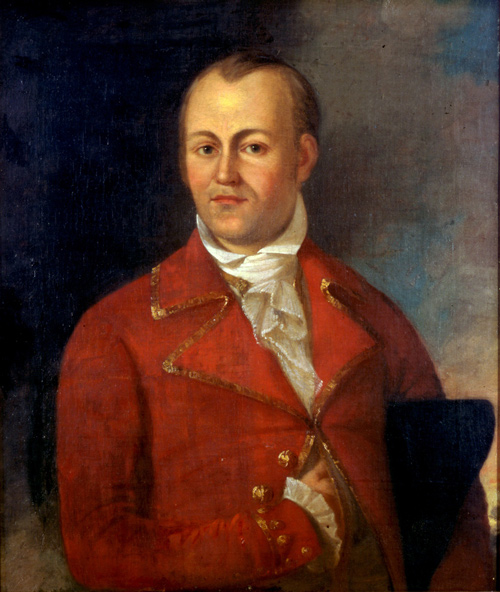
Allied Photocolor, 1987. Por C-0127. NS 11960. Photograph and scan © 1987-2003, Missouri Historical Society.
August Chouteau and his half-brother Pierre dominated the St. Louis-based fur trade when the Lewis and Clark Expedition arrived in 1803. Auguste is sometimes referred to as René Auguste, the same name as his father, the co-founder of St. Louis. In their seminal work on the Chouteaus, Foley and Rice explained the family’s position in American history:
Described variously as the “Royal Family of the Wilderness,” the “First Citizens of Upper Louisiana,” and the “Founding Family of St. Louis,” this distinguished clan of merchant-capitalists assumed an active and vital role in opening the trans-Mississippi West.[1]William E. Foley and C. David Rice, The First Chouteaus: River Barons of Early St. Louis (Urbana: University of Illinois Press, 1983), ix.
On 28 December 1809, Toussaint Charbonneau and Sacagawea were in a St. Louis vertical log church to baptize their son Jean Baptiste Charbonneau. Auguste Chouteau and his daughter Eulalie signed the baptismal record, and Auguste is listed by the priest as the child’s godfather. Clark would likely have been there, but he was in Washington City at the time.[2]See on this site The Charbonneaus in St. Louis.
Auguste continued working closely with Clark. In 1815, Indian Commissioners William Clark, Ninian Edwards, and Auguste Chouteau completed treaties with a dozen nations meeting at Portage des Sioux just north of St. Louis. By 1820, Auguste and Clark would conclude fifteen more for a total of twenty-seven treaties.[3]Stan Hoig, The Chouteaus: First Family of the Fur Trade (Albuquerque: University of New Mexico Press, 2008), 261–63.
Related Pages
The Mineral Specimens
The three collections
by John W. Jengo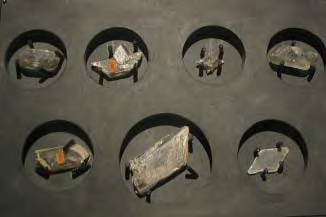
Although not nearly as celebrated as their botanical and zoological work, Lewis and Clark collected a multitude of mineralogical specimens throughout the expedition.
May 18, 1804
Shifting the cargo
by Kristopher K. Townsend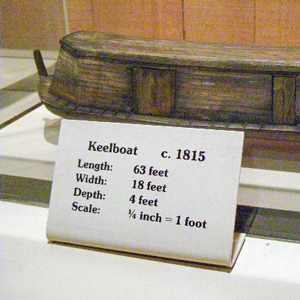
At St. Charles, Clark has the enlisted men shift each boat’s load to the front so that they will handle better. Drouillard leaves for St. Louis with a message for Lewis. More supplies are purchased, and some of the men pass the evening dancing with St. Charles ladies.
May 20, 1804
Church in St. Charles
by Kristopher K. Townsend
Lewis leaves St. Louis with Amos Stoddard, key traders, and several distinguished citizens. Due to a violent thunderstorm, they must shelter in a small cabin. Already in St. Charles, many of the enlisted men attend a Catholic mass.
May 31, 1804
At the Osage
by Kristopher K. Townsend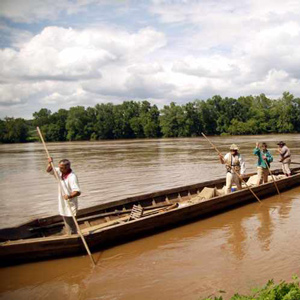
In present Missouri, the expedition struggles against a strong current before stopping at the mouth of the Osage River. The captains try to determine the precise location of this important tributary by taking celestial observations late into the night. Lewis also collects a specimen of wild ginger.
September 6, 1806
A taste of whiskey
by Kristopher K. Townsend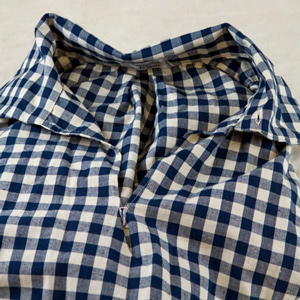
Moving down the Missouri along the present Nebraska-Iowa border, the expedition meets a large boat owned by Auguste Chouteau of St. Louis. Some of the enlisted men trade beaver skins for new linen shirts and woven hats. They also enjoy their first whiskey since their 1805 Fourth of July celebration. Clark advises the traders to treat the Lakotas with contempt.
September 12, 1806
Given up for dead
by Kristopher K. Townsend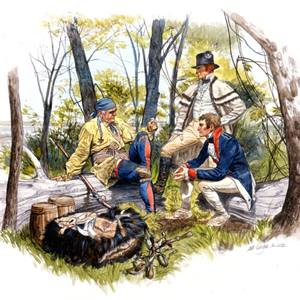
Heading home, the captains meet four old acquaintances. At present St. Joseph, Missouri, the captains review and modify the orders given by President Jefferson to Pierre Dorion and Joseph Gravelines. An old military companion, Robert McClellan, says that in the states, Lewis and Clark have been given up for dead.
The Charbonneaus in St. Louis
by Robert J. Moore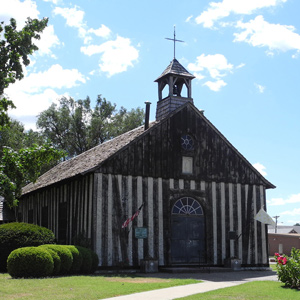
In 1809, Toussaint, Sacagawea, and Jean Baptiste Charbonneau traveled to St. Louis. Jean Baptiste’s baptism began a new era in his life, is father would try to become a farmer, and Sacagawea would become sickly.
Notes
| ↑1 | William E. Foley and C. David Rice, The First Chouteaus: River Barons of Early St. Louis (Urbana: University of Illinois Press, 1983), ix. |
|---|---|
| ↑2 | See on this site The Charbonneaus in St. Louis. |
| ↑3 | Stan Hoig, The Chouteaus: First Family of the Fur Trade (Albuquerque: University of New Mexico Press, 2008), 261–63. |
Experience the Lewis and Clark Trail
The Lewis and Clark Trail Experience—our sister site at lewisandclark.travel—connects the world to people and places on the Lewis and Clark Trail.

Discover More
- The Lewis and Clark Expedition: Day by Day by Gary E. Moulton (University of Nebraska Press, 2018). The story in prose, 14 May 1804–23 September 1806.
- The Lewis and Clark Journals: An American Epic of Discovery (abridged) by Gary E. Moulton (University of Nebraska Press, 2003). Selected journal excerpts, 14 May 1804–23 September 1806.
- The Lewis and Clark Journals. by Gary E. Moulton (University of Nebraska Press, 1983–2001). The complete story in 13 volumes.
This site is provided as a public service by the

Lewis and Clark Trail Alliance
with additional funding from the following: