Nicholas Jarrot Mansion
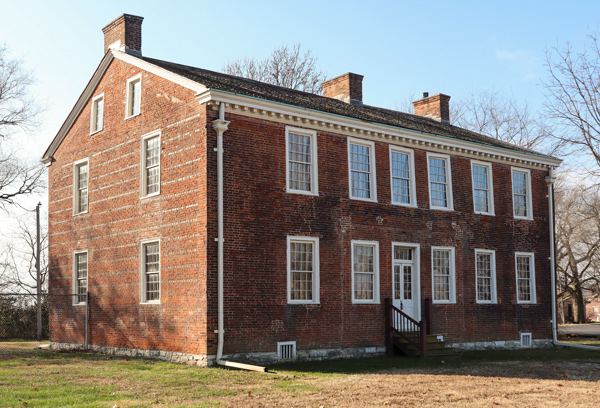
By Self-created photograph by Jonathunder—Own work, GFDL, https://en.wikipedia.org/w/index.php?curid=66168030 accessed 8 March 2025.
Meriwether Lewis met Nicholas Jarrot (1764–1820) in Cahokia on 7 December 1803. Jarrot—a prominent figure in the region—played a significant role in local affairs. Soon after, Lewis, along with Cahokia postmaster John Hay, served as translators during a pivotal meeting with the Spanish Governor of Upper Louisiana, Carlos Dehault Delassus. Concurrent with these negotiations, Jarrot gave permission for Lewis to establish winter quarters on his land at the mouth of the Rivière à Dubois, known today as the Wood River.
In early April 1804, Lewis, accompanied by Jarrot, traveled to St. Louis. This city was rapidly becoming a key hub for trade and exploration in the American frontier. From St. Louis, Jarrot continued his journey to Prairie du Chien, which was his base in the Upper Mississippi fur trade. This region was a bustling center for commerce, where traders, trappers, and Native American tribes interacted regularly.
Jarrot was instrumental in ensuring the success of the Lewis and Clark Expedition and in establishing the United States’ authority over the Louisiana Territory. His historic American-style house built between 1807 and 1810 still stands in Cahokia Heights.
Related Pages
December 7, 1803
Cahokia arrivals
by Kristopher K. Townsend
Lewis travels by land and Clark by river to arrive at Cahokia, Illinois. Lewis meets John Hay and Nicholas Jarrot who help him negotiate with the Spanish Lt. governor of Upper Louisiana.
December 8, 1803
Spanish resistance
by Kristopher K. Townsend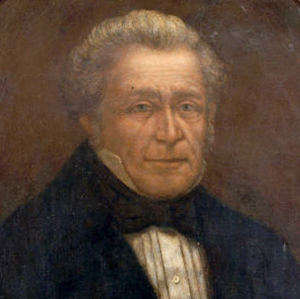
On this or the previous day, Lewis meets with Dehault Delassus, the Spanish Lt. Governor of Upper Louisiana, and all agree that the expedition should spend the winter near Cahokia.
Sugaring at River Dubois
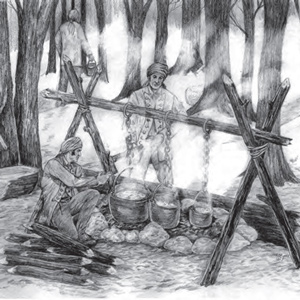
Surrounded by maple trees at Camp Dubois, tapping and boiling the sweet, watery sap until it crystallized into sugar could begin as soon as the days warmed enough to get the sap rising in the trees.
April 2, 1804
Northward-bound traders
by Kristopher K. Townsend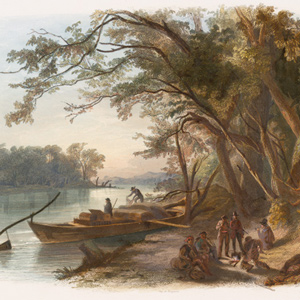
The day is fair at Camp River Dubois opposite the mouth of the Missouri, and Clark reports that the men are “a cleaning to Day.” A boat loaded with provisions to sell at Prairie du Chien stops for the night, and Lewis remains in St. Louis.
April 3, 1804
A Letter for Prairie du Chien
by Kristopher K. Townsend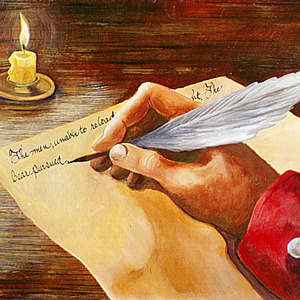
At sunrise, Nicholas Jarrot‘s boat leaves Camp River Dubois with a letter from Clark to John Campbell of Prairie Du Chien, an important fur trade center in present Wisconsin. Clark has the enlisted men pack corn meal, flour, and salted pork. Lewis works in St. Louis.
The Charbonneaus in St. Louis
by Robert J. Moore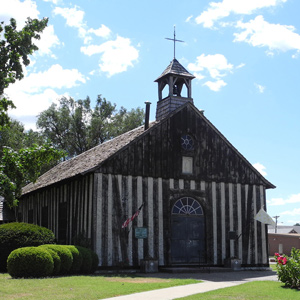
In 1809, Toussaint, Sacagawea, and Jean Baptiste Charbonneau traveled to St. Louis. Jean Baptiste’s baptism began a new era in his life, is father would try to become a farmer, and Sacagawea would become sickly.
Experience the Lewis and Clark Trail
The Lewis and Clark Trail Experience—our sister site at lewisandclark.travel—connects the world to people and places on the Lewis and Clark Trail.
Discover More
- The Lewis and Clark Expedition: Day by Day by Gary E. Moulton (University of Nebraska Press, 2018). The story in prose, 14 May 1804–23 September 1806.
- The Lewis and Clark Journals: An American Epic of Discovery (abridged) by Gary E. Moulton (University of Nebraska Press, 2003). Selected journal excerpts, 14 May 1804–23 September 1806.
- The Lewis and Clark Journals. by Gary E. Moulton (University of Nebraska Press, 1983–2001). The complete story in 13 volumes.
This site is provided as a public service by the
Lewis and Clark Trail Alliance
with additional funding from the following: