After a wind delay, the enlisted men tow the boats sixteen miles up the Missouri along present Charles M. Russell National Wildlife Refuge. They pass “grows Creek,” named for the many grouse seen there, and then stop early to render oil from a grizzly bear.
In St. Louis, Pierre Chouteau asks Illinois Governor William Henry Harrison about the numerous Indian delegates that have recently arrived on the expedition’s barge.
Delayed by Wind
The wind blew so violently this morning that we did not think it prudent to set out untill it had in some measure abated; this did not happen untill 10 A. M. when we proceeded principally by the toe lines
—Meriwether Lewis
Grouse Creek
Sharp-tailed Grouse
Tympanuchus phasianellus
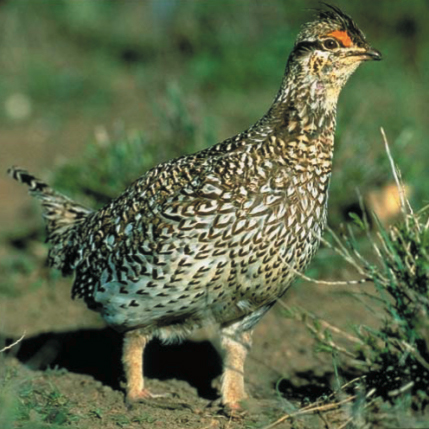
Provided by Richard Hoffman, U.S. Forest Service.
passed the entrance of grows Creek 20 yds wide, affords but little water. this creek we named from seeing a number of the pointed tail praire hen [sharp-tailed grouse] near it’s mouth, these are the fist we have seen in such numbers for some days.
—Meriwether Lewis
Poor Fishing
we have caught but few fish since we left the Mandans, they do not bite freely, what we took were the white cat of 2 to 5 lbs. I presume that fish are scarce in this part of the river.
—Meriwether Lewis
Rendering Bear Grease
We camped on the Stard. Side, earlier than we intend on account of Saveing the oil of a bear which the party killed late this afternoon.
—William Clark
Weather Diary
State of thermometer at rise
Weather Wind at State of thermometer at 4 P. M. Weather Wind at 4 P. M. State of the river 46 [above 0] cloudy N W 48 [above 0] cloudy N. W. fallen ½ in. the wind excessively hard all night— saw some particles of snow fall today it did not lye in sufficient quantity on the ground to be perceptible.—
—Meriwether Lewis[1]To assist the reader, the editor of this web page has omitted the date column, merged the “State of the river” columns, and spelled out some abbreviations.
Indian Delegations
St. Louis le [22] May 1805
Sir [William Henry Harrison]
I Will observe to you that I am ever in the same opinion that the Warm Season is very dangerous for these Indians of whom perhaps a great number will fall victims to so long and penible journey in a climate so different from their own, and I think that the automn and Winter are the only proper season to undertake with security that trip . . . .
Finally I pray you to give me particular instructions on every article being very desirous that my conduct may be approved. Fix if you please to the certain epoch of the departure the number of the Indians to be conducted, the road to be taken, and authorizes me to expend which sums you will judge necessary.
[Pierre Chouteau][2]Letters of the Lewis and Clark Expedition with Related Documents: 1783-1854, 2nd ed., ed. Donald Jackson (Urbana: University of Illinois Press, 1978), 242–43.
Experience the Lewis and Clark Trail
The Lewis and Clark Trail Experience—our sister site at lewisandclark.travel—connects the world to people and places on the Lewis and Clark Trail.
Plan a trip related to May 22, 1805:
Notes
| ↑1 | To assist the reader, the editor of this web page has omitted the date column, merged the “State of the river” columns, and spelled out some abbreviations. |
|---|---|
| ↑2 | Letters of the Lewis and Clark Expedition with Related Documents: 1783-1854, 2nd ed., ed. Donald Jackson (Urbana: University of Illinois Press, 1978), 242–43. |