Sacagawea, also known as Sacajawea or Sakakawea, was a vital member of the Lewis and Clark Expedition, serving as an interpreter, diplomat, guide, and food gatherer. Her—and her child’s—presence symbolized peace among many of the Natives they encountered. The expedition journals document her life, tribal background, and key contributions.
1804
First Encounter
Fort Mandan, Knife River Indian Villages, North Dakota, November 4, 1804
a french man by Name Chabonah [Toussaint Charbonneau], who Speaks the Big Belley [Hidatsa] language visit us, he wished to hire & informed us his 2 Squars were Snake Indians [Lemhi Shoshones], we engau him to go on with us and take one of his wives to interpet the Snake language
—William Clark
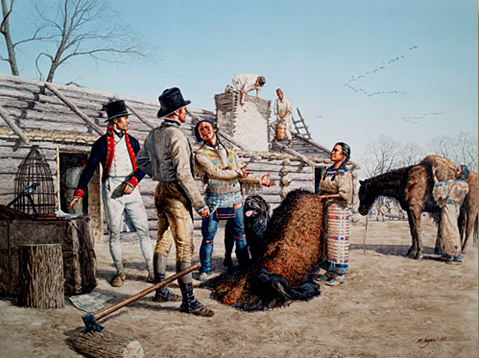
Offering Buffalo Robes
Fort Mandan, November 11, 1804
a frenchmans Squaw came to our camp who belonged to the Snake nation. She came with our Intreperters wife & brought with them 4 buffalow [buffalo] Robes and Gave them to our officers. they Gave them out to the party. I Got one fine one myself.
—John Ordwaytwo Squars of the Rock Mountain, purchased from the Indians by a frenchmen [Nicholas Biddle: Chaboneau] Came down.[1]Between Ordway, Clark, and Nicholas Biddle’s insertion, most historians believe that Charbonneau brought both of his Shoshone wives on this day.
—William Clark
Harvesting the Hunt
Near Fort Mandan, December 7, 1804
. . . as the River Shut up last night the Ice had not Got Strong enofe to bear the Buffalow out in the middle of the R. but we dragged Sd. bufo. down near Shore & dressed it. it was a cow with calf our Interpreters Squaws cut the calf.
—John Ordway
Watching the Christmas Dance
Fort Mandan, December 25, 1804
At 10 o’clock we had another glass of brandy, and at 1 a gun was fired as a signal for dinner. At half past 2, another gun was fired, as a notice to assemble at the dance, which was continued in a jovial manner till 8 at night; and without the presence of any females, except three squaws, wives to our interpreter, who took no other part than the amusement of looking on.
—Patrick Gass
Related: Alcohol Rations
1805
Delivering Jean Baptiste
Fort Mandan, February 11, 1805
about five oclock this evening one of the wives [Sacagawea] of Charbono [Charbonneau] was delivered of a fine boy. it is worthy of remark that this was the first child which this woman had boarn and as is common in such cases her labour was tedious and the pain violent; Mr. Jessome informed me that he had freequently adminstered a small portion of the rattle of the rattle-snake, which he assured me had never failed to produce the desired effect, that of hastening the birth of the child; having the rattle of a snake by me I gave it to him and he administered two rings of it to the woman broken in small pieces with the fingers and added to a small quantity of water. Whether this medicine was truly the cause or not I shall not undertake to determine, but I was informed that she had not taken it more than ten minutes before she brought forth perhaps this remedy may be worthy of future experiments, but I must confess that I want faith as to it’s efficacy.—
—Meriwether Lewis
Leaving Fort Mandan
Leaving Fort Mandan
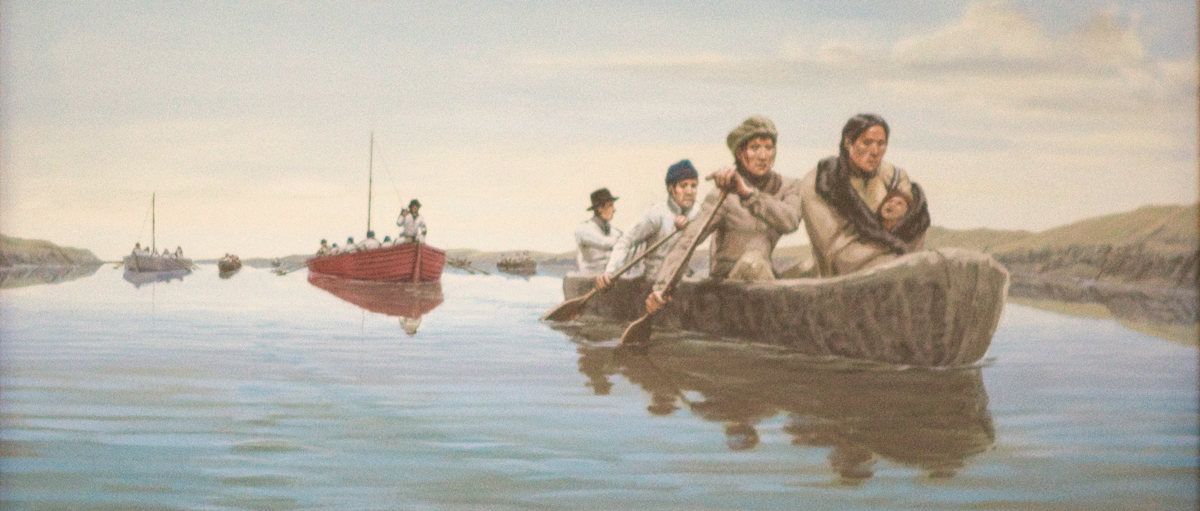
Painting created by Split Rock Studios, Sioux City, Iowa. Original in the collection of the Lewis and Clark Trail Heritage Foundation and photographed by Kristopher K. Townsend.
we Sout [set] out on our voyage up the river in 2 perogues and 6 canoes, and proceded on to the 1st villg. of Mandans & Camped on the S. S.— our party consisting of . . . Shabonah and his Indian Squar to act as an Interpreter & interpretress for the snake Indians—one Mandan & Shabonahs infant. Sah-kah-gar we â
—William Clark
Jerusalem Artichokes
Helianthus tuberosus

© 2020 by Kristopher K. Townsend. Permission to use granted under the Creative Commons Attribution-Share Alike 4.0 International license.
Gathering Jerusalem Artichokes
Near Pick City, North Dakota, April 9, 1805
when we halted for dinner the squaw busied herself in serching for the wild artichokes [Jerusalem artichokes] which the mice collect and deposit in larger hoards.
—Meriwether Lewis
Walking the Shore
Approaching Williston, North Dakota, April 18, 1805
I concluded to walk thro’ the point about 2 miles and take Shabono, with me, he had taken a dost of Salts &c. his Squar followed on with his child
—William Clark
Describing Bighorn Sheep
Approaching Culbertson, Montana, April 29, 1805
On the Top of one of the highest of those Bluffs, we saw the Animal called the Ibex, or mountain Sheep [bighorn sheep], they were in a large Flock.—
This animal is about the size of a large Buck deer,— the Colour Grey, and has hair coarse & like that of a Goat, it ears small and its body lengthy, the horns like that of a Ram, (sheep) but four times as large. They are very nimble, and generally are to be found on high Mountains and Bluffs, and are very Shy, and difficult to be come at.— The Indian women that was with us, inform’d us that those animals were very common to be found On the Rocky mountains.—
—Joseph Whitehouse
Buffalo Currant
Ribes aureum var. villosum

© 21 July 2009 Gaardenier Mortsel. Permission to use granted via the Creative Commons Attribution-Share Alike 3.0 Unported license.
Gathering Buffalo Currants
Approaching Brockton, Montana, April 30, 1805
in my walk the Squar found & brought me a bush Something like the Current, which She Said bore a delicious froot and that great quantites grew on the Rocky Mountains, this Srub was in bloom has a yellow flower with a deep Cup, the froot when ripe is yellow and hangs in bunches like Cheries, Some of those berries yet remained on the bushes.
—William Clark
Gathering Breadroot
Milk River, May 8, 1805
in walking on Shore with the Interpreter & his wife, the Squar Geathered on the Sides of the hills wild Lickerish, & the white apple as called by the angegies and gave me to eat, the Indians of the Missouri make great use of the white apple dressed in different ways—
—William Clark
Showing Fortitude and Resolution
Snow Creek, Fort Peck Lake, May 14, 1805
the Indian woman to whom I ascribe equal fortitude and resolution, with any person onboard at the time of the accedent, caught and preserved most of the light articles which were washed overboard
—Meriwether Lewis, (recorded on 16 May 1805)
“Sâh-câ-gar me-âh or bird woman’s River”
Mussellshell River, May 20, 1805
about five miles abe the mouth of shell river a handsome river of about fifty yards in width discharged itself into the shell river on the Stard. or upper side; this stream we called Sâh-câ-gar me-âh or bird woman’s River, after our interpreter the Snake woman.
—Meriwether Lewis
Sacagawea and Jean Baptiste

From an interpretive sign at Sulphur Springs photographed 2013 by Kristopher K. Townsend.
Very Sick
Lower Portage Camp, Belt Creek, June 10, 1805
Sâh-câh-gâh, we â, our Indian woman is very sick this evening; Capt. C. blead her.
—Meriwether Lewis
Bled Again
Lower Portage Camp, June 11, 1805
the Indian woman verry Sick, I blead her which appeared to be of great Service to her
—William Clark
In Need of Shade
Lower Portage Camp, June 12, 1805
The interpreters wife verry Sick So much So that I move her into the back part of our Covered part of the Perogue which is Cool, her own situation being a verry hot one in the bottom of the Perogue exposed to the Sun—
—William Clark
A Dose of Salts
Lower Portage Camp, June 13, 1805
a fair morning, Some dew this morning the Indian woman Verry sick I gave her a doste of Salts. We Set out early
—William Clark
Dangerously Ill
Lower Portage Camp, June 14, 1805
the Indian woman complaining all night & excessively bad this morning— her case is Somewhat dangerous—
—William Clark
Refusing Medicine
Lower Portage Camp, June 15, 1805
our Indian woman Sick & low Spirited I gave her the bark & apply it exteranaly to her region which revived her much.
the Indian woman much wors this evening, She will not take any medison, her husband petetions to return &c.,
—William Clark
Lewis Worries
Lower Portage Camp, June 16, 1805
I reached the campfound the Indian woman extreemly ill and much reduced by her indisposition. this gave me some concern as well for the poor object herself, then with a young child in her arms, as from the consideration of her being our only dependence for a friendly negociation with the Snake Indians on whom we depend for horses to assist us in our portage from the Missouri to the columbia River.
—Meriwether Lewis
Sulphur Springs’ Healing Waters
Lower Portage Camp, June 16, 1805
Sulphur Springs
(view south)
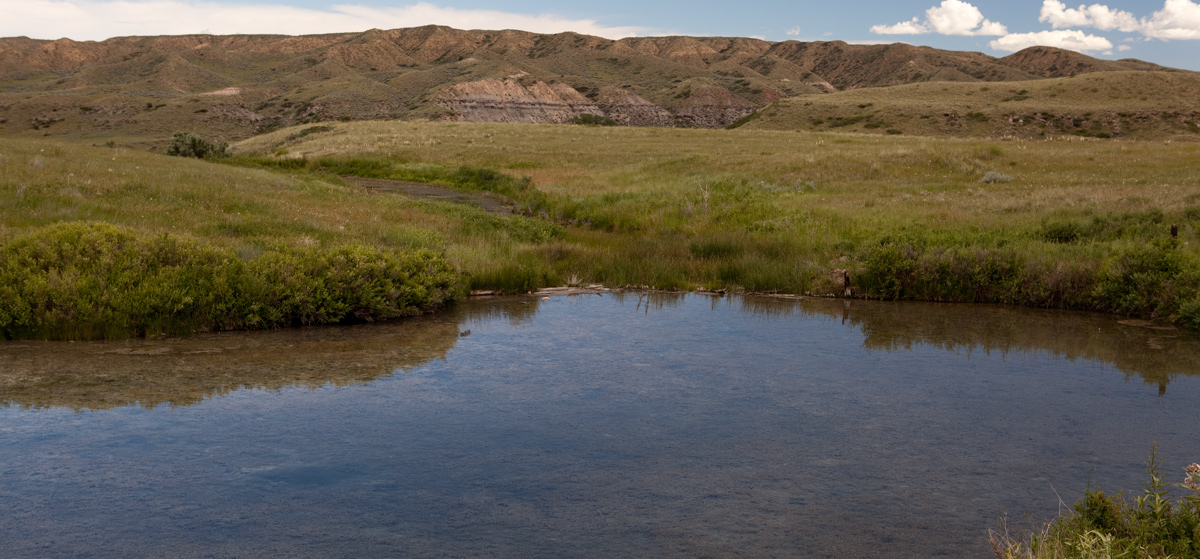
© 2013 by Kristopher K. Townsend. Permission to use granted under the Creative Commons Attribution-Share Alike 4.0 International license.
one of the small canoes was left below this rappid in order to pass and repass the river for the purpose of hunting as well as to procure the water of the Sulpher spring, the virtues of which I now resolved to try on the Indian woman. this spring is situated about 200 yards from the Missouri on the N. E. side nearly opposite to the entrance of a large creek; it discharges itself into the Missouri over a precepice of rock about 25 feet, forming a pretty little [erasure, perhaps “cactaract” the water is as transparent as possible strongly impregnated with sulpher, and I suspect Iron also, as the colour of the hills and bluffs in the neighbourhood indicate the existence of that metal. the water to all appearance is precisely similar to that of Bowyer’s Sulphur Springs in Virginia.
—Meriwether Lewis
Obstruction of the Menses
Lower Portage Camp, June 16, 1805
I found that two dozes of barks and opium which I had given her since my arrival had produced an alteration in her pulse for the better; they were now much fuller and more regular. I caused her to drink the mineral water altogether. wen I first came down I found that her pulse were scarcely perceptible, very quick frequently irregular and attended with strong nervous symptoms, that of the twitching of the fingers and leaders of the arm; now the pulse had become regular much fuller and a gentle perspiration had taken place; the nervous symptoms have also in a great measure abated, and she feels herself much freeer from pain. she complains principally of the lower region of the abdomen, I therefore continued the cataplasms of barks and laudnumn which had been previously used by my friend Capt Clark. I beleive her disorder originated principally from an obstruction of the mensis in consequence of taking could.—
—Meriwether Lewis
Condition Improves
Lower Portage Camp, June 17, 1805
The Indian woman much better today, I have still continued the same course of medecine; she is free from pain clear of fever, her pulse regular, and eats as heartily as I am willing to permit her of broiled buffaloe well seasoned with pepper and salt and rich soope of the same meat; I think therefore that there is every rational hope of her recovery.
—Meriwether Lewis
Eating Heartily and Walking
Lower Portage Camp, June 18, 1805
The Indian woman is recovering fast she set up the greater part of the day and walked out for the fist time since she arrived here; she eats hartily and is free from fever or pain. I continue same course of medecine and regimen except that I added one doze of 15 drops of the oil of vitriol today about noon.
—Meriwether Lewis
Recovery, Relapse, and Rest
Lower Portage Camp, June 19, 1805
the Indian woman was much better this morning she walked out and gathered a considerable quantity of the white apples of which she eat so heartily in their raw state, together with a considerable quantity of dryed fish without my knowledge that she complained very much and her fever again returned. I rebuked Sharbono severely for suffering her to indulge herself with such food . . . .
I now gave her broken dozes of diluted nitre untill it produced perspiration and at 10 P. M. 30 drops of laudnum which gave her a tolerable nights rest.
—Meriwether Lewis
Free From Pain
Lower Portage Camp, June 20, 1805
The Indian woman is qute free from pain and fever this morning and appears to be in a fair way for recovery, she has been walking about and fishing.
—Meriwether Lewis
Portage Begins
Lower Portage Camp, June 22, 1805
This morning early Capt Clark and myself with all the party except Sergt. Ordway Sharbono, Goodrich, york and the Indian woman, set out to pass the portage with the canoe and baggage to the Whitebear Islands, where we intend that this portage shall end.
—>Meriwether Lewis
Breathless Moment
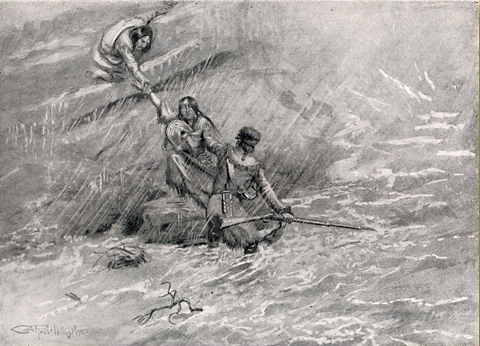
C.M. Russell (1903), for Olin D. Wheeler, The Trail of Lewis and Clark. See also Wheeler’s “Trail of Lewis and Clark”.
Caught in a Flash Flood
Great Falls of the Missouri, June 29, 1805
the rain fell like one voley of water falling from the heavens and gave us time only to get out of the way of a torrent of water which was Poreing down the hill in the rivin with emence force tareing every thing before it takeing with it large rocks & mud, I took my gun & Shot pouch in my left hand, and with the right Scrambled up the hill pushing the Interpreters wife (who had her Child in her arms) before me, the Interpreter himself makeing attempts to pull up his wife by the hand much Scared and nearly without motion— we at length retched the top of the hill Safe where I found my Servent in Serch of us greatly agitated, for our wellfar—
. . . . .
before I got out of the bottom of the revein which was a flat dry rock when I entered it, the water was up to my waste & wet my watch, I Scrcely got out before it raised 10 feet deep with a torrent which turrouble to behold, and by the time I reached the top of the hill, at least 15 feet water, I directed the party to return to the Camp at the run as fast as possible to get to our lode where Clothes Could be got to Cover the Child whose Clothes were all lost, and the woman who was but just recovering from a Severe indispostion, and was wet and Cold, I was fearfull of a relaps I caused her as also the others of the party to take a little Spirits, which my Servent had in a Canteen, which revived verry much.
. . . . .
I lost at the river in the torrent the large Compas, an eligant fusee [a trade gun], Tomahawk Humbrallo [Clark’s umbrella], Shot pouh, & horn wih powder & Ball, mockersons, & the woman lost her Childs Bear [mosquito netting] & Clothes bedding &c.— The Compass is a Serious loss; as we have no other large one.
—William Clark
Leaving the White Bear Islands
Great Falls to Ulm, Montana, July 13, 1805
I now bid a cheerfull adue to my camp and passed over to the opposite shore. Baptiest La Page one of the men whom I had reserved to man the canoes being sick I sent Charbono in his stead by water and the sick man and Indian woman accompanyed me by land.
—Meriwether Lewis
Cheering the Men’s Spirits
Nearing Townsend, Montana, July 22, 1805
Missouri River at Beaver Creek

© 23 July 2013 by Kristopher K. Townsend. Permission to use granted under the Creative Commons Attribution-Share Alike 4.0 International license.
Above: The Missouri River here is a reservoir lake behind a modern dam.
The Indian woman recognizes the country and assures us that this is the river on which her relations live, and that the three forks are at no great distance. this peice of information has cheered the sperits of the party who now begin to console themselves with the anticipation of shortly seeing the head of the missouri yet unknown to the civilized world.
—Meriwether Lewis
Giving Assurance
Near Townsend, July 24, 1805
I fear every day that we shall meet with some considerable falls or obstruction in the river notwithstanding the information of the Indian woman [Sacagawea] to the contrary who assures us that the river continues much as we see it.
—Meriwether Lewis
Abduction Story
Three Forks of the Missouri, July 28, 1805
Our present camp is precisely on the spot that the Snake Indians were encamped at the time the Minnetares of the Knife R. [Hidatsas] first came in sight of them five years since. from hence they retreated about three miles up Jeffersons river and concealed themselves in the woods, the Minnetares pursued, attacked them, killed 4 men 4 women a number of boys, and mad prisoners of all the females and four boys, Sah-cah-gar-we-ah or Indian woman was one of the female prisoners taken at that time; tho’ I cannot discover that she shews any immotion of sorrow in recollecting this events, or of joy in being again restored to her native country; if she has enough to eat and a few trinkets to wear I believe she would be perfectly content anywhere.—
—Meriwether Lewis
Recognizing the Beaver’s Head
Approaching Dillon, Montana, August 8, 1805
Beaverhead Rock

© 22 July 2013 by Kristopher K. Townsend. Permission to use granted under the Creative Commons Attribution-Share Alike 4.0 International license.
the Indian woman recognized the point of a high plain to our right which she informed us was not very distant from the summer retreat of her nation on a river beyond the mountains which runs to the west. this hill she says her nation calls the beaver’s head from a conceived remblance of it’s figure to the head of that animal.
—Meriwether Lewis
Struck by Husband
Rattlesnake Cliffs, Beaverhead River, August 14, 1805
the river near the mountain is one continued rapid, which requres great labour to push & haul the Canoes up. We Encamped on the Lard Side near the place the river passes thro’ the mountain. I checked our interpreter for Strikeing his woman at their Dinner.
—William Clark
Family Reunion
Fortunate Camp, Clark Canyon Reservoir, August 17, 1805
Capt. Clark arrived with the Interpreter Charbono, and the Indian woman, who proved to be a sister of the Chif Cameahwait. the meeting of those people was really affecting, particularly between Sah cah-gar-we-ah and an Indian woman, who had been taken prisoner at the same time with her, and who had afterwards escaped from the Minnetares and rejoined her nation.
—Meriwether Lewis
A Horse for Sacagawea
32″ x 38″ oil on canvas
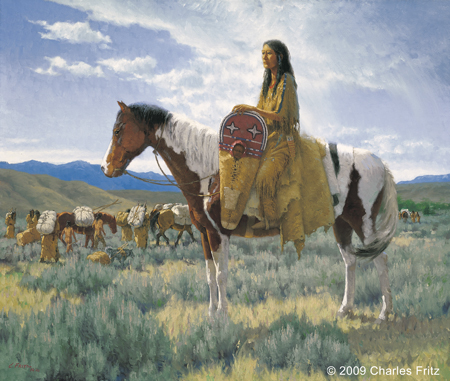
© 2009 by Charles Fritz. Used by permission.
A Gift Horse from Clark
Fortunate Camp, August 24, 1805
I had given the Interpreter some articles with which to purchase a horse for the woman which he had obtained.
—Meriwether Lewis
Pacifying the Palouse
Snake River near the mouth of the Palouse, October 13, 1805
The wife of Shabono our interpetr we find reconsiles all the Indians, as to our friendly intentions a woman with a party of men is a token of peace
—William Clark
Pacifying the Umatilla
Columbia River near Umatilla, Oregon, October 19, 1805
found the Indians much fritened, all got in to their lodges and I went in found Some hanging down their heads, Some Crying and others in great agitation, I took all by the hand, and distributed a few Small articles which I chanced to have in my Pockets and Smoked with them which expelled their fears . . . . I am confident that I could have tomahawked every Indian here.
. . . . .
as Soon as they Saw the Squar wife Sacagawea of the interperters they pointed to her and informed those who continued yet in the Same position I first found them, they imediately all came out and appeared to assume new life, the sight of This Indian woman, wife to one of our interprs. confirmed those people of our friendly intentions, as no woman ever accompanies a war party of Indians in this quarter—
—William Clark
Failure to Translate
Approaching Portland, Oregon, November 3, 1805
a Canoe arrived from the village below the last rapid with a man his wife and 3 children, and a woman whome had been taken prisoner from the Snake Inds. on Clarks River I Sent the Interpreters wife who is a So So ne or Snake Indian of the Missouri, to Speake to this Squar, they Could not understand each other Sufficiently to Converse.
—William Clark
Seasick Paddlers
Grays Bay, Columbia River, November 8, 1805
Grays Bay (view east)

© circa November 1995 by Kristopher K. Townsend. Permission to use granted under the Creative Commons Attribution-Share Alike 4.0 International license.
we took the advantage of a returning tide and proceeded on to the Second point on the Std. here we found the Swells or waves So high that we thought it imprudent to proceed . . . . The Swells were So high and the Canoes roled in Such a manner as to cause Several to be verry Sick. Reuben fields, Wiser [Weiser] McNeal & the Squar wer of the number
—William Clark
Blue Beads Given
Station Camp, Columbia River, November 20, 1805
one of the Indians had on a roab made of 2 Sea Otter Skins the fur of them were more butifull than any fur I had ever Seen both Capt. Lewis & my Self endeavored to purchase the roab with differant articles at length we precured it for a belt of blue beeds which the Squar—wife Sacagawea of our interpreter Shabono wore around her waste.
—William Clark
Blue Coat Received
Station Camp, November 20, 1805
we gave the Squar a Coate of Blue Cloth for the belt of Blue Beeds we gave for the Sea otter Skins purchased of an Indian.
—William Clark
In Favor of Wapato
Station Camp, November 24, 1805
Sacagawea’s opinion about where to locate for the winter was recorded as a footnote to the official tally.
Janey in favour of a place where there is plenty of Potas [wapato].
—William Clark
Flour Bread Given
Tongue Point, Astoria, Oregon, November 30, 1805
The Squar gave me a piece of bread made of flour which She had reserved for her child and carefully Kept untill this time, which has unfortunately got wet, and a little Sour— this bread I eate with great Satisfaction, it being the only mouthfull I had tasted for Several months past.
—William Clark
Making Elk Tallow
Tongue Point, December 3, 1805
The Squar Broke the two Shank bones of the Elk after the marrow was taken out, boiled them & extracted a Pint of Greese or tallow from them—
—William Clark
Clark’s Christmas Gift
Fort Clatsop, Astoria, Oregon, December 25, 1805
I recved a presnt of Capt L. of a fleece hosrie Shirt Draws and Socks—, a pr. mockersons of Whitehouse a Small Indian basket of Gutherich, two Dozen white weazils tails of the Indian woman
—William Clark
“The Pacific from Point of Clark’s View”
36″ x 48″ oil on canvas
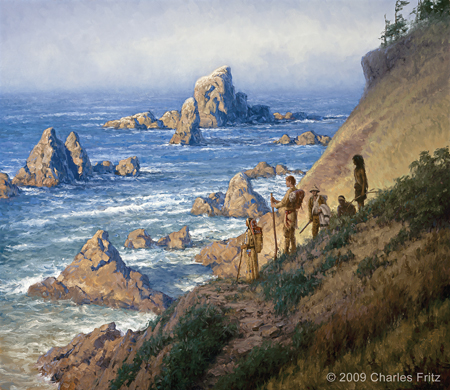
© 2009 by Charles Fritz. Used by permission.
1806
“Indulged” to See the Ocean
The Salt Works and Ecola, January 6, 1806
Capt Clark set out after an early breakfast with the party in two canoes as had been concerted the last evening; Charbono and his Indian woman were also of the party; the Indian woman was very impotunate to be permited to go, and was therefore indulged; she observed that she had traveled a long way with us to see the great waters, and that now that monstrous fish was also to be seen, she thought it very hard she could not be permitted to see either (she had never yet been to the Ocean).
—Meriwether Lewis
Translating Among the Walla Wallas
Columbia River near Wallula, Washington, April 28, 1806
our Intrepters wife found a woman of hir own nation who was a prisoner among these Indians, and as they could Speak together our officers Spoke to the head chief & told him our business and that the white people would Supply them with marchandize at the head of the Missourie &C. asked for canoes to cross the river they Said they wished us to Stay with them to day as we lived a great way off, and they wished to See us dance this evening
—John Ordway
Allaying Fears
Colter’s Creek (Potlatch, River), May 5, 1806
we met with a snake indian man at this place through whome we spoke at some length to the natives this evening with rispect to the objects which had induced us to visit their country. this address was induced at this moment by the suggestions of an old man who observed to the natives that he thought we were bad men and had come most probably in order to kill them. this impression if really entertained I beleive we effaced; they appeared well satisfyed with what we said to them, and being hungry and tired we retired to rest at 11 oClock.—
—Meriwether Lewis
The Nez Perce Council
Lawyer Canyon near Kamiah, Idaho, May 11, 1806
by the assistance of the snake boy and our interpretters were enabled to make ourselves understood by them altho’ it had to pass through the French, Minnetare [Hidatsa], Shoshone and Chopunnish [Nez Perce] languages. the interpretation being tedious it ocupyed nearly half the day before we had communicated to them what we wished.
—Meriwether Lewis
Gathering “Agreeable” Roots
Long Camp, Kamiah, Idaho, May 16, 1806
Sahcargarmeah geathered a quantity of the roots of a speceis of fennel which we found very agreeable food, the flavor of this root is not unlike annis seed, and they dispell the wind which the roots called Cows [cous root] and quawmash [camas] are apt to create particularly the latter.
—Meriwether Lewis
Jean Baptiste’s Illness Begins
Long Camp, May 22, 1806
Charbono’s Child is very ill this evening; he is cuting teeth, and for several days past has had a violent lax, which having suddonly stoped he was attacked with a high fever and his neck and throat are much swolen this evening. we gave him a doze of creem of tartar and flour of sulpher and applyed a poltice of boiled onions to his neck as warm as he could well bear it.
—Meriwether Lewis
Leaving for the Yellowstone
Travelers’ Rest, Lolo, Montana, July 3, 1806
we colected our horses and after brackfast I took My leave of Capt Lewis and the indians and at 8 A M Set out with [blank] meninterpreter Shabono & his wife & child (as an interpreter & interpretess for the Crow Inds and the latter for the Shoshoni) with 50 horses. we proceeded on through the Vally of Clarks [Bitterroot] river on the West Side of the [river] nearly South
—William Clark
Recognizing the Big Hole Valley
Big Hole Valley

© 25 July 2011 by Kristopher K. Townsend. Permission to use granted under the Creative Commons Attribution-Share Alike 4.0 International license.
entered an extensive open Leavel plain in which the Indian trail Scattered in Such a manner that we Could not pursue it. the Indian woman wife to Shabono informed me that she had been in this plain frequently and knew it well that the Creek which we decended was a branch of Wisdom river and when we assended the higher part of the plain we would discover a gap in the mountains in our direction to the Canoes
—William Clark
Finding a New Lomatium Root
Near Fortunate Camp, July 9, 1806
The Squar brought me a Plant the root of which the nativs eat. this root most resembles a Carrot in form and Size and Something of its colour, being of a pailer yellow than that of our Carrot, the Stem and leaf is much like the Common Carrot, and the taste not unlike. it is a native of moist land.—
—William Clark
Recommending a Pass
Approaching Bozeman Pass, July 13, 1806
The indian woman who has been of great Service to me as a pilot through this Country recommends a gap in the mountain more South which I shall cross.—.
—William Clark
Finding a Buffalo Trace
Approaching Bozeman Pass, July 14, 1806
Swamped as I may Say in this bottom of beaver I was compelled to turn Short . . . . the Squar informed me that there was a large road passing through the upper part of this low plain from Madicins river through the gap which I was Stearing my Course to . . . . Struck an old buffalow road [Nicholas Biddle added: the one our Indn woman meant] which I kept
—William Clark
Explaining War Party Shelters
Yellowstone River near Reed Point, Montana, July 17, 1806
I Saw in one of those Small bottoms which I passed this evening an Indian fort which appears to have been built last Summer. this fort was built of logs and bark . . . . the Squaw informs me that when the war parties find themselves pursued they make those forts to defend themselves . . . .
—William Clark
Gathering Currants
Missouri River below Williston, North Dakota, August 9, 1806
The Squar brought me a large and well flavoured Goose berry of a rich Crimsin Colour, and deep purple berry of the large Cherry of the Current Speces which is common on this river as low as the Mandans, the engagés Call it the Indian Current.
—William Clark
Parting Ways
Knife River Villages, August 17, 1806
Leaving the Knife River Villages
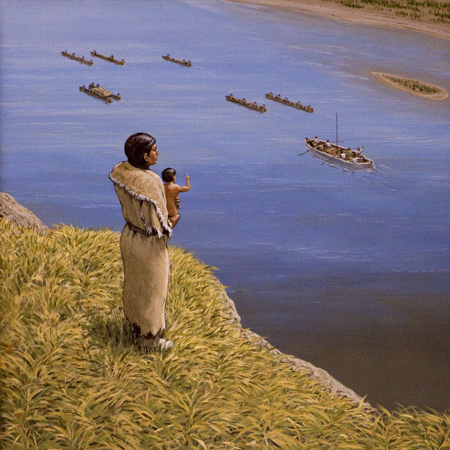
Painting created by Split Rock Studios, Sioux City, Iowa. Original in the collection of the Lewis and Clark Trail Heritage Foundation and photographed by Kristopher K. Townsend.
we . . . took our leave of T. Chabono, his Snake Indian wife and their Son Child who had accompanied us on our rout to the pacific Ocean in the Capacity of interpreter and interpretes. . . .
I offered to take his little Son a butifull promising Child who is 19 months old to which they both himself & wife wer willing provided the Child had been weened. they observed that in one year the boy would be Sufficiently old to leave his mother & he would then take him to me if I would be so freindly as to raise the Child for him in Such a manner as I thought proper, to which I agreeed &c.—
—William Clark
Notes
| ↑1 | Between Ordway, Clark, and Nicholas Biddle’s insertion, most historians believe that Charbonneau brought both of his Shoshone wives on this day. |
|---|
Experience the Lewis and Clark Trail
The Lewis and Clark Trail Experience—our sister site at lewisandclark.travel—connects the world to people and places on the Lewis and Clark Trail.
Discover More
- The Lewis and Clark Expedition: Day by Day by Gary E. Moulton (University of Nebraska Press, 2018). The story in prose, 14 May 1804–23 September 1806.
- The Lewis and Clark Journals: An American Epic of Discovery (abridged) by Gary E. Moulton (University of Nebraska Press, 2003). Selected journal excerpts, 14 May 1804–23 September 1806.
- The Lewis and Clark Journals. by Gary E. Moulton (University of Nebraska Press, 1983–2001). The complete story in 13 volumes.
This site is provided as a public service by the

Lewis and Clark Trail Alliance
with additional funding from the following: