Currant Bush
Missouri River Rapids above Lower Portage Camp (view South)
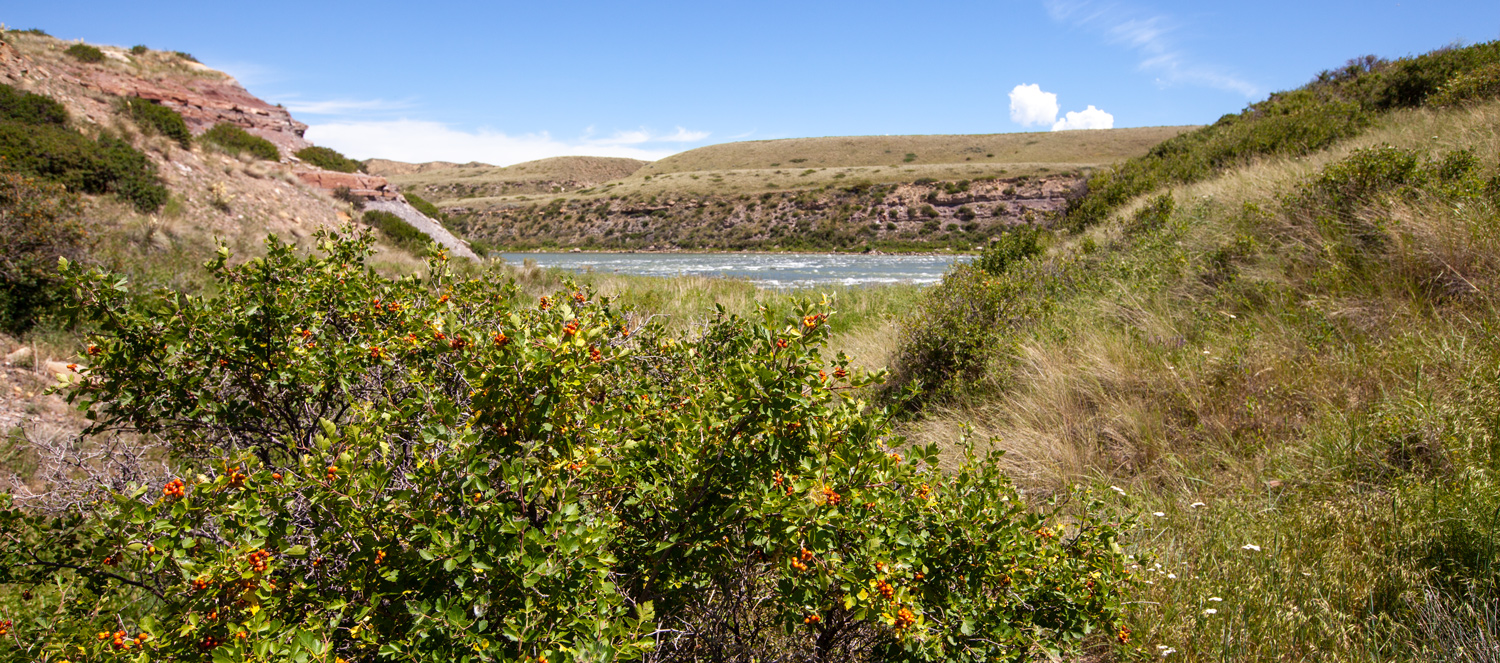
© 29 June 2023 Kristopher K. Townsend. Permission to use granted under the Creative Commons Attribution-Share Alike 4.0 International license.
Introduction
As the Lewis and Clark Expedition crossed North America, currants and gooseberries were pervasive, and in the journals, they are mentioned often. Once considered separate genera, gooseberries and currants have been combined into a single genus, Ribes.[1]For a brief explanation of botanical names, see on this site, Binomial Nomenclature.
Ribes has some 200 recognized species worldwide, ten of which are in the Great Plains and thirty in the Pacific Northwest. Naturally, Meriwether Lewis collected several types.[2]“Ribes L.”, Botanical Royal Gardens Plants of the World Online, powo.science.kew.org/taxon/urn:lsid:ipni.org:names:30002461-2, accessed 2 August 2025; C. Leo Hitchcock and Arthur … Continue reading Currant and gooseberry species were[3]When referring to the ethnobotanical record, past tense will most often be used. This does not imply the plant is no longer in use in the manner described. well-known to Indigenous Peoples, and several species were a source of food and medicine. Regarding botanical discoveries, the captains were merely following the human tendency to learn from exploration and experimentation. Lewis collected at least eight species—four of which exist today—and he also wrote four botanical descriptions giving a nearly complete picture of the currants and gooseberries they encountered.
Four Existing Specimens
Four Ribes specimens reside in the Lewis and Clark Herbarium at the Academy of Sciences of Philadelphia. Two additional duplicates are at the Royal Botanical Gardens Kew. All but the spreading gooseberry specimen were used by Frederick Pursh to classify and name their respective species. As such, they are considered lectotypes—a specimen that serves as the description and name of a species new to science.[4]James L. Reveal, Gary E. Moulton, and Alfred E. Schuyler, “The Lewis and Clark Collections of Vascular Plants: Names, Types, and Comments,” Proceedings of the Academy of Natural Sciences … Continue reading The four existing specimens are:
- Golden currant (R. aureum Pursh)
- Redflower currant (R. sanguineum Pursh)
- Spreading gooseberry (R. divaricatum Douglas)
- Sticky currant (R. viscosissimum Pursh)
Four Lost Specimens
Based on journal entries, Lewis likely preserved four Ribes species that are now lost. One specimen was shipped from Fort Mandan in spring 1805. The other three were given botanical descriptions implying Lewis also preserved specimens of each. The dates of his descriptions suggest that one was cached at the Great Falls of the Missouri and two were cached at Fortunate Camp east of the Continental Divide. While they wintered over at Fort Clatsop, the latter three candidate specimens likely perished. Lewis would not know of these losses until the opportunity to collect new specimens had passed. The four candidate specimens are:
- American black currant (R. americanum Mill.)
- Wax currant (R. cereum Douglas)
- Prickly currant (R. lacustre (Pers.) Poir.)
- Northern black currant (R. hudsonianum Richardson)
American Black Currant
American Black Currant
Ribes americanum Mill.
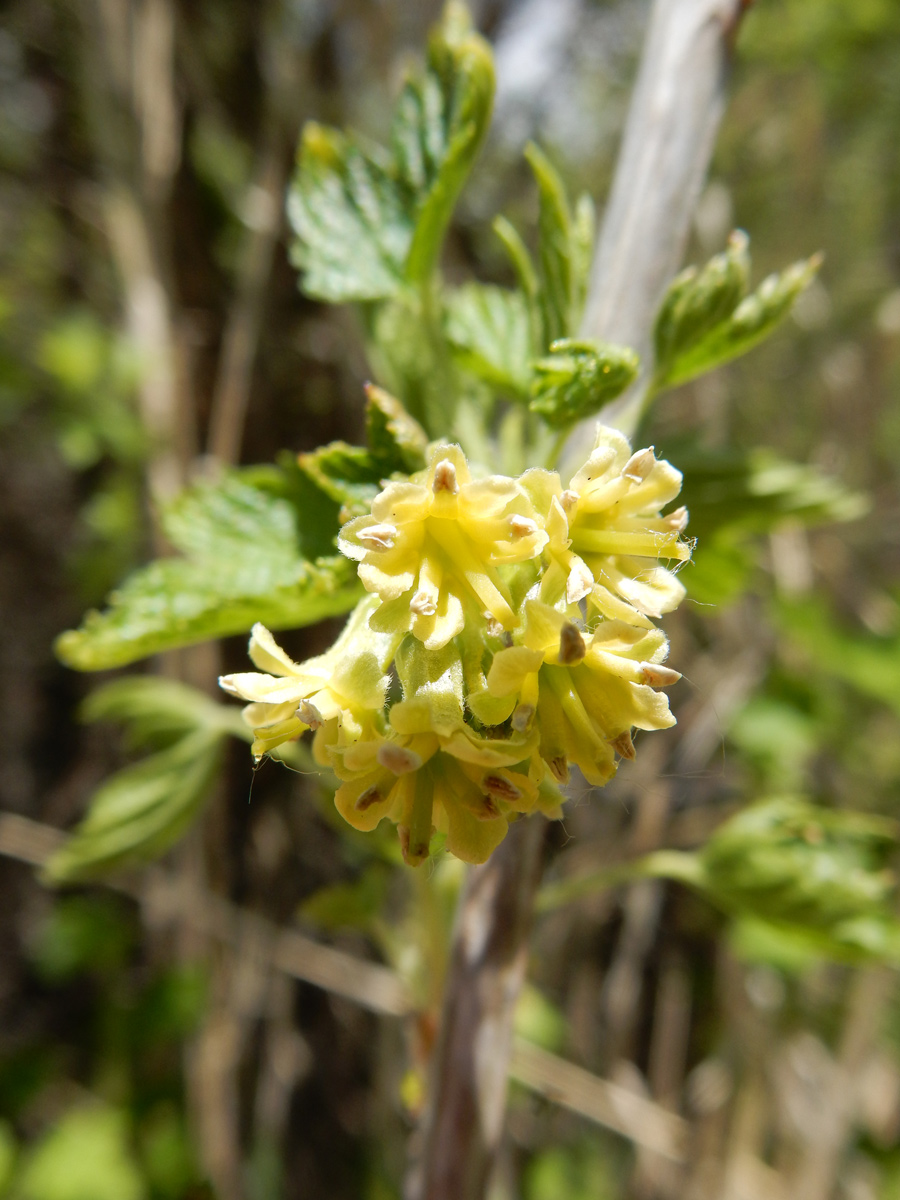
Bozeman, Montana, 14 May. © 2016 by Matt Lavin. Permission to use granted under the Creative Commons Attribution-ShareAlike 2.0 Generic (CC-BY-SA 2.0) license.
Relatively early in their journey, the expedition stopped at Council Bluff within present-day Fort Atkinson, Nebraska. On 1 August 1804, Capt. William Clark prepared a “verry flashey” peace pipe in anticipation of a council with some Otoes. It was his 30th birthday and to celebrate, he:
order’d a Saddle of fat Vennison, an Elk fleece & a Bevertail to be cooked and a Desert of Cheries, Plumbs, Raspberries Currents and grapes of a Supr. quallity.
If Clark appeared put off by his milestone, he did not show it. In fact, he appeared ebullient when he described his dinner. He also revealed a sense of botanical adventure when he added, “What a field for a Botents [botanist] and a natirless [naturalist]”.[5]Gary Moulton, The Definitive Journals of Lewis and Clark (Lincoln and London: University of Nebraska Press, 1986), 2:433.
Notably, Clark had concluded his repast with a dessert—an Ambrosia of the Plains consisting of succulent wild cherries, plumbs, grapes, raspberries, and what was likely the American black currant, R. americanicum Mill.[6]H. Wayne Phillips, Plants of the Lewis and Clark Expedition (Missoula, MT: Mountain Press Publishing, 2005), 38–39. American black currants were highly esteemed as food among Montana Indians, and the Lakota Sioux ate them fresh. Blackfeet Peoples treated kidney ailments with a decoction made from the plant’s roots.[7]Daniel E. Moerman, Native American Ethnobotany (Portland, Oregon: Timber Press, 1988), 475–76.
According to Lewis, one of the hunters had brought in “a bough of the purple courant, which is frequently cultivated in the Atlantic states . . . .” Because he already knew the American black currant, he may have preserved the specimen to enable botanists in the East to better define the plant’s range. The specimen—No. 12 on his shipping manifest—was sent from Fort Mandan on the barge and is now lost.[8]Moulton, Journals, “Fort Mandan Miscellany”, 3:454.
Wax Currant
Wax Currant
Ribes cereum Douglas
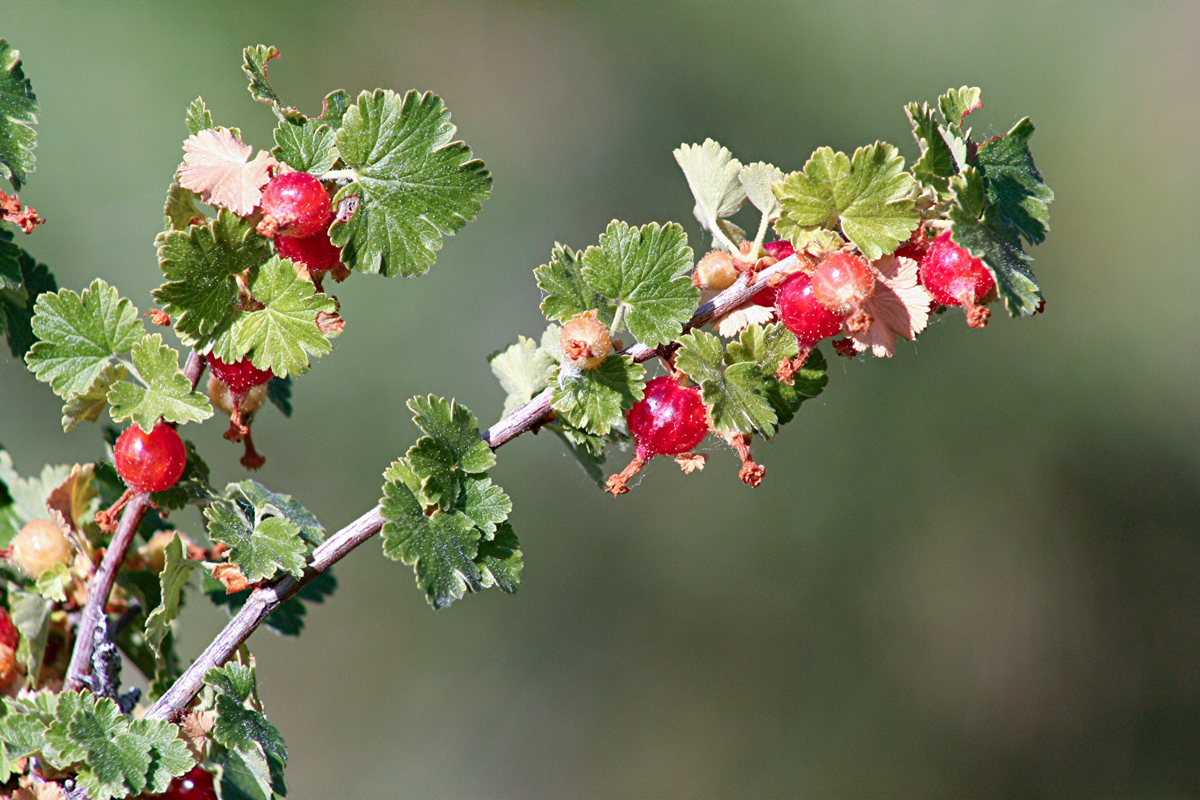
Columbus, Montana, 8 July 2006. USDA Natural Resources Conservation Service, Montana.
Moving forward to 18 June 1805, Clark was surveying the Falls of the Missouri, and Lewis was busy at Lower Portage Camp arranging the upcoming portage. The white pirogue was beached, a cache was planned, and the iron-framed boat was unpacked and inspected. He also kept an eye on Sacagawea who was recovering from a serious illness. Somehow, he found the time to describe the wax currant (R. cereum Douglas)—a species with red to orange, unpalatable berries:
There is a species of goosberry which grows very common about here in open situations among the rocks on the sides of the clifts. they are now ripe of a pale red colour, about the size of a common goosberry, and like it is an ovate pericarp of soft pulp invelloping a number of smal whitish coloured seeds; the pulp is a yelloish slimy muselaginous substance of a sweetish and pinelike tast, not agreeable to me. the surface of the berry is covered with a glutinous adhesive matter, and the frut altho’ ripe retains it’s withered corollar. this shrub seldom rises more than two feet high and is much branched, the leaves resemble those of the common goosberry only not so large; it has no thorns. the berry is supported by seperate peduncles or footstalks of half an inch in length.[9]Moulton, Journals, 3:306.
Lewis likely preserved a specimen sheet and stored it in one of their caches—likely at the Upper Portage Camp. The sheet did not survive, and only his description remains.
Golden Currant
Lewis’ Golden Currant Specimen (Kew)
Ribes Aureum
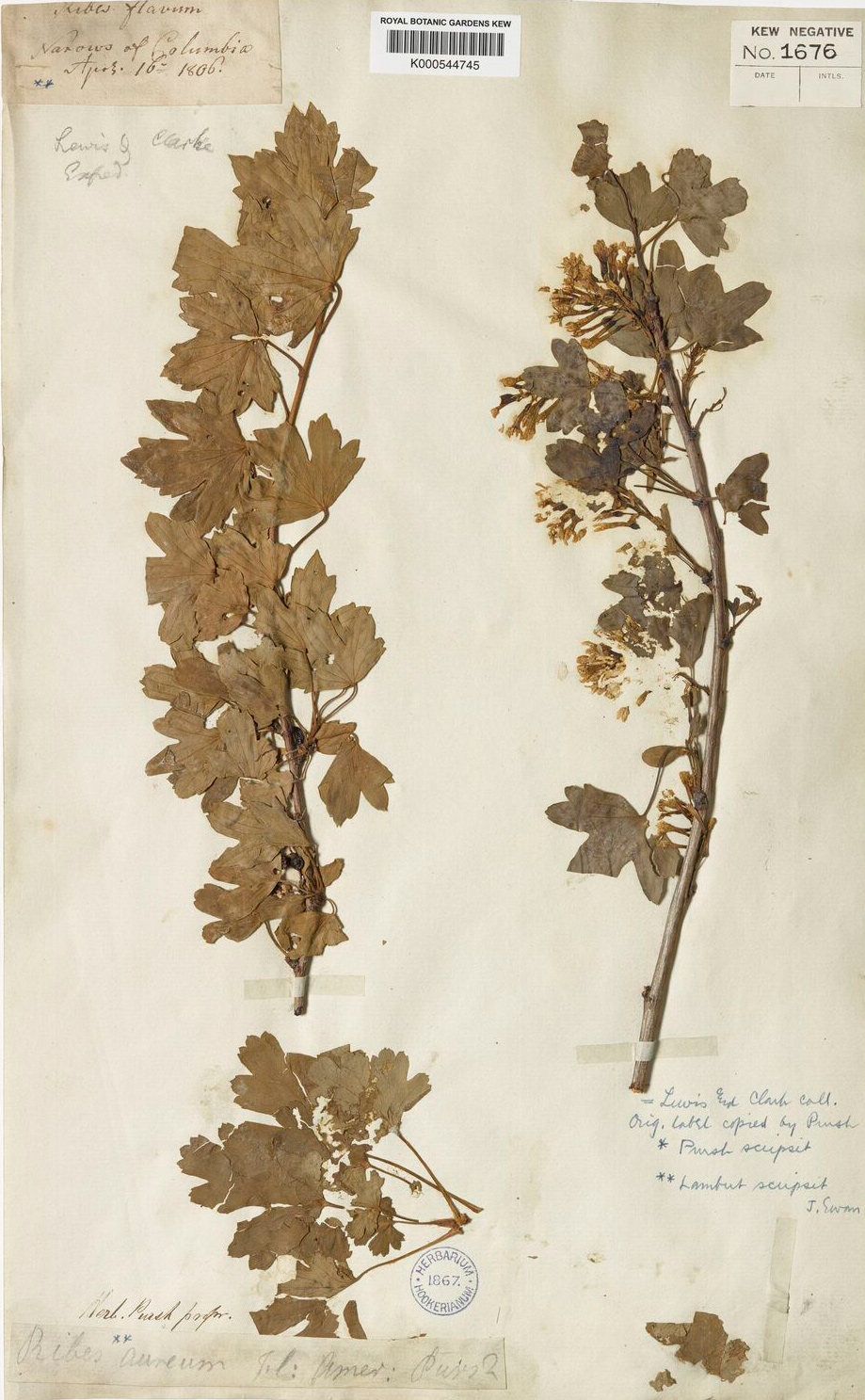
“The Herbarium Catalogue”, Royal Botanic Gardens, Kew, www.kew.org/herbcat, accessed 1 August 2025. Digital Image © Board of Trustees, RBG Kew, creativecommons.org/licenses/by/3.0/.
All currants and gooseberries are edible, but the berries of the golden currant (Ribes aureum Pursh) are especially palatable. The plant’s use as food has been documented among the Blackfeet, Cheyenne, and Lakota. As a medicine, Shoshone People made a decoction from the inner bark to treat snake bites.[10]Moreman, 476. The common name “golden” comes from its bright yellow blooms, not the color of its berries which range from yellow-orange to purple-black.
Lewis collected and prepared two golden currant specimens, one near the Headwaters of the Missouri at present Three Forks, Montana and another at Fort Rock at The Dalles, Oregon. He considered them different species, but in his 1814 book, Frederick Pursh declared them the same species giving the species the name R. aureum. One specimen sheet exists at the Academy of Natural Sciences of Philadelphia and the other at the Kew Botanical Royal Gardens in England.
Golden currants and buffalo currants were long considered separate species. Currently, botanists have lumped Lewis’s currants “of the Columbia” (golden currant) and “of the Missouri” (buffalo currant) into R. aureum. The buffalo currant has been reclassified as R. aureum var. villosum. In the historical literature, including Moulton’s edition of the Lewis and Clark journals, “Great Plains” aka “buffalo” currant is R. odoratum H. Wendl.[11]Moulton, Journals, 7:129n2.
There is some uncertainty regarding the Kew sheet (shown in the figure). First, the material is too nice—typical of a specimen made from a garden rather than in the field. Reveal, et al. raise the possibility that the plant was grown from seeds brought back by Thomas Nuttall in 1811. Further, the authors identify the plant as the currant of the “Great Plains var. villosum” which was not native west of the Continental Divide. They do not believe the plant was collected on the Columbia River as stated on the label.[12]Reveal, Moulton, Schuyler, 43–5. Nevertheless, the Kew specimen is attributed to Lewis and Clark.
Lewis described golden currant on 17 July 1805 while they traveled south of Tower Rock (Montana):
there are a great abundance of red yellow perple & black currants, and service berries now ripe and in great perfection. I find these fruits very pleasent particularly the yellow currant which I think vastly preferable to those of our gardens. the shrub which produces this fruit rises to the hight of 6 or 8 feet; the stem simple branching and erect. they grow closly ascociated in cops either in the oppen or timbered lands near the watercouses. the leaf is petiolate of a pale green and resembles in it’s form that of the red currant common to our gardens. the perianth of the fructification is one leaved, five cleft, abreviated and tubular, the corolla is monopetallous funnel-shaped; very long, superior, 〈permanent tho’〉 withering and of a fine orrange colour. five stamens and one pistillum; of the first, the fillaments are capillare, inserted into the corolla, equal, and converging; the anther ovate, biffid and incumbent. with rispect to the second the germ is roundish, smoth, inferior pedicelled and small; the style, long, and thicker than the stamens, simple, cylinderical, smooth, and erect, withering and remains with the corolla untill the fruit is ripe. stigma simple obtuse and withering.— the fruit is a berry about the size and much the shape of the red currant of our gardins, like them growing in clusters supported by a compound footstalk, but the peduncles which support the several berries are longer in this species and the berries are more scattered. it is quite as transparent as the red current of our gardens, not so ascid, & more agreeably flavored. the other species differ not at all in appearance from the yellow except in the colour and flavor of their berries. I am not confident as to the colour of the corolla, but all those which I observed while in blume as we came up the Missouri were yellow but they might possibly have been all of the yellow kind and that the perple red and black currants here may have corollas of different tints from that of the yellow currant.—[13]Moulton, Journals, 4:391–92.
Prickly Currant
Prickly Currant
Ribes lacustre (Pers.) Poir. Booth & Wright
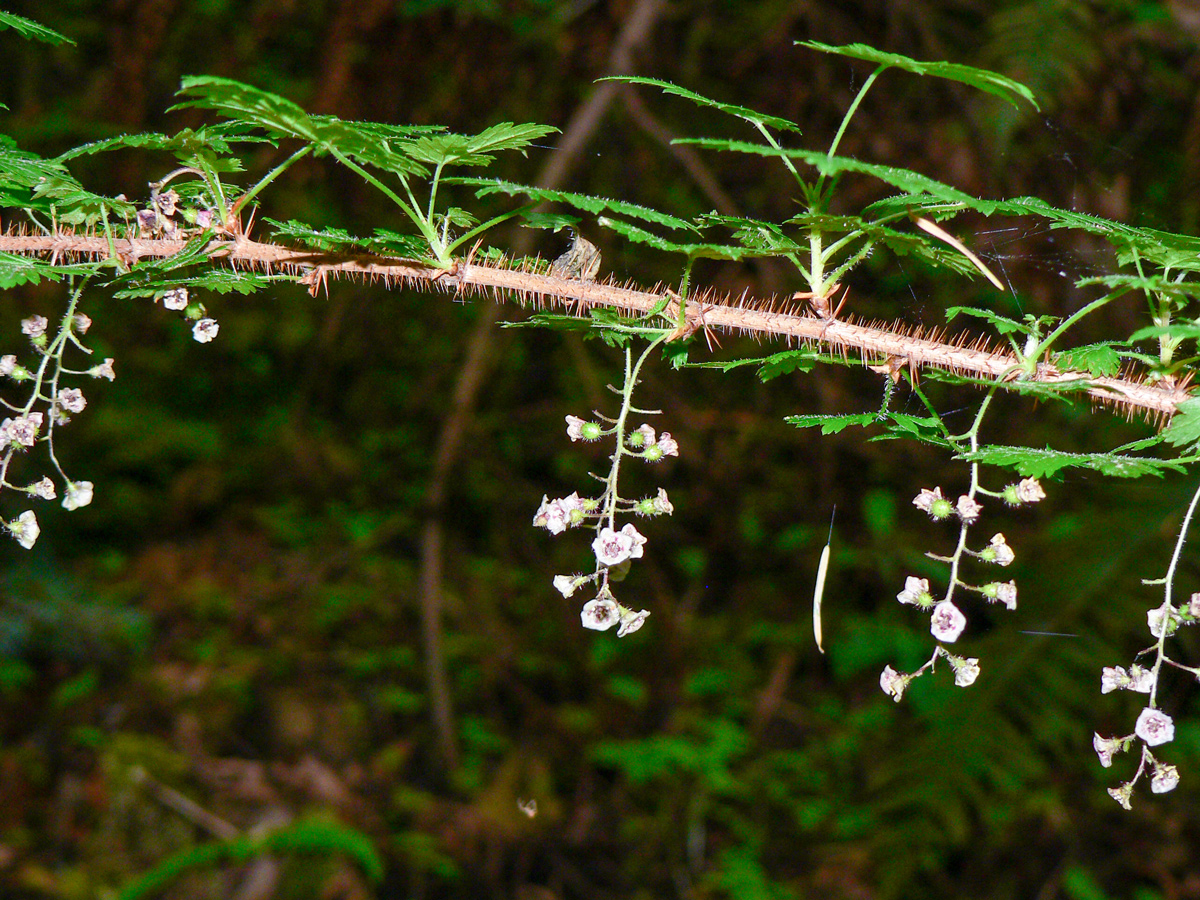
Western Washington, 19 May. © 2007 Walter Siegmund. Permission to use granted under the Creative Commons Attribution-ShareAlike 3.0 Unported license.
The day Lewis arrived at the Three Forks of the Missouri, 27 July 1805, he wrote a botanical description of what is commonly called prickly currant. Other common names—black currant, black swamp gooseberry, and black gooseberry—identify the plant as both a currant and gooseberry. Botanists avoid this confusion by calling it Ribes lacustre (Pers.) Poir. Of the plant, Lewis wrote:
a large black goosberry which grows to the hight of five or six feet is also found here. this is the growth of the bottom lands and is found also near the little rivulets which make down from the hills and mountains it puts up many stems from the same root, some of which are partialy branched and all reclining. the berry is attatched seperately by a long peduncle to the stem from which they hang pendant underneath. the berry is of an ovate form smooth as large as the common garden goosberry when arrived at maturity and is as black as jet, tho’ the pulp is of a cimson colour. this fruit is extreemly asced. the leaf resembles the common goosberry in form but is reather larger and somewhat proportioned to the superior size of it’s stem when compared with the common goosberry. the stem is covered with very sharp thorns or bryers.[14]Moulton, Journals, 4:436.
Prickly currants prefer wet meadows and swamps similar to the low areas between the Jefferson, Madison, and Gallatin Rivers at the Headwaters of the Missouri. Lewis likely preserved a specimen but, unfortunately, it may have been damaged in a cache at Fortunate Camp south of present Dillon, Montana.
The thorns were considered “poisonous” by some Coastal Peoples, but they nevertheless made tea from its bark applying it to sore eyes and drinking it for body aches and to aid childbirth. “Poisonous” may be too strong a term for the swellings that touching the thorns can cause—a type of allergic reaction. Many thought that ingesting the berries fought off the effects of these pricks.[15]Erna Gunther, Ethnobotany of Western Washington: The Knowledge and Use of Indigenous Plants by Native Americans (Seattle: University of Washington Press, 1945, 1973), 32; Betty B. Derig and Margaret … Continue reading
Northern Black Currant
Northern Black Currant
Ribes hudsonianum Richardson var. petiolare
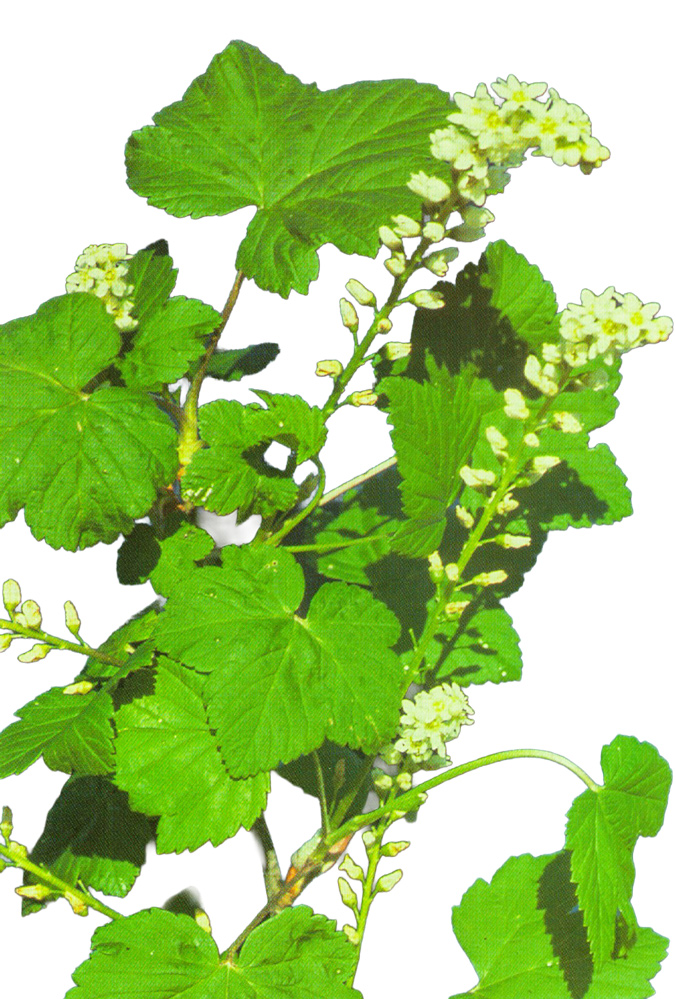
Joe F. Duft. USDA NRCS, 1992, Western wetland flora: Field office guide to plant species. Provided by USDA NRCS Wetland Science Institute (WSI), Sacramento. Modified for clarity.
On 12 August 1805, Clark and most of the enlisted men struggled to get their dugout canoes up the shallow and winding Beaverhead River. On the same day, Lewis, along with Pvt. Hugh McNeal, Pvt. John Shields, and interpreter George Drouillard, moved ahead crossing the Continental Divide at present-day Lemhi Pass. Shortly after he “first tasted the water of the great Columbia river”, Lewis described a currant with very large leaves, likely the Northern black currant (R. hudsonianum):
at the creek on this side of the mountain I observed a species of deep perple currant lower in its growth, the stem more branched and leaf doubly as large as that of the Missouri. the leaf is covered on it’s under disk with a hairy pubersence. the fruit is of the ordinary size and shape of the currant and is supported in the usual manner, but is ascid & very inferior in point of flavor.—[16]Moulton, Journals, 5:74–75.
The Northern black currant has two varieties: R. h. var. hudsonianum and R. h. var. petiolare. Their common names—Hudson Bay currant and Western black currant, respectively—roughly describe each variety’s comparative range. Both grow in present Idaho where Lewis likely collected the plant.[17]“Ribes hudsonianum Richardson: Subordinate Taxa”, USDA Natural Resources Conservation Service PLANTS Database, plants.usda.gov/plant-profile/RIHU/subordinate-taxa, accessed 9 August 2025.
Redflower Currant
Redflower Currant
Ribes sanguineum
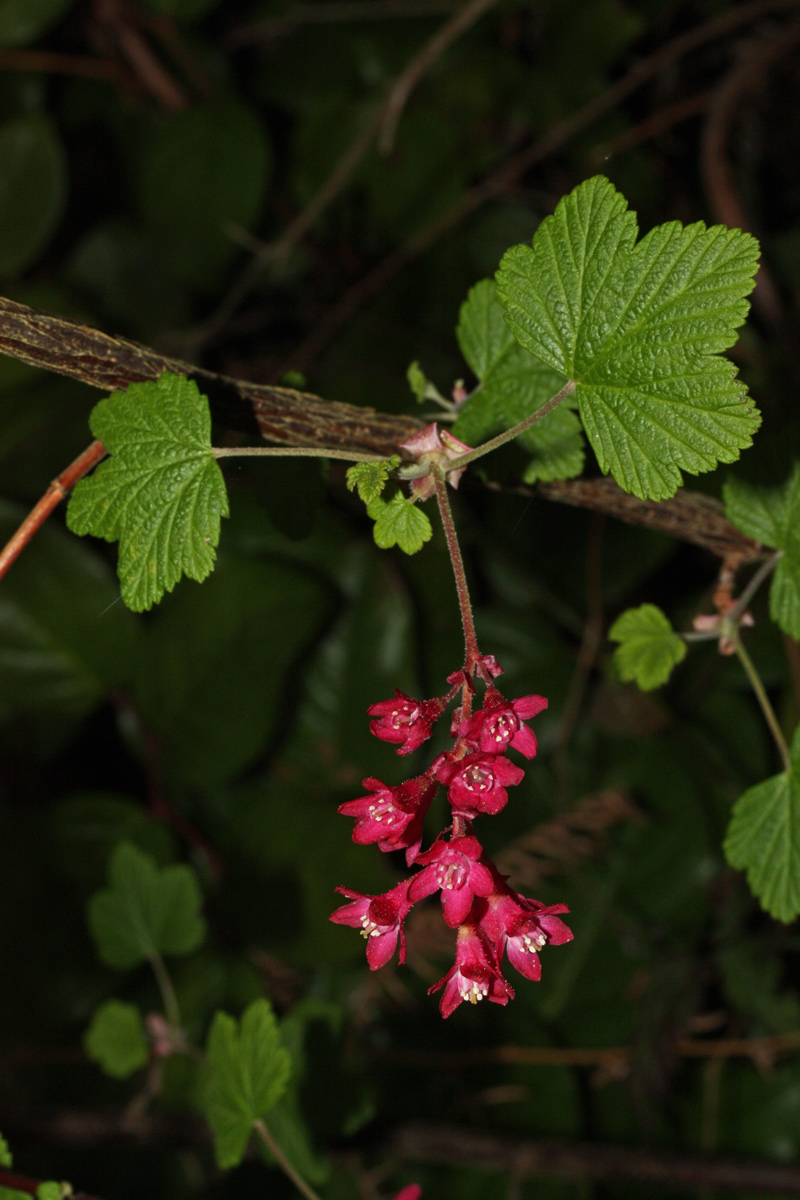
Anacortes, Washington, 19 April. © 2009 Walter Siegmund. Permission to use granted under the Creative Commons Attribution-ShareAlike 3.0 Unported license.
Returning home in the spring of 1806, Lewis saw many flowering plants that were dormant at the time the expedition passed through the previous fall. He leveraged the opportunity to collect several new specimens. Of these, three Ribes species survived the trip home and are included in the Lewis and Clark Herbarium in Philadelphia.
The first currant specimen of 1806 was collected about 58 river miles from Fort Clatsop in the vicinity of present-day Longview, Washington. What remains of the specimen indicates that he had collected the redflower currant (R. sanguineum). The specimen label simply says: “Columbia. March 27th 1806.” His Weather Diary note for the day provides a better description:
the red flowering currant are in blume, this I take to be the same species I first saw in the Rocky Mountains; the fruit is a deep purple berry covered with a gummy substance and not agreeably flavoured.[18]Moulton, Journals, 7:45.
Lewis would later learn that this species is different from the then-naked species he “saw in the Rocky Mountains”. Its showy red flowers have made redflower currant a popular addition to gardens and landscapes. It is a good possibility that seeds brought back from the lower Columbia collection were the original source of its widespread use as an ornamental.[19]Moulton, Journals, 7:47n27.
Although Lewis did not find the berries palatable, Chehalis children ate them, Coastal Salish boiled and then dried them into cakes, and the Coeur d’Alene People at them fresh. The Blackfeet were known to digest them as a laxative.[20]Moerman, 480.
Spreading Gooseberry
Spreading Gooseberry
Ribes divaricatum Douglas
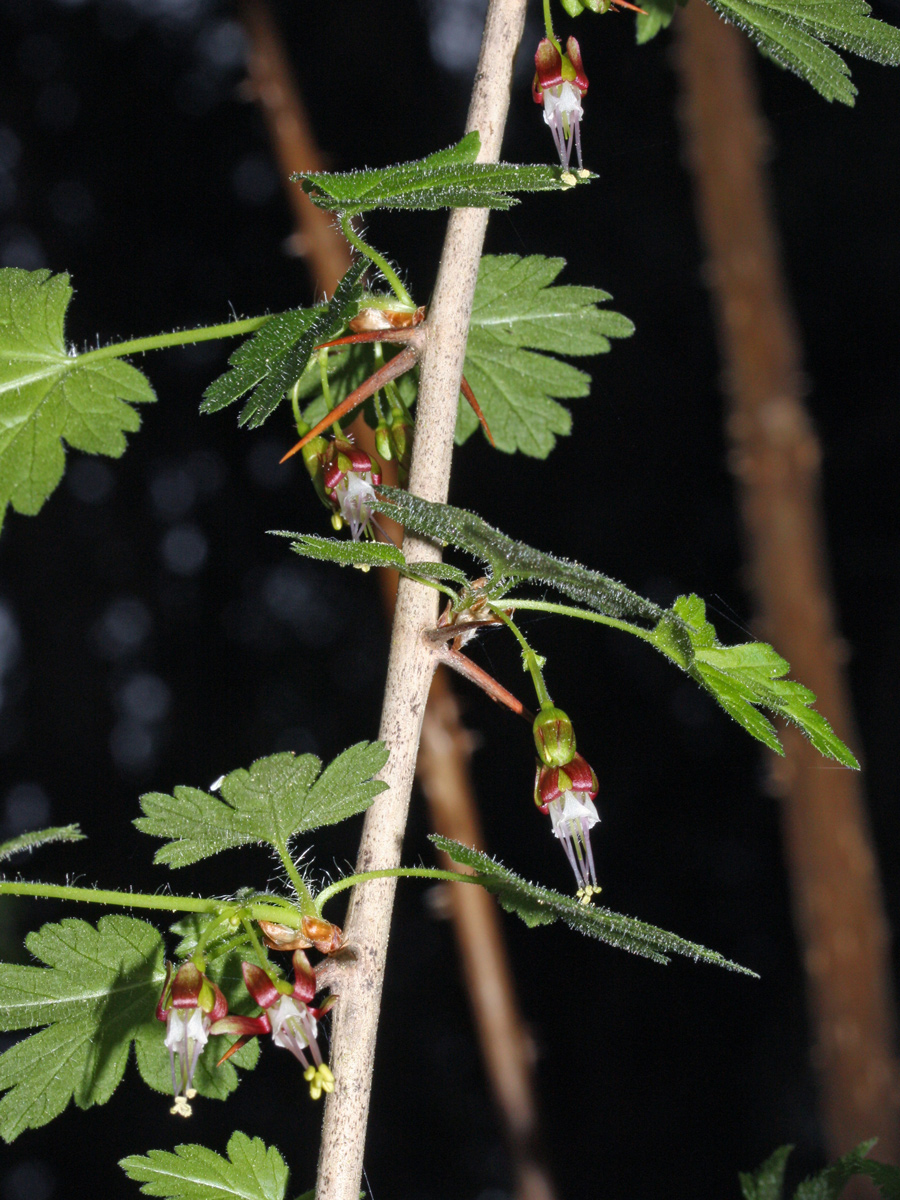
Anacortes, Washington, 19 April. © 2009 Walter Siegmund. Permission to use granted under the Creative Commons Attribution-ShareAlike 3.0 Unported license.
Lewis’s second specimen collected during the 1806 return journey was likely spreading gooseberry (R. divaricatum Douglas)—or less likely, canyon gooseberry (R. menziesii Pursh). He described the plant just after they had departed from “Provision Camp” near the Washougal River. On 8 April 1806, they were camped for three nights in the vicinity of present-day Shepperds Dell State Park in Oregon. Apparently, not enough material remained for Frederick Pursh to identify this specimen. It would not be until David Douglas collected a specimen some two decades later that the divaricatum species was identified and named.
Spreading gooseberry is relatively common along the lower Columbia River. It is typically unarmed, but examples have been found with spines. As such, it represents a bridge between gooseberries (typically armed) and currants (typically unarmed) and shows why both currants and gooseberries have been placed in the Ribes genus.[21]A. Scott Earle and James L. Reveal, Lewis and Clark’s Green World: The Expedition and its Plants (Helena, Montana: Farcountry Press, 2003), 145. The Cowlitz who called the plant tmuxwas, burned the woody stems and rubbed charcoal on sores. The Coastal Salish rubbed an infusion of roots on their bruises. Both nations, as did many Indigenous Peoples of the Pacific Northwest, considered the berries a food source.[22]Gunther, 32; Moerman, 478.
Sticky Currant
Sticky Currant Specimens (Kew)
Ribes viscosissimum
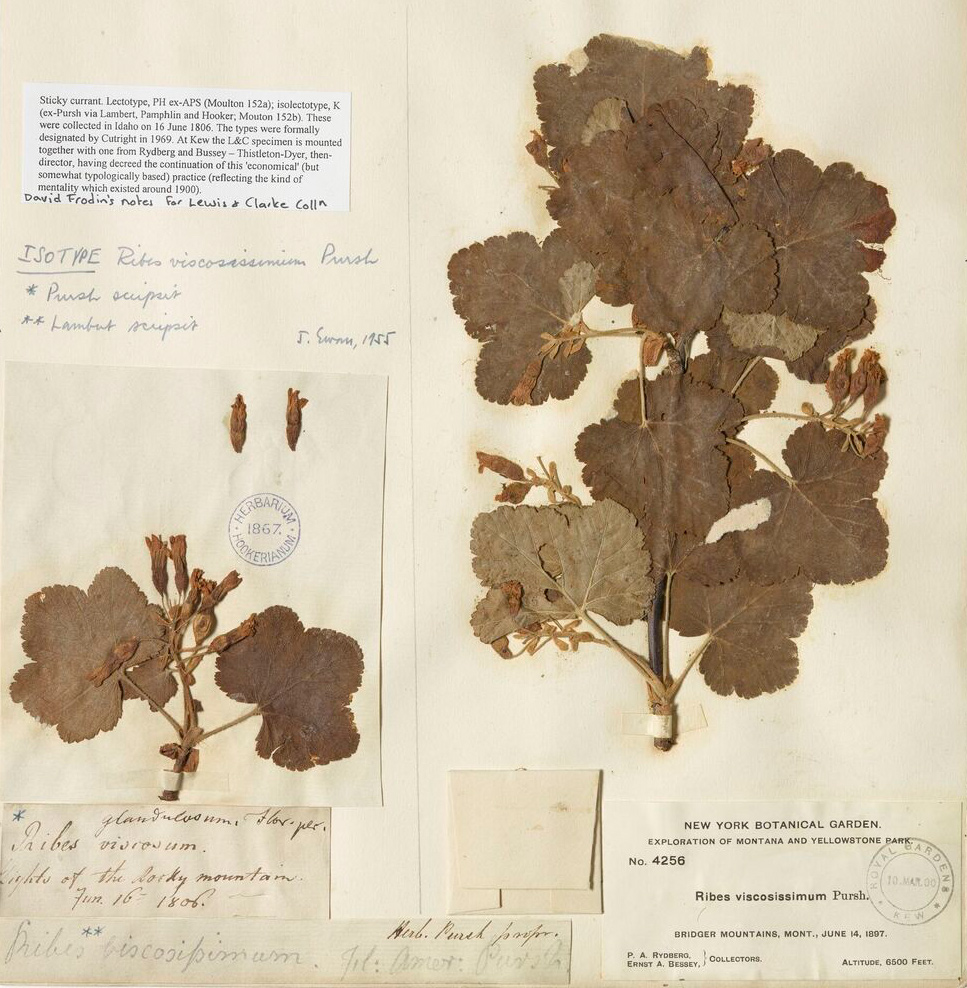
“The Herbarium Catalogue”, Royal Botanic Gardens, Kew, www.kew.org/herbcat, accessed 4 August 2025. Digital Image © Board of Trustees, RBG Kew, creativecommons.org/licenses/by/3.0/.
Lewis’s lectotype is mounted to the left of a specimen collected by Rydberg and Bussey. The typed label reads in part:
Sticky currant. Lectotype, PH ex APS (Moulton 152a); isolectotype, K (ex-Pursh via Lambert, Pamphlin and Hooker, Mouton [sic] 152b). These were collected in Idaho on 16 June 1806. The types were formally designated by Cutright in 1969. At Kew the L&C specimen is mounted together with one from Rydberg and Bussey . . . .
Re-crossing the Bitterroot Mountains in June 1806, Lewis saw the sticky currant (R. viscosissimum Pursh) in flower. He could see that it was not the same plant as the redflower currant (R. sanguineum that he had collected on the Columbia River nearly two months prior. The label on the Philadelphia specimen reads:
Fruit indifferent & gummy The hights of the Rocky mountain. Jun: 16th 1806.[23]Moulton, Journals, 12:49.
The plant’s leaves are sticky, especially when flowering, so he would have felt the difference as soon as he touched it. Using material collected by Lewis, Frederick Pursh identified sticky currant as a new species and gave it its name, viscosissimum. A second specimen sheet exists at the Royal Botanical Gardens Kew (see figure).
Conclusion
Following the story of currants and gooseberries along the Lewis and Clark Trail shows the triumphs of Lewis as a botanist and the inherent risks of preserving specimens in the field. Today, almost any outing to a natural area along the Lewis and Clark Trail will reward the visitor with berry bushes that can be easily identified as Ribes sp.—currants and gooseberries. When found, the Trail enthusiast can be reminded of the great lengths taken by Meriwether Lewis to share his love of attractive and useful plants. One can respect even older ways by learning how the plant was used as a medicine and food source—and by learning of the people who did so.
Glossary of Botanical Terms
Meriwether Lewis used botanical terms consistent with the vocabulary in Benjamin Smith Barton‘s Elements of Botany—a copy of which Lewis likely carried in his traveling library. What follows below is a list of the terms Lewis used to describe currants and gooseberries with definitions. Whenever possible, the definitions are direct quotes from Barton’s text.[24]Barton: Benjamin Smith Barton, Elements of Botany: or Outlines of the Natural History of Vegetables (Philadelphia: 1803), … Continue reading
- abbreviated: “shorter” (Barton, 110); “shortened,” (Kew, 5)
- anther: “a capsule or vessel, destined to produce or contain a substance [i.e. pollen] whose office is the impregnation of the germ, or female organ” (Barton, 161); “the part of the stamen holding the pollen” (Kew, 12)
- bifid: “a leaf divided by linear sinuses” (Barton, 31); “divided at the tip in two (usually equal) parts by a median cleft” (Kew, 19)
- branched, branching: “subdivided” (Barton, 15)
- capillary: “long and fine like a hair” (Barton, 159)
- compound: “subdivided into . . . small branches” (Barton, 22); there are different meanings when applied to a fruit or an inflorescence (Kew, 31)
- converting [converging]: “approaching the other filaments with the point” (Barton, 160)
- corolla/corollary: The petals surrounding the stamens and pistils (Barton, 131); “the second whorl of floral organs, inside or above the calyx and outside the stamens” (Kew, 33)
- cylindrical: “formed into a cylinder, or equal tube” (Barton, 165)
- equal: “all of the same length” (Barton, 160)
- erect: “upright” (Barton, 72)
- filament: “the more slender, or thread-like part of the stamen which supports the anther, and connects it with the flower” (Barton, 159)
- footstalk: “petiole” (Barton, 40); “leaf stalk” (Harris, 84)
- fructification: “temporary part of vegetables, dedicated to the business of generation” (Barton quoting Linnaeus, 106)
- Funnel-shaped: “having a conical border rising from a tube” (Barton, 135)
- germ: “The Germen . . . the rudiment of the fruit in embryo-state” (Barton, 171); the structure that holds the seeds—today called the ovary
- glutinous: “mucilaginous” (Barton, 233); “covered with a sticky substance” (Kew, 55)
- incumbent: “fixed by the middle upon the filament” (Barton, 165)
- inferior: “when the germ is above the base of the perianth” (Barton, 111); below the calyx (Kew, 63)
- monopetalous: “one-petalled” (Barton, 131)
- mucilaginous: “glutinous” (Barton, 233); “slimy and moist” (Harris, 71)
- obtuse(ly): “blunt” (Barton, 32)
- ovate: “egg-shaped” (Barton 31)
- pedicelled: standing on a pedicel, or footstalk” (Barton, 172)
- peduncle: “a partial stem, or trunk, which supports the fructification, without the leaves” (Barton, 71)
- pendant: “hanging” (Kew, 85)
- perianth: “flower-cup” (Barton, 107); “collective term for the calyx and corolla” (Kew, 86)
- pericarp: “Seed-vessel, or Seed-case” (Barton, 179)
- permanent: opposite of deciduous (Barton, 31). Today, persistent is used (Kew, 87)
- petiolate: “growing on a petiole or foot stalk” (Barton, 41); “with a leaf stalk” (Kew, 87)
- pistillum: “the female part of the vegetable . . . . it consists of three parts, the Germen, the Stylus, and the Stigma” (Barton, 170–1); today the pistil with “ovary, style and stigma” (Kew, 90)
- pubescence: “hairy appearance” (Barton, 68)
- reclining: “bending in an arch towards the earth” (Barton, 22)
- scattered: “without any regular order” (Barton, 7)
- simple: “not divided” (Barton, 172)
- simple branching: “does not divide” (Barton, 22)
- smooth: “beardless” (Barton, 91); not rough or hairy (Kew, 110)
- stamen: the male organ (Barton, 108); “the filamentum, and the anther” (Barton, 158)
- stigma: “the summit or top of [the] female part of the plant . . . destined to receive the influence of the pollen, and transmit it to the germ” (Barton, 175)
- style: “the middle portion of the pistil, which, in many plants, connects the stigma with the germ” (Barton, 172)
- superior: “attached above, as an ovary that is attached above the point of attachment of the other floral whorls” (Harris, 117)
- tubular: “hollow” (Barton, 25)
- under disk: the groundward center surface of a leaf (Barton, 43, 114)
Notes
| ↑1 | For a brief explanation of botanical names, see on this site, Binomial Nomenclature. |
|---|---|
| ↑2 | “Ribes L.”, Botanical Royal Gardens Plants of the World Online, powo.science.kew.org/taxon/urn:lsid:ipni.org:names:30002461-2, accessed 2 August 2025; C. Leo Hitchcock and Arthur Cronquist, Flora of the Pacific Northwest (Seattle: University of Washington Press, 1973), 199–204; 352–356. |
| ↑3 | When referring to the ethnobotanical record, past tense will most often be used. This does not imply the plant is no longer in use in the manner described. |
| ↑4 | James L. Reveal, Gary E. Moulton, and Alfred E. Schuyler, “The Lewis and Clark Collections of Vascular Plants: Names, Types, and Comments,” Proceedings of the Academy of Natural Sciences of Philadelphia 149 (29 January 1999): 43–45. |
| ↑5 | Gary Moulton, The Definitive Journals of Lewis and Clark (Lincoln and London: University of Nebraska Press, 1986), 2:433. |
| ↑6 | H. Wayne Phillips, Plants of the Lewis and Clark Expedition (Missoula, MT: Mountain Press Publishing, 2005), 38–39. |
| ↑7 | Daniel E. Moerman, Native American Ethnobotany (Portland, Oregon: Timber Press, 1988), 475–76. |
| ↑8 | Moulton, Journals, “Fort Mandan Miscellany”, 3:454. |
| ↑9 | Moulton, Journals, 3:306. |
| ↑10 | Moreman, 476. |
| ↑11 | Moulton, Journals, 7:129n2. |
| ↑12 | Reveal, Moulton, Schuyler, 43–5. |
| ↑13 | Moulton, Journals, 4:391–92. |
| ↑14 | Moulton, Journals, 4:436. |
| ↑15 | Erna Gunther, Ethnobotany of Western Washington: The Knowledge and Use of Indigenous Plants by Native Americans (Seattle: University of Washington Press, 1945, 1973), 32; Betty B. Derig and Margaret C. Fuller, Wild Berries of the West (Missoula, Montana: Mountain Press Publishing Company, 2001),44; Moerman, 478. |
| ↑16 | Moulton, Journals, 5:74–75. |
| ↑17 | “Ribes hudsonianum Richardson: Subordinate Taxa”, USDA Natural Resources Conservation Service PLANTS Database, plants.usda.gov/plant-profile/RIHU/subordinate-taxa, accessed 9 August 2025. |
| ↑18 | Moulton, Journals, 7:45. |
| ↑19 | Moulton, Journals, 7:47n27. |
| ↑20 | Moerman, 480. |
| ↑21 | A. Scott Earle and James L. Reveal, Lewis and Clark’s Green World: The Expedition and its Plants (Helena, Montana: Farcountry Press, 2003), 145. |
| ↑22 | Gunther, 32; Moerman, 478. |
| ↑23 | Moulton, Journals, 12:49. |
| ↑24 | Barton: Benjamin Smith Barton, Elements of Botany: or Outlines of the Natural History of Vegetables (Philadelphia: 1803), www.google.com/books/edition/Elements_of_Botany_Or_Outlines_of_the_Na/Hk0aAAAAYAAJ?hl=en&gbpv=0; Kew: Henk Beentje, The Kew Plant Glossary: An Illustrated Dictionary of Plant Terms (Royal Botanic Gardens: Kew Publishing, 2012); Harris: James G. Harris and Melinda Woolf Harris, Plant Identification Terminology: An Illustrated Glossary (Spring Lake, Utah: Spring Lake Publishing, 2009). |
Experience the Lewis and Clark Trail
The Lewis and Clark Trail Experience—our sister site at lewisandclark.travel—connects the world to people and places on the Lewis and Clark Trail.

Discover More
- The Lewis and Clark Expedition: Day by Day by Gary E. Moulton (University of Nebraska Press, 2018). The story in prose, 14 May 1804–23 September 1806.
- The Lewis and Clark Journals: An American Epic of Discovery (abridged) by Gary E. Moulton (University of Nebraska Press, 2003). Selected journal excerpts, 14 May 1804–23 September 1806.
- The Lewis and Clark Journals. by Gary E. Moulton (University of Nebraska Press, 1983–2001). The complete story in 13 volumes.
This site is provided as a public service by the
Lewis and Clark Trail Alliance
with additional funding from the following: