Sacagawea’s Agreeable Food
Western Sweet Cicely Root
Osmorhiza occidentalis
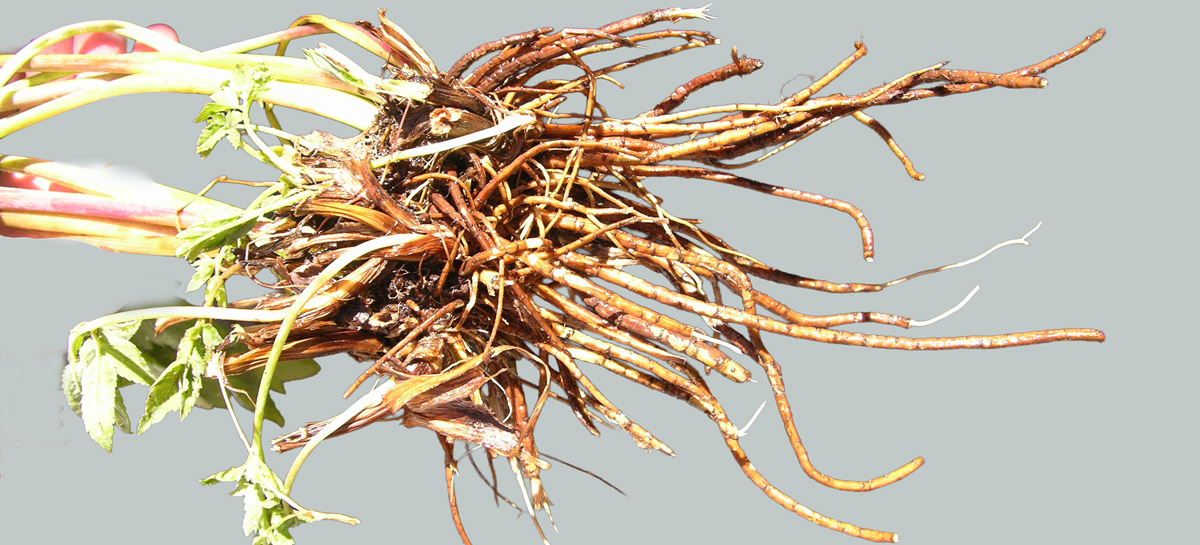
© 2025 by John W. Fisher. Used with permission.
The ungainly roots of Western Sweet Cicely not only improved the taste of food with its anise- or fennil-like taste, it was long used as medicine among many Native American Nations. Sacagawea collected the root which likely made its way into the Captains’ meals. If she had brought the entire plant, Meriwether Lewis may have written a botanical description to help future botanists better identify the plant she collected.
Western Sweet Cicely
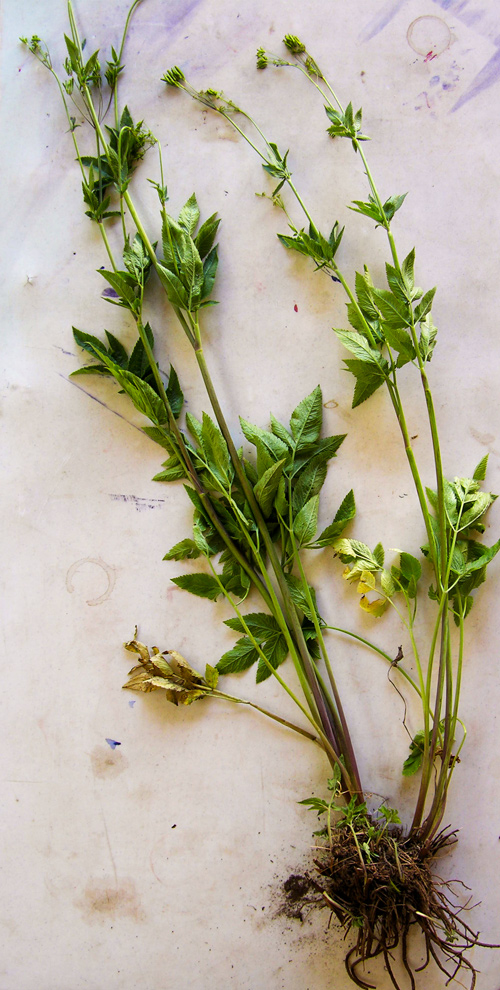
© 2025 by John W. Fisher. Used with permission.
The above specimen was collected by John Fisher in the Blue Mountains south of Lewiston, Idaho. He stated that his “entire shop and house was filled with anise/fennel aroma for days.” Small wonder Lewis’s specimen attracted vermin and/or insects who devoured every bit of it.[1]John W. Fisher, email 19 June 2025.
May 16, 1806, was a routine day at Long Camp across the Clearwater River from Kamiah, Idaho—another day of waiting for the Bitterroot Mountain snows to melt. A Nez Perce man brought in George Drouillard‘s stray horse. Hunters were dispersed to various camps, but they were not having much success. Lewis was ruminating on the variously colored grizzly bears he was encountering, and Sacagawea brought in a tasty food with beneficial medicinal qualities:
Sahcargarmeah geathered a quantity of the roots of a speceis of fennel which we found very agreeable food, the flavor of this root is not unlike annis seed, and they dispell the wind which the roots called Cows and quawmash are apt to create particularly the latter.[2]Meriwether Lewis, The Definitive Journals of Lewis & Clark, Gary Moulton, ed. (Lincoln: University of Nebraska Press, 2002), 7: 264.
In his version of the event, William Clark found the root a “very paleatiable and nurishing food.”[3]Journals, 7: 265.
Key to identifying this plant is that it was described as a fennel species, and it tasted like anise-seed. Fennel (Foeniculum vulgare) is a widely spread plant originating in the Mediterranean. It tastes like anise (Pimpinella anisum) which has been cultivated in Egypt for approximately 4,000 years. Both are members of the carrot—or parsley—family (Apiaceae) and both are flavorful additions to food, candy, and alcoholic drink. The journalists were obviously familiar with these two flavors. Similar flavors include star anise, licorice, and tarragon.[4]“Anise”, drugs.com, www.drugs.com/npc/anise.html; “Anise”, Wikipedia, en.wikipedia.org/wiki/Anise; “Fennel”, Wikipedia, en.wikipedia.org/wiki/Fennel, all accessed … Continue reading Those two plants were not growing near Long Camp, so most botanists agree that the roots that Sacagawea gathered were from the Western sweet cicely (Osmorhiza occidentalis).
In botanical nomenclature, the citation Osmorhiza occidentalis (Nutt. ex Torr. & A. Gray) Torr. indicates that the Latin binomial was coined by Thomas Nuttall and first described by John Torrey and Asa Gray. Other text indicates that the plant was first placed in a different genus—Glycosma—and later moved to Osmorhiza by Torrey.
A Useful Plant
Ethnobotanist Daniel Moerman has cataloged no less than 20 uses of sweet cicely by the Shoshoni—Sacagawea’s original people. Whether she learned of this plant as young girl, on her return to the Lemhi River Valley in 1805, or gathered the root with Nez Perce women in 1806 is not known. She did collect a useful plant. Not only does it smell and taste good, but it helps dispel the mighty winds reported by the captains after eating other roots such as camas and cous.
The Shoshones flavored their food with sweet cicely and applied it in a variety of ways to treat colds, diarrhea, venereal disease, snakebites, infections, and of course, as a decoction for treating “stomachaches, indigestion, or gas pains.”[5]Daniel E. Moerman, Native American Ethnobotany (Portland, Oregon: Timber Press, 1988), 372.
Western Sweet Cicely Flower
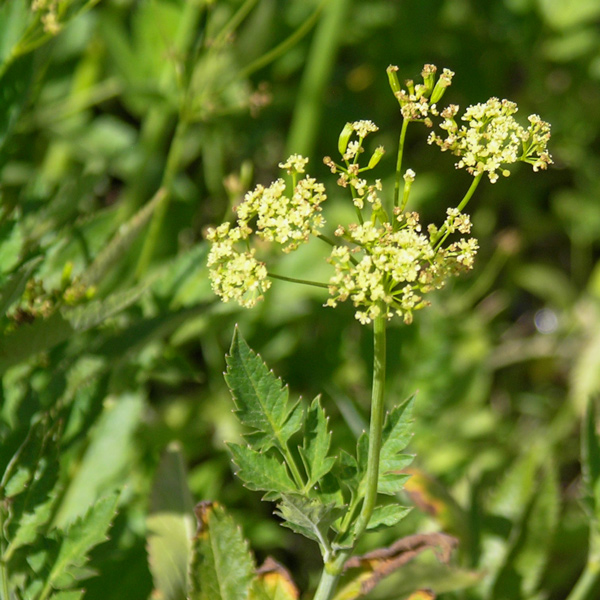
© 2025 by John W. Fisher. Used with permission.
First Mention
Lewis wasn’t likely the first journalist to comment on the plant. That honor should probably go to Sgt. Patrick Gass who often observed plants independent of Lewis. After a foggy, disorienting, and snowy night on Lost Trail Pass, the party descended towards present Ross Hole where a band of Flathead Salish warmly greeted them:
. . . proceeded down a small valley about a mile wide, with a rich black soil; in which there are a great quantity of sweet roots and herbs, such as sweet myrrh [likely sweet cicely], angelica and several other, that the natives make use of, and of the names of which I am unacquainted.[6]4 September 1805, Journals, 10:137.
It is not known if Gass shared the plant with Lewis. Doing so would have pleased Lewis, but the captains were preoccupied with endearing themselves with a new Native Nation and no mention is made from Lewis.
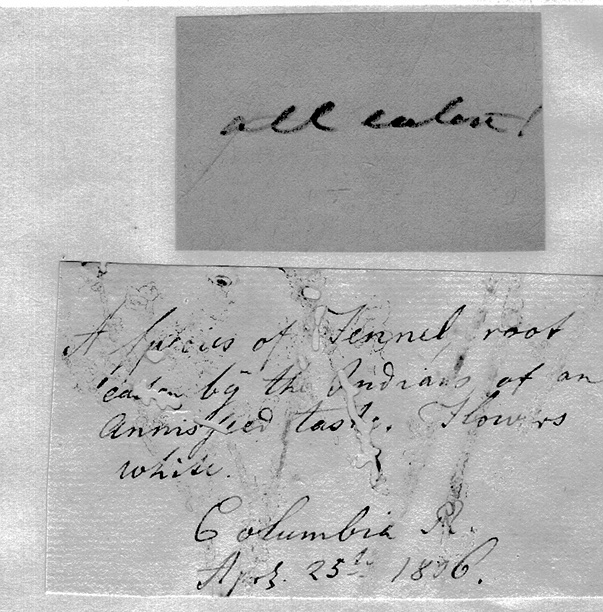
Lewis’s Mystery Specimen
On 25 April 1806 along the Columbia River near Alder Creek, Lewis prepared a specimen that today has nothing left of the plant. A label written and attached by Thomas Meehan reveals the specimen’s fate: “All eaten”. The tasty plant had been devoured by discerning insects or rodents. Influential natural historian Paul Cutright decided that the missing plant—and the plant collected by Sacagawea—was yampah (Perideridia gairdneri). This is a reasonable conjecture given that when Lewis described yampah, his botanical description identifies that plant as Yampah and in his own words, he says that “the flavor of this root is not unlike that of annisseed but not so pungent”.[7]Journals, 5:172.
Some three decades later when Moulton was assembling and annotating all the Lewis and Clark Expedition journals, he gave another possibility for both the plant collected by Sacagawea and the blank herbarium specimen—Western sweet cicely. Botanists A. Scott Earle and James L. Reveal also identify the specimen and plant collected by Sacagawea as western sweet cicely. In their analysis of the Lewis and Clark Herbarium, Reveal et al. regarded O. occidentalis “an unlikely candidate.”[8]A. Scott Earle and James L. Reveal, Lewis and Clark’s Green World: The Expedition and its Plants (Helena, Montana: Farcountry Press, 2003), 166–17; James L. Reveal, Gary E. Moulton, and … Continue reading
Frederick Pursh‘s copy of Lewis’s original note reads: “A Species of Fennel root eaten by the Indians of an Annis Seed taste. Flowers white. Columbia R. Aprl. 25th 1806.”[9]Reveal, Moulton, Schuyler, 35.
For the mystery specimen in question, yampa’s qualified anise flavor—”not so pungent”—is missing. In other words, the mystery specimen has a full-on anise flavor. Further, when comparing the ethnobotanical uses of the plant, sweet cicely matches the description of the plant gathered by Sacagawea and yampah does not. Sweet cicely was used for stomach ailments including gas. Yampah, on the other hand, had no such uses and was even given as a laxative.[10]Moerman, 386. Botanist H. Wayne Phillips goes farther to state that yampah tastes more like the domestic parsnip than anise seed.[11]H. Wayne Phillips, Plants of the Lewis and Clark Expedition (Missoula, MT: Mountain Press Publishing, 2005), 208. If we had a botanical description from Lewis or pieces of the plant attached to the specimen sheet, we would likely be able to positively identify it.
Notes
| ↑1 | John W. Fisher, email 19 June 2025. |
|---|---|
| ↑2 | Meriwether Lewis, The Definitive Journals of Lewis & Clark, Gary Moulton, ed. (Lincoln: University of Nebraska Press, 2002), 7: 264. |
| ↑3 | Journals, 7: 265. |
| ↑4 | “Anise”, drugs.com, www.drugs.com/npc/anise.html; “Anise”, Wikipedia, en.wikipedia.org/wiki/Anise; “Fennel”, Wikipedia, en.wikipedia.org/wiki/Fennel, all accessed 17 June 2025. |
| ↑5 | Daniel E. Moerman, Native American Ethnobotany (Portland, Oregon: Timber Press, 1988), 372. |
| ↑6 | 4 September 1805, Journals, 10:137. |
| ↑7 | Journals, 5:172. |
| ↑8 | A. Scott Earle and James L. Reveal, Lewis and Clark’s Green World: The Expedition and its Plants (Helena, Montana: Farcountry Press, 2003), 166–17; James L. Reveal, Gary E. Moulton, and Alfred E. Schuyler, “The Lewis and Clark Collections of Vascular Plants: Names, Types, and Comments,” Proceedings of the Academy of Natural Sciences of Philadelphia 149 (29 January 1999): 35. |
| ↑9 | Reveal, Moulton, Schuyler, 35. |
| ↑10 | Moerman, 386. |
| ↑11 | H. Wayne Phillips, Plants of the Lewis and Clark Expedition (Missoula, MT: Mountain Press Publishing, 2005), 208. |
Experience the Lewis and Clark Trail
The Lewis and Clark Trail Experience—our sister site at lewisandclark.travel—connects the world to people and places on the Lewis and Clark Trail.

Discover More
- The Lewis and Clark Expedition: Day by Day by Gary E. Moulton (University of Nebraska Press, 2018). The story in prose, 14 May 1804–23 September 1806.
- The Lewis and Clark Journals: An American Epic of Discovery (abridged) by Gary E. Moulton (University of Nebraska Press, 2003). Selected journal excerpts, 14 May 1804–23 September 1806.
- The Lewis and Clark Journals. by Gary E. Moulton (University of Nebraska Press, 1983–2001). The complete story in 13 volumes.
This site is provided as a public service by the
Lewis and Clark Trail Alliance
with additional funding from the following: