Kristopher Townsend
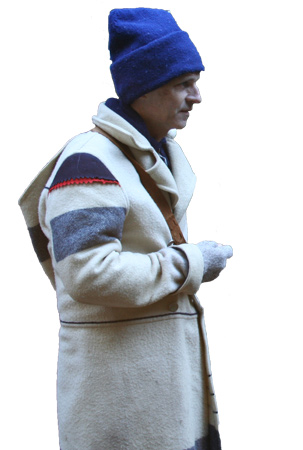
From the Pacific Northwest Living Historians at Lewis and Clark National Historic Park, Fort Clatsop.
Since 2016, Kristopher K. Townsend has been the webmaster and editor of this site, Discovering Lewis & Clark®. He has been actively photo-documenting the Lewis and Clark Trail since 1995. He attempts as closely as possible to re-create scenes as described in the journals including the same time of year, natural state, location, and weather. He has contributed numerous photos throughout the Discovering Lewis & Clark website.
Kris taught several years as a tenured instructor at Spokane Falls Community College. His courses included Internet programming and other information technology and computer science courses. During that time, he was also the series editor and an author of a popular college textbook series on Office Technology.
Shortly after the advent of the World Wide Web, he managed a web server featuring digital photos, digital video, and articles created by his Glenwood Heights Primary students. Topics included historical sites of Clark County (Washington State), wildflowers and birds of Clark County, and how-to videos for school’s physical education program.
Contributions to this Site
March 23, 1806
Homeward bound
by Kristopher K. Townsend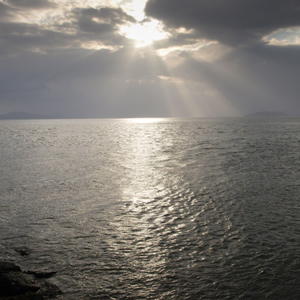
The dugouts are loaded, and they leave Fort Clatsop to begin their homeward-bound journey. Fighting high waves, they round Tongue Point and camp near the John Day River.
March 22, 1806
Giving away the fort
by Kristopher K. Townsend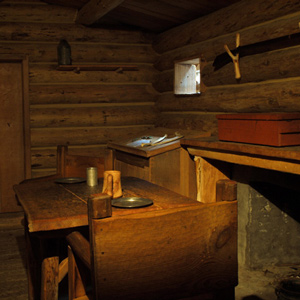
In anticipation of leaving for home tomorrow, Fort Clatsop is given to Coboway, and hunters are sent up the Columbia. Dried eulachon and a dog are purchased, and the canoes are plugged with mud.
March 21, 1806
Weather delay
by Kristopher K. Townsend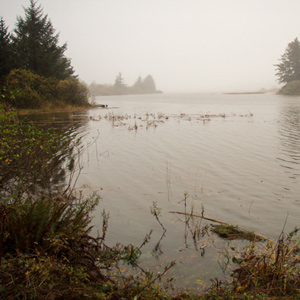
At Fort Clatsop near the Pacific Ocean, bad weather prevents the expedition from leaving for home. Provisions are low, so hunters are dispatched and eulachon purchased from some visiting Clatsops.
March 20, 1806
Fort Clatsop reflections
by Kristopher K. Townsend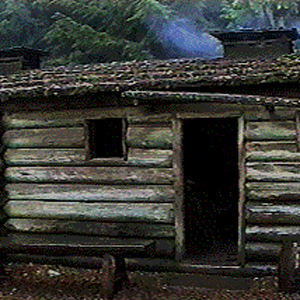
As they wait for better weather before leaving, Lewis reflects on their winter at Fort Clatsop. Pvt. Whitehouse says they killed 155 elk and deer while at the fort and Pvt. Shields repairs two guns.
March 19, 1806
Chinookan lifeways
by Kristopher K. Townsend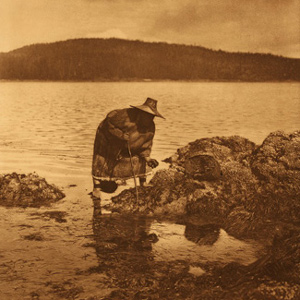
At Fort Clatsop, the captains give Coboway a certificate for his good conduct and describe Chinookan lifeways including manner of dress, decorations, and how they flatten their foreheads.
March 18, 1806
Stealing a canoe
by Kristopher K. Townsend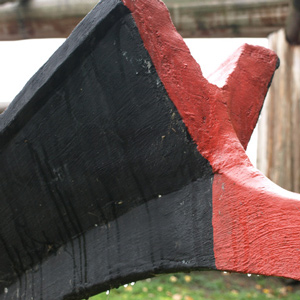
Near the Pacific Ocean, four men steal and hide a Clatsop canoe. The captains write a short description of the expedition which they distribute among the local residents.
March 17, 1806
A new canoe
by Kristopher K. Townsend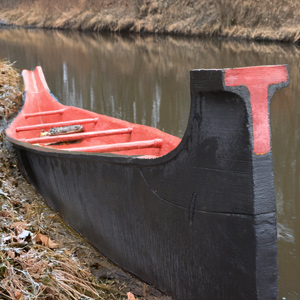
Drouillard returns to Fort Clatsop with a canoe purchased with Lewis’s uniform coat and suggests they take another in lieu of the six ‘stolen elk ‘. Lewis describes seaweed and lists ship captain names.
March 16, 1806
A "scant dependence"
by Kristopher K. Townsend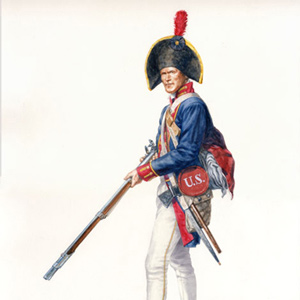
At Fort Clatsop, Lewis bemoans the expedition’s “scant dependence” for trade. A Coho salmon run begins, and the captains write letters with hopes they will be taken east by visiting ship captains.
March 15, 1806
Harvesting the hunt
by Kristopher K. Townsend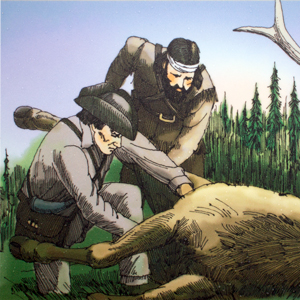
At Fort Clatsop near the Pacific Ocean, the captains continue to barter for canoes. Several enlisted men are busy hunting and gathering meat, and the “old baud” sets up her business outside the fort.
March 14, 1806
Canoe dealers
by Kristopher K. Townsend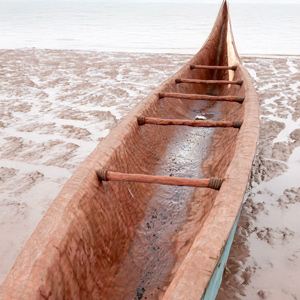
Interpreter George Drouillard and a party of Clatsops arrive with a canoe for sale, but the captains fail to make a deal. Clark reports news of trading ships to the north, and Lewis describes steelhead and cutthroat trout.
In Washington City, the Secretary of War reports on the Indian delegations visiting the city. He finds Arikara chief Too Né (Eagle Feather) an “interesting character”.
March 13, 1806
Looking for canoes
by Kristopher K. Townsend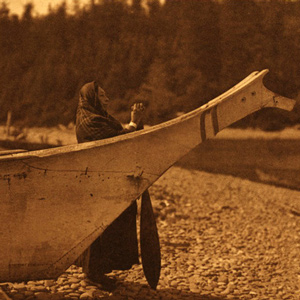
At Fort Clatsop, George Drouillard is sent out to buy two canoes from the Clatsops. Enlisted men are sent out to hunt, retrieve elk meat, or find a lost dugout canoe. Lewis discusses coastal fish species.
March 12, 1806
Homeward preparations
by Kristopher K. Townsend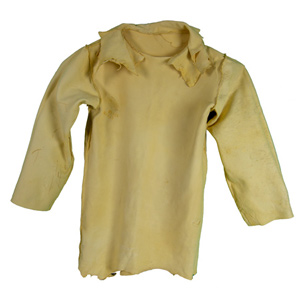
At Fort Clatsop, the dugout canoes are corked and pitched, and new clothing tallied in preparation for the trip home. Lewis describes golden eagles and how their feathers are used by Chinookan People.
March 11, 1806
Living "in clover"
by Kristopher K. Townsend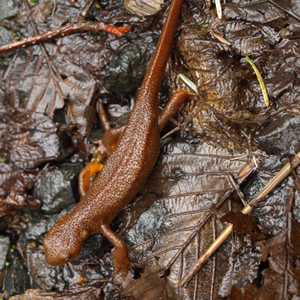
Sgt. Pryor returns to Fort Clatsop in a borrowed canoe full of fish and wapato, and Lewis says they are living in clover. Lewis describes the western fence lizard and rough-skinned newt.
March 10, 1806
42-feet in girth
by Kristopher K. Townsend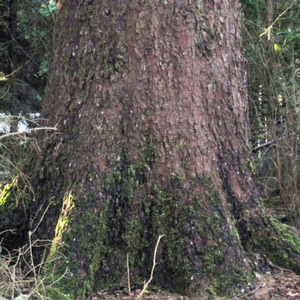
At Fort Clatsop near the Pacific Ocean, hunters tell the captains of a Sitka spruce 42 feet in girth. Several men are sent out to hunt elk, and Lewis describes ducks and grebes.
March 9, 1806
Spanish beeswax
by Kristopher K. Townsend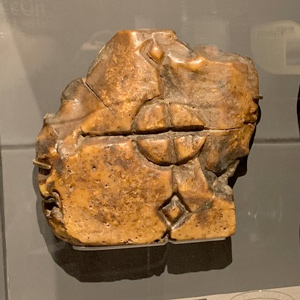
At Fort Clatsop near present Astoria, Oregon, traders bring eulachon and beeswax from a shipwrecked Spanish galleon. Lewis describes various swans encountered on the journey.
March 8, 1806
The elk return
by Kristopher K. Townsend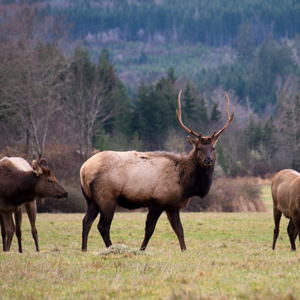
After a paucity of game at Fort Clatsop, Pvt. Collins kills three elk and reports seeing two herds. The captains report on the recovery of a few sick men, and Lewis describes the lesser snow goose.
March 7, 1806
Aquatic birds
by Kristopher K. Townsend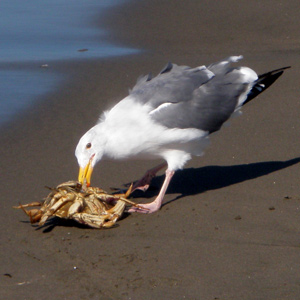
At Fort Clatsop near the Pacific Ocean, Lewis describes aquatic birds: four seagulls, black cormorant, Arctic loon, and western grebe. Pvt. Bratton’s back pain worsens, and the hunters take one elk.
March 6, 1806
Coboway and sons
by Kristopher K. Townsend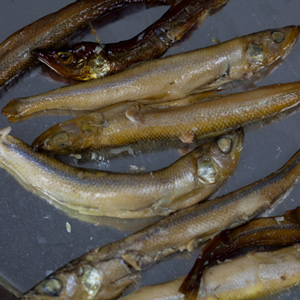
Coboway and two sons bring cooked eulachon to Fort Clatsop which the captains find excellent. Detachments are sent out to hunt and fish, several men are sick, and Lewis lists aquatic birds of the area.
March 5, 1806
Youngs River Falls
by Kristopher K. Townsend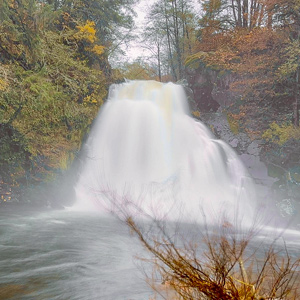
At Fort Clatsop, hunters find a large waterfall—today’s Youngs River Falls, and Clatsop traders bring some fish. Hunters report that the elk have vacated the area, and the captains come up with a plan to leave Fort Clatsop early should they run out of provisions.
In Washington City, President Jefferson invites the Attorney General to visit Arikara chief Too Né (Eagle Feather) who possesses the art of Plains Sign Language.
March 4, 1806
Sumptuous living
by Kristopher K. Townsend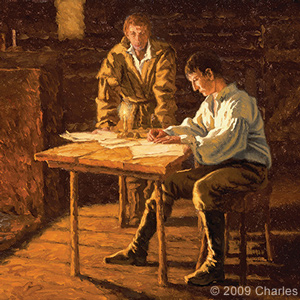
At Fort Clatsop near Astoria, Oregon, the captains “live sumptuously” on eulachon and sturgeon. Continuing his March treatise on birds, Lewis focuses on western meadowlarks and jays.
March 3, 1806
Lewis's three "pheasants"
by Kristopher K. Townsend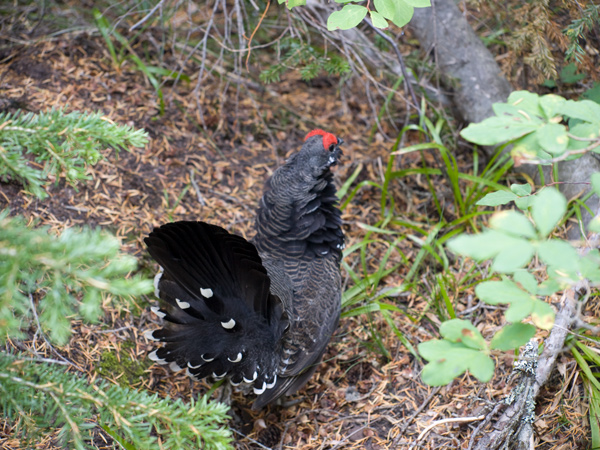
A routine has settled in at Fort Clatsop near the Pacific Ocean, and they are counting the days when they can return home. Lewis describes three species of ‘pheasants’ known today as grouse.
March 2, 1806
Welcome change in diet
by Kristopher K. Townsend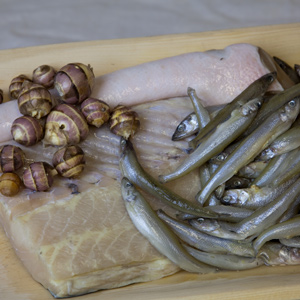
At Fort Clatsop near the mouth of the Columbia, Drouillard arrives with eulachon, sturgeon, and wapato—a welcome change from their poor diet of lean and rotting elk. Lewis describes the sage grouse.
March 1, 1806
Describing birds
by Kristopher K. Townsend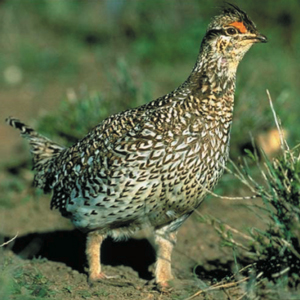
At Fort Clatsop, Lewis begins his treatise on bird species starting with the Columbian sharp-tailed grouse—a species new to science. He also writes about Chinookan slavery and their use of cattail roots.
February 28, 1806
Clatsop traders
by Kristopher K. Townsend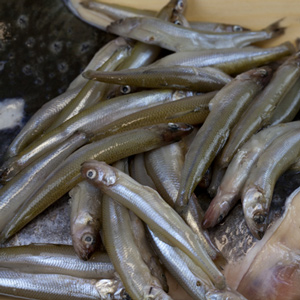
Clatsop traders come to the fort to sell food and a slave boy. Every offer is declined except for some sturgeon. The hunters find elk nearly ten miles out, and Lewis discusses the white-tailed jackrabbit.
February 27, 1806
Bushy-tailed woodrat
by Kristopher K. Townsend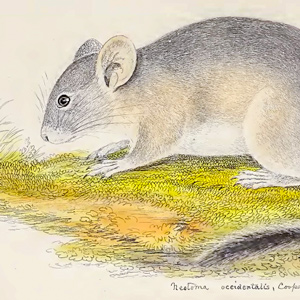
Pvt. Reubin Field returns to Fort Clatsop to report that the elk in at have left the Point Adams area. Lewis describes the bushy-tailed woodrat, new to science. A handful of enlisted men remain ill.
February 26, 1806
The mountain beaver
by Kristopher K. Townsend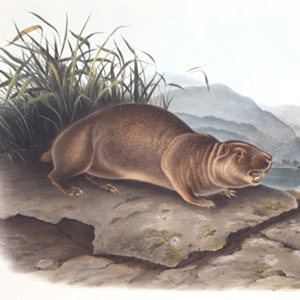
At Fort Clatsop near the Pacific Ocean, Lewis describes the elusive mountain beaver. With food running out, hunters and traders are sent out to raise everyone’s “prospect for good living.”
February 25, 1806
Western gray squirrel
by Kristopher K. Townsend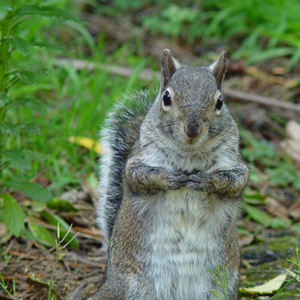
At Fort Clatsop near Astoria, Oregon, there is little movement today other than violent winds and rain. Lewis describes Richardson’s ground squirrels and western gray squirrels—the latter new to science.
In Washington City, Arikara chief Too Né (Eagle Feather) draws a map and shows where Lewis and Clark were camped las winter.
February 24, 1806
Fresh eulachon
by Kristopher K. Townsend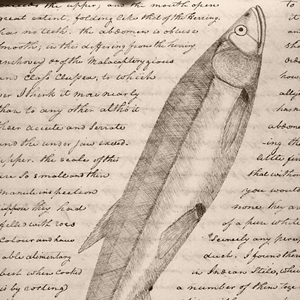
At Fort Clatsop near the Pacific Ocean, Clatsop traders arrive with fresh eulachon enabling Lewis to draw, describe, and taste this small fish. Hunters report that the elk have vacated the neighborhood.
February 23, 1806
Sea otters and seals
by Kristopher K. Townsend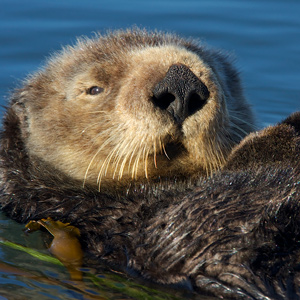
At Fort Clatsop near present Astoria, Oregon, several enlisted men are sick, and Sgt. Ordway writes that he may have influenza. Lewis describes sea otters and seals.
February 22, 1806
New rain hats
by Kristopher K. Townsend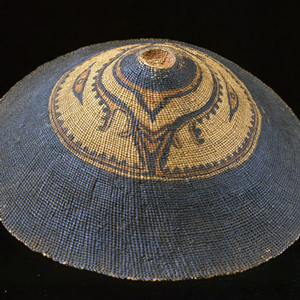
Two Clatsop women deliver woven hats previously ordered by the captains, and they distribute them among the enlisted men. The eulachon run begins, and Lewis describes pronghorns and bighorn sheep.
February 21, 1806
Salt makers' return
by Kristopher K. Townsend
All the salt makers return to Fort Clatsop with Sgt. Ordway’s detachment. Lewis gives Pvts. Willard and Bratton a dose of Scot’s Pills and describes the Oregon bobcat and fisher.
February 20, 1806
Cranberries for the sick
by Kristopher K. Townsend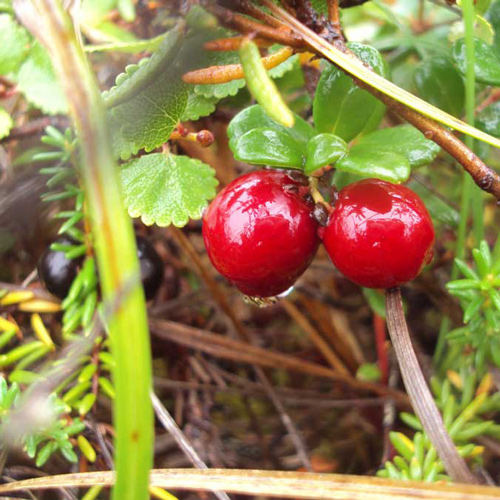
Pvt. Collins brings cranberries for the sick, and an important Chinook chief visits Fort Clatsop. Sgt. Ordway’s detachment travels to the salt makers’ camp, and Lewis describes wolves and coyotes.
February 19, 1806
Columbian black-tailed deer
by Kristopher K. Townsend
Sgt. Ordway faces freezing rain and blowing sand as his party hikes towards the salt makers’ camp at present Seaside, Oregon. At Fort Clatsop, Lewis describes the Columbian black-tailed deer.
February 18, 1806
Woven hats and bobcat robes
by Kristopher K. Townsend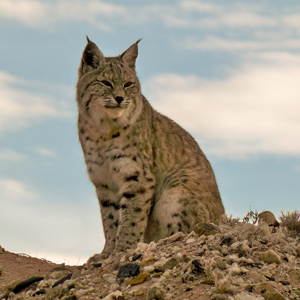
At Fort Clatsop, Chinookan traders arrive with woven hats and furs to sell. Pvt. Whitehouse shows Clark his bobcat robe, and Sgt. Ordway’s attempt to reach the salt makers’ camp fails due to high waves.
February 17, 1806
The California condor
by Kristopher K. Townsend
At Fort Clatsop, Pvt. Shannon brings in a California condor and golden eagle. Pvt. Joseph Field returns from the salt makers’ camp and the captains decide to close the works.
February 16, 1806
Indian dogs
by Kristopher K. Townsend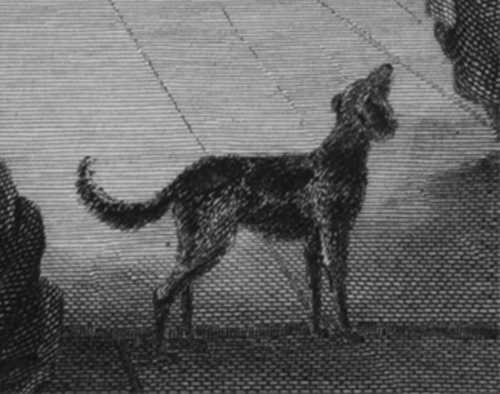
At Fort Clatsop near the Pacific, Pvt. Bratton is given Peruvian bark and Pvt. Gibson is given a dose of Rush’s ‘Thunderbolts’. Lewis compares grizzly and black bears, and he describes Indian dogs.
February 15, 1806
Indian horses
by Kristopher K. Townsend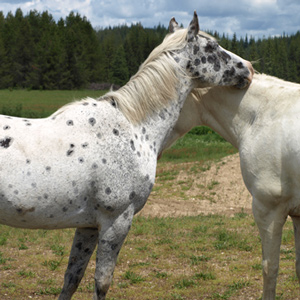
At Fort Clatsop, the captains describe Indian horses and list the other four-footed mammals they have encountered. Pvt. Gibson is carried from the salt makers’ camp, and his medical treatment begins.
February 14, 1806
Mapping unknown lands
by Kristopher K. Townsend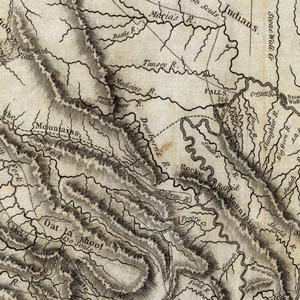
The captains worry about the men at the Salt Works in present Seaside, Oregon, and Clark finishes a map of their route. On it, he includes “the most practicable and navigable passage” over the Rockies.
February 13, 1806
Local ferns and grasses
by Kristopher K. Townsend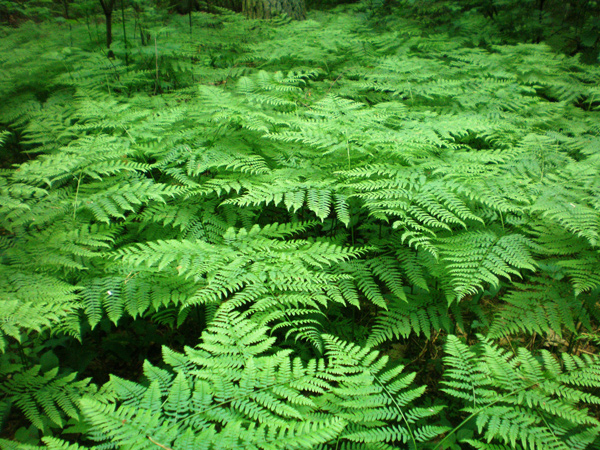
At Fort Clatsop near the Pacific Ocean, visiting Indians inform the captains that a Captain “More” had visited in a vessel with three cows. Lewis describes local ferns and grasses.
February 12, 1806
Two Oregon grapes
by Kristopher K. Townsend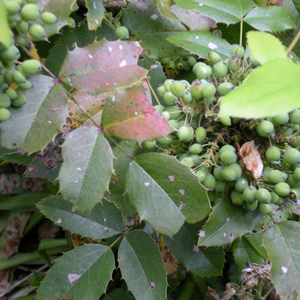
At Fort Clatsop near present Astoria, Oregon, Lewis describes two species of Oregon grape, and three Clatsop dogs are brought as payment for missing elk meat. In Washington City and Madrid, suspicions grow.
February 11, 1806
New salt makers
by Kristopher K. Townsend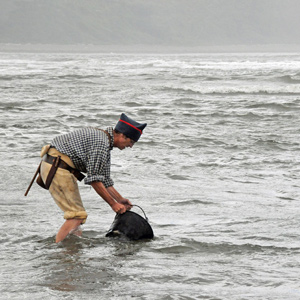
Two new men are sent from Fort Clatsop to the salt works at present Seaside, Oregon. In Washington City, President Jefferson lists the zoological and mineral specimens sent from Fort Mandan last year.
February 10, 1806
Two maples
by Kristopher K. Townsend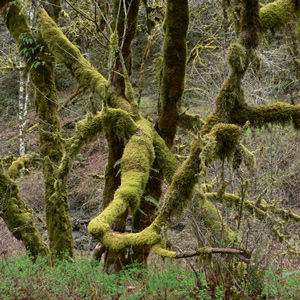
At Fort Clatsop, Pvts. Willard and Colter return from the salt works. Willard has cut his knee with his tomahawk while butchering elk, and Lewis describes two maples common to the area.
February 9, 1806
Small fir No. 5
by Kristopher K. Townsend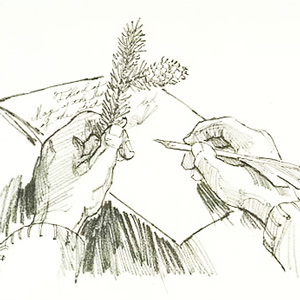
At Fort Clatsop, Lewis describes a small Douglas-fir and the red alder. The enlisted men make elk jerky and leather, and they sew new clothes. Drouillard sees a black bear out of hibernation.
February 8, 1806
Bringing in the elk
by Kristopher K. Townsend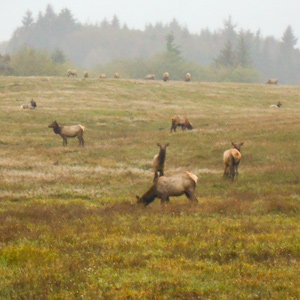
All three sergeants are dispatched to bring into Fort Clatsop the various elk killed on previous days. By day’s end, they all complete their missions. Lewis describes the salal plant.
February 7, 1806
Ravages of smallpox
by Kristopher K. Townsend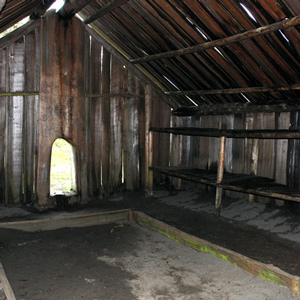
After a dinner of elk marrow bones and brisket, Lewis sarcastically says they are living in high style at Fort Clatsop. He describes the ravages of smallpox among the Clatsop and a local species of huckleberry.
February 6, 1806
Stolen elk
by Kristopher K. Townsend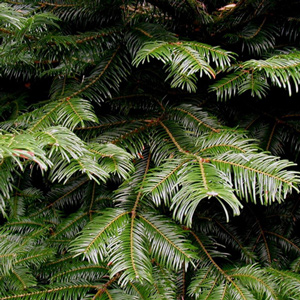
At Fort Clatsop, Sgt. Pryor reports that some Clatsops have taken four elk killed by the hunters. Lewis finishes his treatise on local conifers including grand fir, Douglas-fir, and western white pine.
February 5, 1806
Oregon ruffed grouse
by Kristopher K. Townsend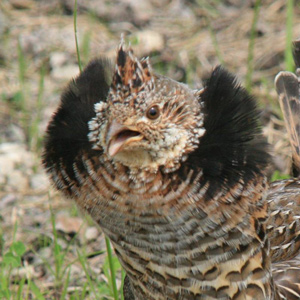
On their way to retrieve elk meat, the Chinookan canoe—lost since 11 January 1806—is found. Lewis describes the Oregon ruffed grouse and continues his treatise on local firs with the western hemlock.
February 4, 1806
Lewis's five firs
by Kristopher K. Townsend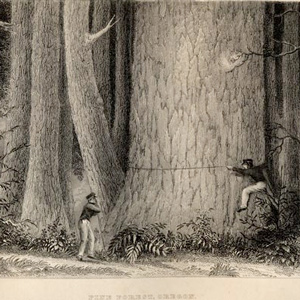
At Fort Clatsop near present Astoria, Oregon, Lewis begins his treatise on local fir trees starting with the Sitka spruce. He also notes the better health of elk taken from prairies rather than forests.
February 3, 1806
Seven elk in peril
by Kristopher K. Townsend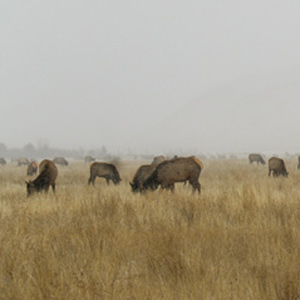
Hunters leave some elk near a Clatsop village, and Lewis worries they are in peril of being stolen. Four men arrive from the salt works with two bushels of salt and some whale blubber.
February 2, 1806
Another month passes
by Kristopher K. Townsend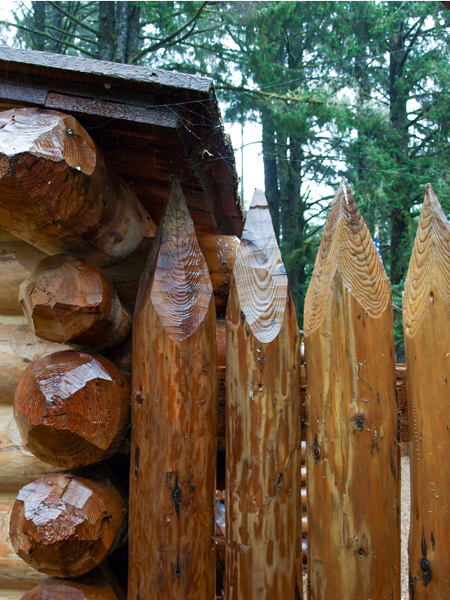
At Fort Clatsop near the Pacific Ocean, nothing worthy of notice occurs, but the captains say they are glad another month has passed. Lewis describes two Chinookan games.
Experience the Lewis and Clark Trail
The Lewis and Clark Trail Experience—our sister site at lewisandclark.travel—connects the world to people and places on the Lewis and Clark Trail.
Discover More
- The Lewis and Clark Expedition: Day by Day by Gary E. Moulton (University of Nebraska Press, 2018). The story in prose, 14 May 1804–23 September 1806.
- The Lewis and Clark Journals: An American Epic of Discovery (abridged) by Gary E. Moulton (University of Nebraska Press, 2003). Selected journal excerpts, 14 May 1804–23 September 1806.
- The Lewis and Clark Journals. by Gary E. Moulton (University of Nebraska Press, 1983–2001). The complete story in 13 volumes.
This site is provided as a public service by the
Lewis and Clark Trail Alliance
with additional funding from the following: