Kristopher Townsend
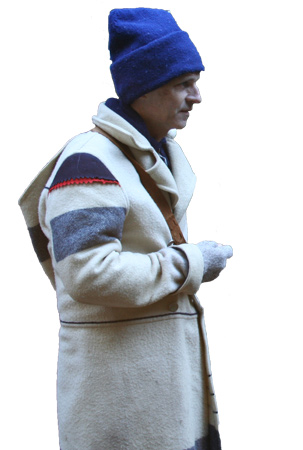
From the Pacific Northwest Living Historians at Lewis and Clark National Historic Park, Fort Clatsop.
Since 2016, Kristopher K. Townsend has been the webmaster and editor of this site, Discovering Lewis & Clark®. He has been actively photo-documenting the Lewis and Clark Trail since 1995. He attempts as closely as possible to re-create scenes as described in the journals including the same time of year, natural state, location, and weather. He has contributed numerous photos throughout the Discovering Lewis & Clark website.
Kris taught several years as a tenured instructor at Spokane Falls Community College. His courses included Internet programming and other information technology and computer science courses. During that time, he was also the series editor and an author of a popular college textbook series on Office Technology.
Shortly after the advent of the World Wide Web, he managed a web server featuring digital photos, digital video, and articles created by his Glenwood Heights Primary students. Topics included historical sites of Clark County (Washington State), wildflowers and birds of Clark County, and how-to videos for school’s physical education program.
Contributions to this Site
May 12, 1806
Swallowing objections
by Kristopher K. Townsend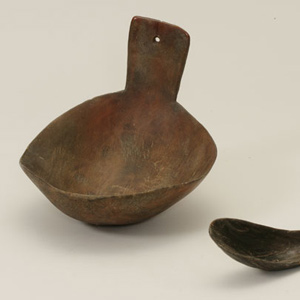
At Lawyer Creek near Kamiah, Idaho, the Nez Perce chiefs share what they heard at yesterday’s council and the People are told to swallow their objections with their mush. The captains then give a gun and ammunition to Walammottinin, Twisted Hair, as payment for watching their horses the previous winter. They also form a plan for crossing the Bitterroot Mountains.
May 11, 1806
Council at Lawyer Creek
by Kristopher K. Townsend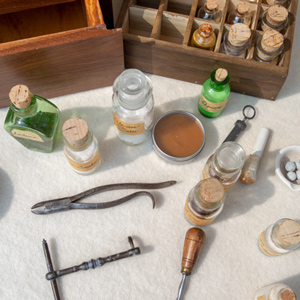
Four major Nez Perce chiefs assemble at Lawyer Creek near Kamiah, Idaho and are added to the ongoing council. Progress is slow as the translated words must move between five different languages. The captains demonstrate the air gun and magnets and give medical aid to several applicants.
May 10, 1806
Broken Arm's welcome
by Kristopher K. Townsend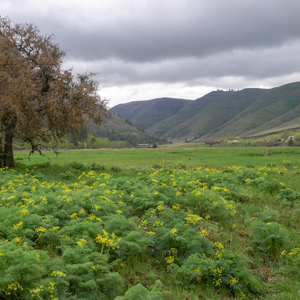
After waking to six or more inches of snow, the enlisted men gather the horses, and everyone travels about 16 miles across the Camas Prairie. They descend to Lawyer Creek near present Kamiah, Idaho where Tunnachemootoolt, Broken Arm, welcomes them, and a council begins.
May 9, 1806
Horses and saddles found
by Kristopher K. Townsend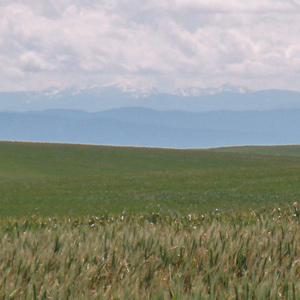
The expedition moves about six miles to Walammottinin’s [Twisted Hair’s] small camp near present Nezperce, Idaho. The horses and saddles that the captains left with the Nez Perce last fall are found, and then, it begins to snow.
In Washington City, arrangements are made to send a sick Osage delegate home.
May 8, 1806
An argument about horses
by Kristopher K. Townsend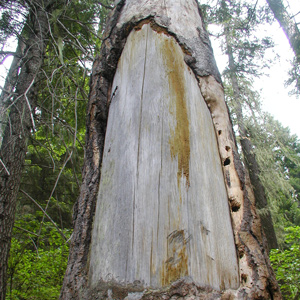
After describing northern shovelers and the Nez Perce methods of feeding on ponderosa pine, the expedition climbs to the Camas plains high above present Idaho’s Clearwater River. Walammottinin, Twisted Hair, and Neesh-ne-park-ke-ook, Cutnose, argue about the expedition’s horses left in their care the previous winter, and Lewis adds the glacier lily to his plant collection.
May 7, 1806
Mosquito Creek
by Kristopher K. Townsend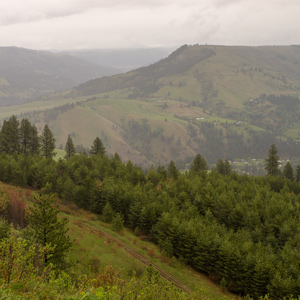
Following their Nez Perce guides, the expedition crosses to the southern side of the Clearwater River and then climbs present Angel Ridge where they can see the “spurs” of the Rocky Mountains still covered in snow. They camp at “Musquetoe” Creek, present Big Canyon. A Nez Perce man brings two lost lead canisters, and Lewis collects a specimen of serviceberry.
May 6, 1806
Colter's Creek
by Kristopher K. Townsend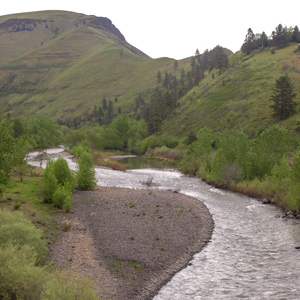
The expedition spends most of the day at Colter’s Creek—present Potlatch River. Lewis meets three Coeur d’Alene Indians, and Clark gives medical aid as payments of food. Lewis collects a nine-leaved biscuit-root specimen—an indigenous vegetable. They eventually move to another Nez Perce village a few miles up the Clearwater River.
May 5, 1806
Clark's eye water magic
by Kristopher K. Townsend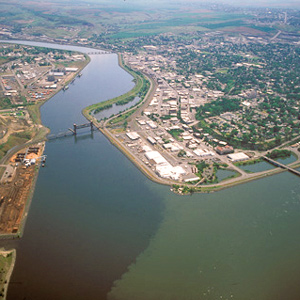
The Corps travels up the Clearwater River where they meet various Nez Perce families. They discover that Clark’s eye water can be traded for food and horses. As a joke, a Nez Perce man tosses a puppy at Lewis to eat, but he fails to see the humor. At the day’s camp at Colters Creek—present Potlatch River—they hold a council of sorts with the help of a Shoshone interpreter.
May 4, 1806
Reaching the Snake
by Kristopher K. Townsend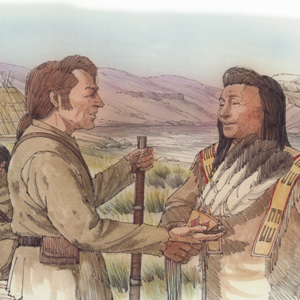
After a frosty morning, the Corps descends present Alpowa Creek to reach the Snake River. Their 1805 guide Te-toh-kan Ahs-kahp, or Tetoharsky, shows them where to cross the river. They continue to a campsite near present Clarkston, Washington where many curious Nez Perce villagers crowd around them. Lewis describes their menstrual lodges.
May 3, 1806
The Tucannon crossing
by Kristopher K. Townsend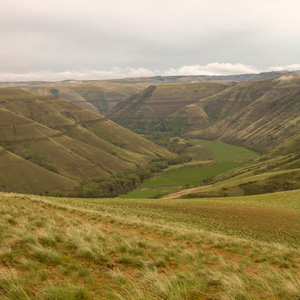
In southeastern Washington, the expedition follows the Travois Road climbing from present Patit Creek to the high plains. They then descend into the Tucannon Canyon and climb to the plains on the other side. The trail takes them to the fertile Pataha Creek valley where they are met by a familiar Nez Perce chief, We-ah-koomt.
May 2, 1806
Along the Touchet
by Kristopher K. Townsend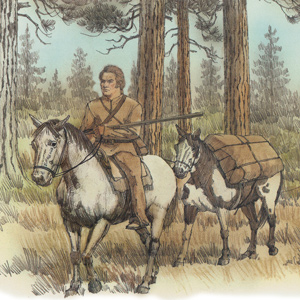
The day begins with considerable time and effort collecting horses. An Indian brings in a stray and is given a tomahawk, knife, and pants. The expedition then continues along the north hills of the Touchet River. Near present Dayton, Washington, they turn up Patit Creek and encamp where the trail leaves the valley.
May 1, 1806
Along the Travois Road
by Kristopher K. Townsend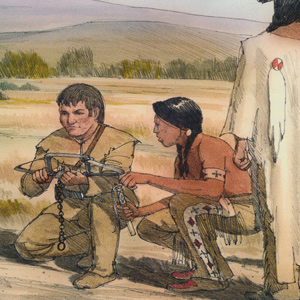
While traveling along the Travois Road in southeastern Washington, the corps’ guides and companions argue about which trail to take. Three honest Walla Walla men return a forgotten beaver trap, and after 26 miles, they camp on the Touchet River near present Waitsburg.
April 30, 1806
Crossing the sandy plain
by Kristopher K. Townsend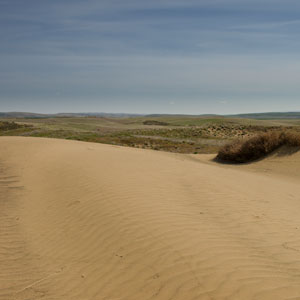
After spending considerable time collecting horses, the expedition sets out on the Travois Road passing through plains abundant with sagebrush and sand dunes. They camp on the Touchet River north of present Walla Walla. Lewis describes eating dog, river otter, and horse among Walla Walla People.
April 29, 1806
Crossing the Columbia
by Kristopher K. Townsend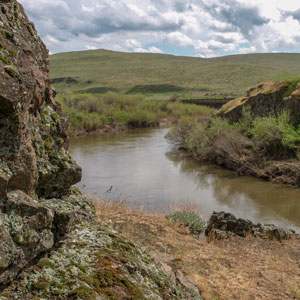
Using Chief Yelleppit’s canoes, the men ferry baggage and people across the Columbia River. Lewis gives one of his pistols and two small Indian peace medals in exchange for two horses, and Clark treats several local People for sore eyes. Lewis prepares a specimen of cous, a staple Native vegetable, and they camp a short distance up the Walla Walla River.
April 28, 1806
Yelleppit brings a horse
by Kristopher K. Townsend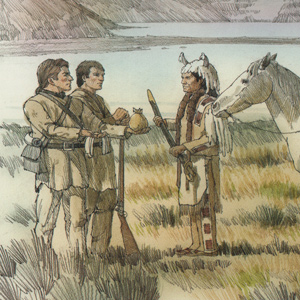
A Shoshone prisoner is found at Yelleppit’s village across from the mouth of the Walla Walla and talks begin with Sacagawea, Charbonneau, and one of the French men acting as interpreters. Yelleppit brings Clark a horse, Clark gives medical aid, and Pvt. Frazer buys ten fat dogs for consumption. The day ends with singing and dancing.
April 27, 1806
Yelleppit's village
by Kristopher K. Townsend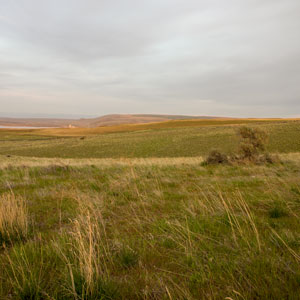
Moving up the Columbia River, the expedition passes the Umatilla River and then climbs to the high plain above Wallula Gap. Late in the day, they are met by Chief Yelleppit who escorts them to his village opposite the mouth of the Walla Walla. There, the captains learn of a good road to take them back to the Nez Perce.
April 26, 1806
A crowded, dusty trail
by Kristopher K. Townsend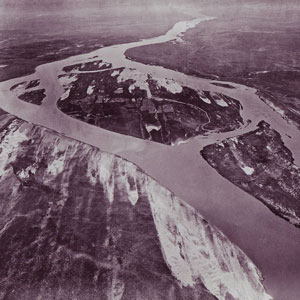
The Corps of Northwestern Discovery continues along the north shore of the Columbia River reaching the low plains near present Plymouth, Washington. The trail is dusty and crowded with people on the move. At evening camp, a young boy catches several Columbia River chub, a species new to science.
April 25, 1806
Horse heaven
by Kristopher K. Townsend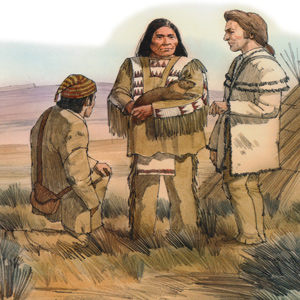
During a march of twenty miles, the travelers stop at a large village of Pish-quit-pahs—Yakamas or Umatillas—where none of the residents have seen white men before. Lewis remarks on the abundant bunch grass of the Horse Heaven Hills, Columbia River basalt, and the Northern Shoveler, new to science.
April 24, 1806
The dry plains commence
by Kristopher K. Townsend
After threatening to cut up the last two dugout canoes for firewood, Lewis trades them for a few strands of beads. For the first time since arriving at the Clearwater River, the entire group travels by land. They leave the last hills of the Columbia River Gorge and Lewis notes the dryness of the plains. Those without horses complain of sore feet and legs.
April 23, 1806
Friendly Tenino village
by Kristopher K. Townsend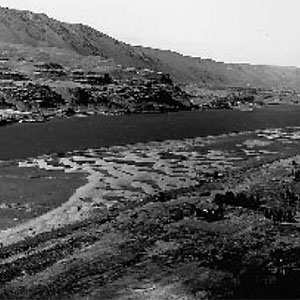
To continue up the Columbia without enough horses, the travelers must walk over large sand dunes. They meet a Nez Perce family with several horses who offer to help pack some of their cargo. At present Rock Creek, they reach a friendly Tenino village of Wah-how-pum. The day ends with smoking and dancing.
April 22, 1806
Clark's mountain view
by Kristopher K. Townsend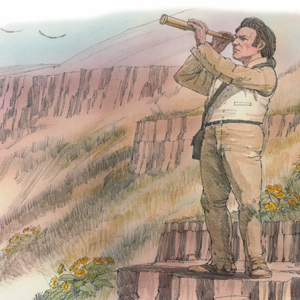
Charbonneau‘s horse suffers an accident causing several items to fall off. The scattered booty is quickly hidden by watchful Wishram Indians. While Lewis retrieves the lost items, Clark climbs a hill to view the landscape. They continue by foot, horse, and dugout canoe reaching a spring near present John Day dam.
April 21, 1806
Several severe blows
by Kristopher K. Townsend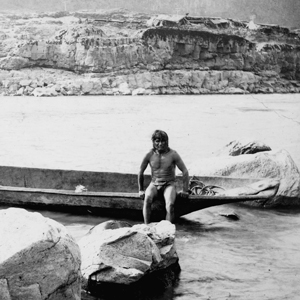
When several items are stolen from his camp above the Long Narrows of the Columbia, Lewis gives an Indian “several severe blows” and then threatens to kill and burn the entire village. He then moves up the river to join with Clark. After portaging the two remaining canoes around the last of the Celilo Falls, the boats are sent up the Columbia River. The rest of the group travels by land with a Nez Perce guide hoping to find better prices for the horses they need.
April 20, 1806
Six stolen tomahawks
by Kristopher K. Townsend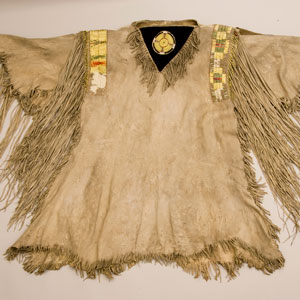
Working at Celilo Falls, the captains have difficulty buying horses and even lose one. Lewis describes Wishram and Tenino clothing, but after six tomahawks are stolen, he orders all Indians away from his camp.
Further up the river, Clark endures a cold night after a day of fruitless trading at a Tenino village.
April 19, 1806
First Salmon Ceremony
by Kristopher K. Townsend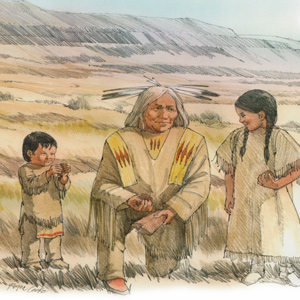
All hands spend the day portaging the Long Narrows of the Columbia River. The last big kettles are traded for horses, and the Indians celebrate the start of the spring salmon run. In the evening, Clark and a few others move up to a Tenino village to trade for horses.
April 18, 1806
Tenino horse deal
by Kristopher K. Townsend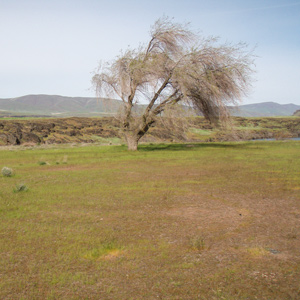
At a Wishram village on the north side of the Columbia, Clark meets a Nez Perce man who would become their guide. He doctors a Tenino chief and his wife, and he is able to buy a horse from them.
At Fort Rock on the south side of the Columbia, Lewis has the two large dugouts cut up for fuel, crosses the river, and sets up camp at the Long Narrows below Celilo Falls.
April 17, 1806
Struggles with horses
by Kristopher K. Townsend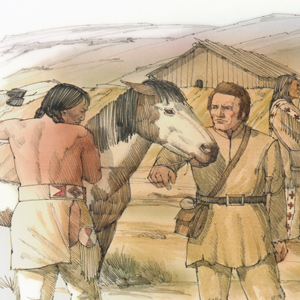
At the Wishram villages on the north side of Celilo Falls, Clark and Charbonneau struggle to buy horses. Across the river at Fort Rock, Lewis remarks on the rich verdure of the country and prepares several plant specimens including the bicolored cluster lily (Brodiaea howellii).
April 16, 1806
"Great Mart of all this Country"
by Kristopher K. Townsend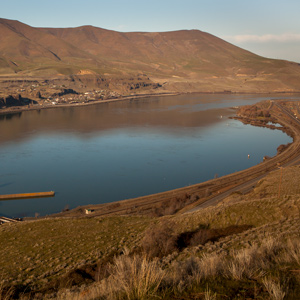
Clark’s group crosses the Columbia River to trade for horses at a Wishram village. He calls The Dalles of the Columbia the “Great Mart of all this Country”. At Fort Rock, the enlisted men make pack saddles, Lewis collects shooting star and golden currant specimens, and in the evening, Pvt. Cruzatte plays the fiddle.
April 15, 1806
Return to Fort Rock
by Kristopher K. Townsend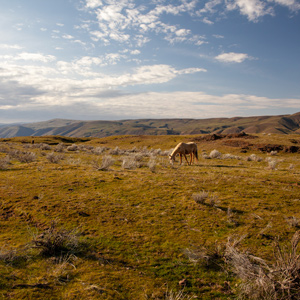
While paddling up the Columbia, the captains see many horses but are unsuccessful in trading for any. They set up a long-term encampment at Fort Rock int present The Dalles, Oregon hoping to obtain horses. Lewis prepares four plant specimens: Serviceberry, Bare-stemmed desert-parsley, biscuitroot, and thimbleberry.
April 14, 1806
Romantic scenes
by Kristopher K. Townsend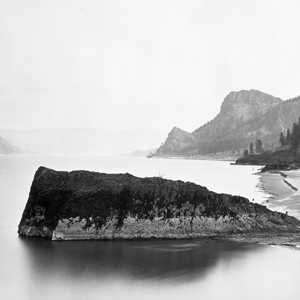
Below present Lyle, Washington, the canoeists paddle a relatively calm stretch of the Columbia River. Lewis enjoys romantic scenes and a drier climatic zone; and he prepares four plant specimens. The captains are encouraged when they see horses among the local residents.
April 13, 1806
New dugouts and dogs
by Kristopher K. Townsend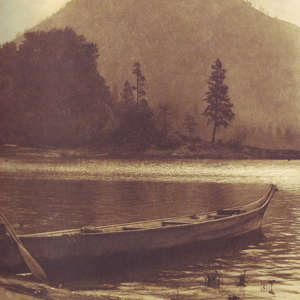
With only four dangerously overloaded canoes, the expedition continues paddling up the Columbia. Lewis buys two new dugouts from some Watlalas and rejoins Clark‘s group on the north shore near present Dog Mountain east of Stevenson, Washington. Lewis tells of his preference of dog meat over venison, elk, and horse.
April 12, 1806
A lost canoe
by Kristopher K. Townsend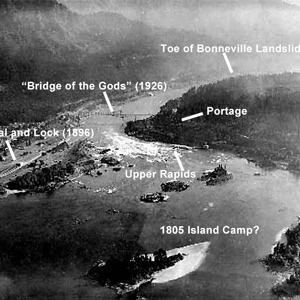
While towing the last and largest dugout canoe up the Cascades of the Columbia, a rope breaks and the boat is lost. To prevent thievery, the men arm themselves as they carry the baggage over the portage. Lewis enjoys a visit from some Watlalas who condemn their relatives who have been stealing expedition equipment.
April 11, 1806
Lining the big chute
by Kristopher K. Townsend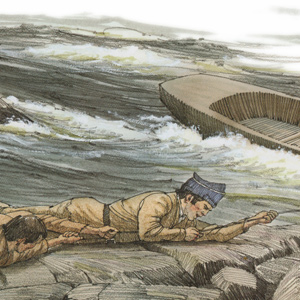
On this wet spring day at the Cascades of the Columbia, the men tow four dugout canoes through the “big Shoote.” Hostilities ensue when a few local Natives start stealing things. Even Lewis’s dog Seaman is stolen.
In Washington City, President Jefferson writes a letter to the Arikaras explaining Chief Too Né‘s death there.
April 10, 1806
To the Cascades of the Columbia
by Kristopher K. Townsend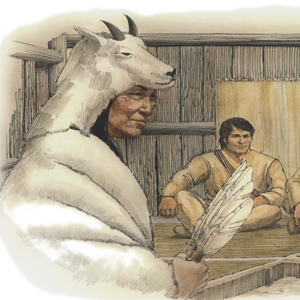
The men tow and ferry the dugout canoes to reach the portage around the Cascades of the Columbia. Before ferrying, Lewis collects a checker lily specimen on “Brant Island”. A canoe breaks loose, loses all its cargo, and is returned by local villagers.
In Washington City, President Thomas Jefferson seeks the name of the Arikara chief who recently died.
April 9, 1806
Beautiful waterfalls
by Kristopher K. Townsend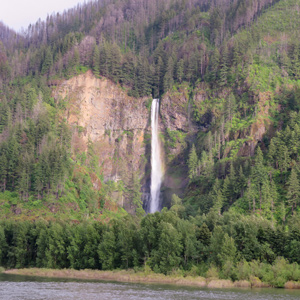
The expedition’s flotilla moves sixteen miles up the Columbia River Gorge marveling at its many beautiful waterfalls. In one of the villages, Pvt. Colter confiscates a tomahawk stolen the previous year.
In Washington City, the Secretary of War deals with the death of Arikara Chief Too Né who went there at the request of the captains.
April 8, 1806
High winds, poor hunting
by Kristopher K. Townsend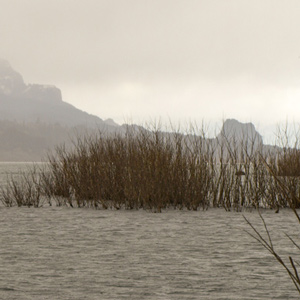
At present Shepperds Dell, Oregon, the dugout canoes are hastily unloaded before wind-driven waves fill them with water. On an evening walk, Lewis corrects an error he had made regarding salmonberry bushes. Late in the night, a thief is caught sneaking into camp.
April 7, 1806
Regulating the firearms
by Kristopher K. Townsend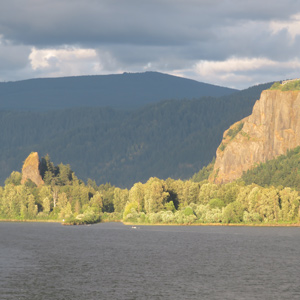
The expedition spends the day hunting and jerking meat at present Shepperds Dell at the lower end of the Columbia River Gorge. The enlisted men are ordered to practice shooting and to adjust their gun sights. Lewis describes the mountain quail, new to science. After the meat was dried and packed, Drouillard returns with some Watlalas in tow.
April 6, 1806
Into the Columbia River Gorge
by Kristopher K. Townsend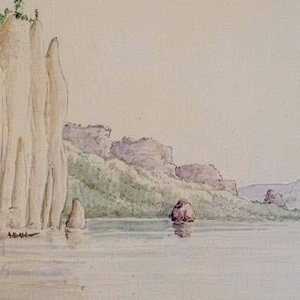
The expedition members pack up the last of the dried meat and paddle into the Columbia River Gorge. Lewis notes the height of the spring flood, a ‘remarkable’ Beacon Rock, and the blindness common with local People. Camp for the next few days is at Shepperds Dell in present Oregon.
April 5, 1806
Last day at Provision Camp
by Kristopher K. Townsend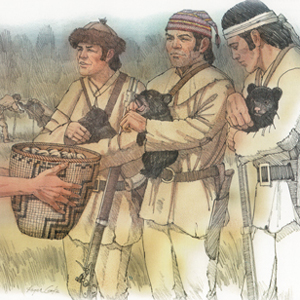
At Provision Camp near present Washougal, Washington, Nathaniel Pryor brings in the last of the elk jerky. Lewis says it is too wet and must be jerked again. Three “pett” bear cubs are brought to camp and traded for wapato.
In Philadelphia, Charles Willson Peale reports on the pronghorn specimens that recently arrived from Fort Mandan.
April 4, 1806
Hunting parties
by Kristopher K. Townsend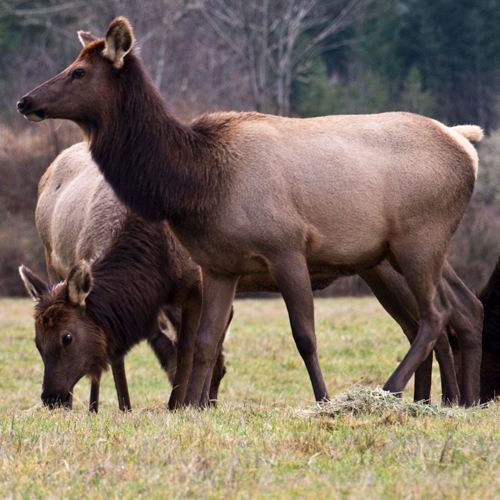
At Provision Camp near present Washougal, Washington, the captains coordinate various hunting parties. One group is sent up the Columbia River to hunt in advance of the main group. Many “parties of the natives” visit, and Lewis takes astronomical observations.
April 3, 1806
Mapping the Willamette River
by Kristopher K. Townsend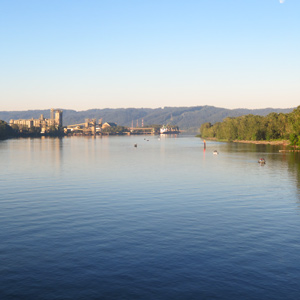
Clark concludes his exploration of the Willamette River. On his way back, he learns that a smallpox epidemic had devastated the local population. The group at Provision Camp at present Washougal, Washington are greatly outnumbered by starving Native People, and Lewis demonstrates the air gun as a defensive measure.
April 2, 1806
Exploring the Willamette River
by Kristopher K. Townsend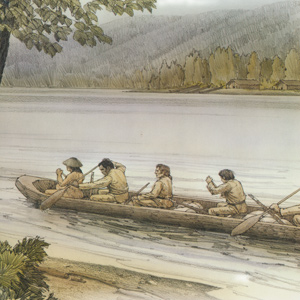
Clackamas visitors tell the captains about the Willamette River, and Clark sets out to find it. At a village at the that rivers’ mouth, Clark resorts to trickery to entice them to trade for food. At Provision Camp at present Washougal, Washington, Lewis says the berries are all gone except for the Oregon grape.
April 1, 1806
Exploring the 'Quicksand' River
by Kristopher K. Townsend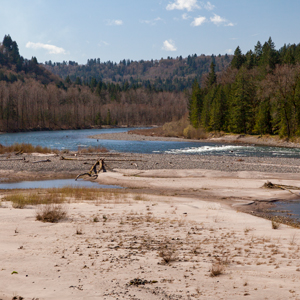
At Provision Camp, the expedition readies the hunt and makes new elk hide rope. Pryor’s detachment explores the Quicksand River—the present Sandy River in Oregon. Visiting Indians of various Nations warn there is no food upriver, and that the salmon will not come for another month. Lewis buys a Chinookan canoe for 6 fathoms of wampum beads.
March 31, 1806
Provision Camp
by Kristopher K. Townsend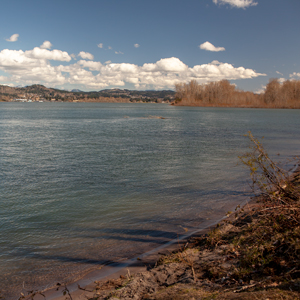
A multi-day basecamp is established to find the rumored “Waters of California” and to gather provisions. They learn that the missing river could be the as yet seen Willamette River.
March 30, 1806
Prospects for a settlement
by Kristopher K. Townsend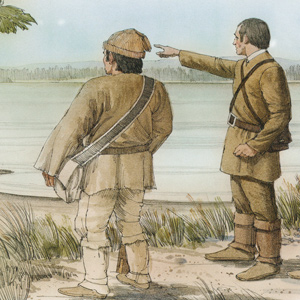
As they paddle through an area dense with Multnomah and Watlala villages, they see Cascade Mountain snow peaks, fertile land, and the best prospect for a large settlement west of the Rocky Mountains.
March 29, 1806
Nahpooitle Village
by Kristopher K. Townsend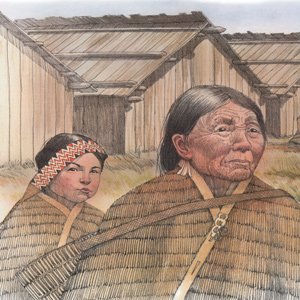
They paddle fifteen miles up the Columbia and encamp near present Ridgefield, Washington. The captains describe the dress, houses, wapato trade, and customs of the Nahpooitle (Cathlapotle) villagers.
March 28, 1806
Deer hunting
by Kristopher K. Townsend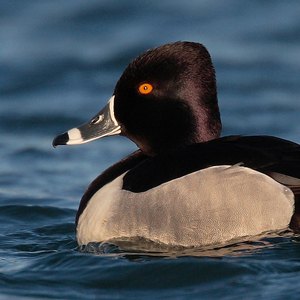
The main group joins the hunters who are on Deer Island in present Oregon. They spend the day hunting or repairing leaky dugout canoes. Lewis describes the red-sided garter snake and ring-necked duck.
March 27, 1806
Generous Skilloots
by Kristopher K. Townsend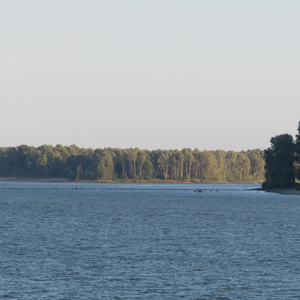
Near present Deer Island, Oregon, some generous Skilloots give away food with hopes that the expedition hunters will hunt with them. Lewis describes the area’s trees and prepares a salmonberry specimen.
March 26, 1806
At Fanny's Bottom
by Kristopher K. Townsend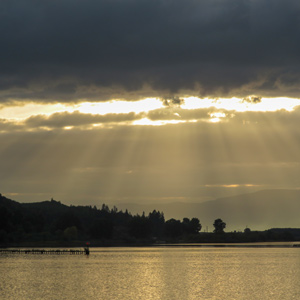
After a wet night, they paddle approximately 18 miles up the Columbia River and camp on an island near an area they call “fannys bottom”. Lewis describes eagles and substitutes for tobacco.
March 25, 1806
Downstreamer Chinooks
by Kristopher K. Townsend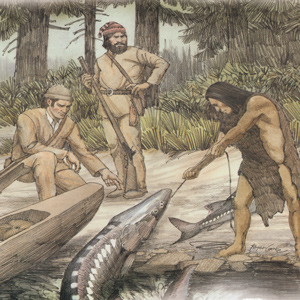
As they paddle along the south shore of the Columbia, the expedition sees Downstreamer Chinooks trolling for sturgeon. After fifteen miles, they find a popular camping spot at the present Clatskanie River.
March 24, 1806
Stolen canoe claimed
by Kristopher K. Townsend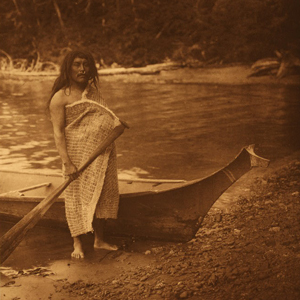
On their way to present Aldrich Point, they cross shallow waters crowded with islands, and a Kathlamet man guides them to the correct channel. The guide claims he is the owner of one of their canoes.
Experience the Lewis and Clark Trail
The Lewis and Clark Trail Experience—our sister site at lewisandclark.travel—connects the world to people and places on the Lewis and Clark Trail.
Discover More
- The Lewis and Clark Expedition: Day by Day by Gary E. Moulton (University of Nebraska Press, 2018). The story in prose, 14 May 1804–23 September 1806.
- The Lewis and Clark Journals: An American Epic of Discovery (abridged) by Gary E. Moulton (University of Nebraska Press, 2003). Selected journal excerpts, 14 May 1804–23 September 1806.
- The Lewis and Clark Journals. by Gary E. Moulton (University of Nebraska Press, 1983–2001). The complete story in 13 volumes.
This site is provided as a public service by the
Lewis and Clark Trail Alliance
with additional funding from the following: