Trains to Auburn, California in 1866
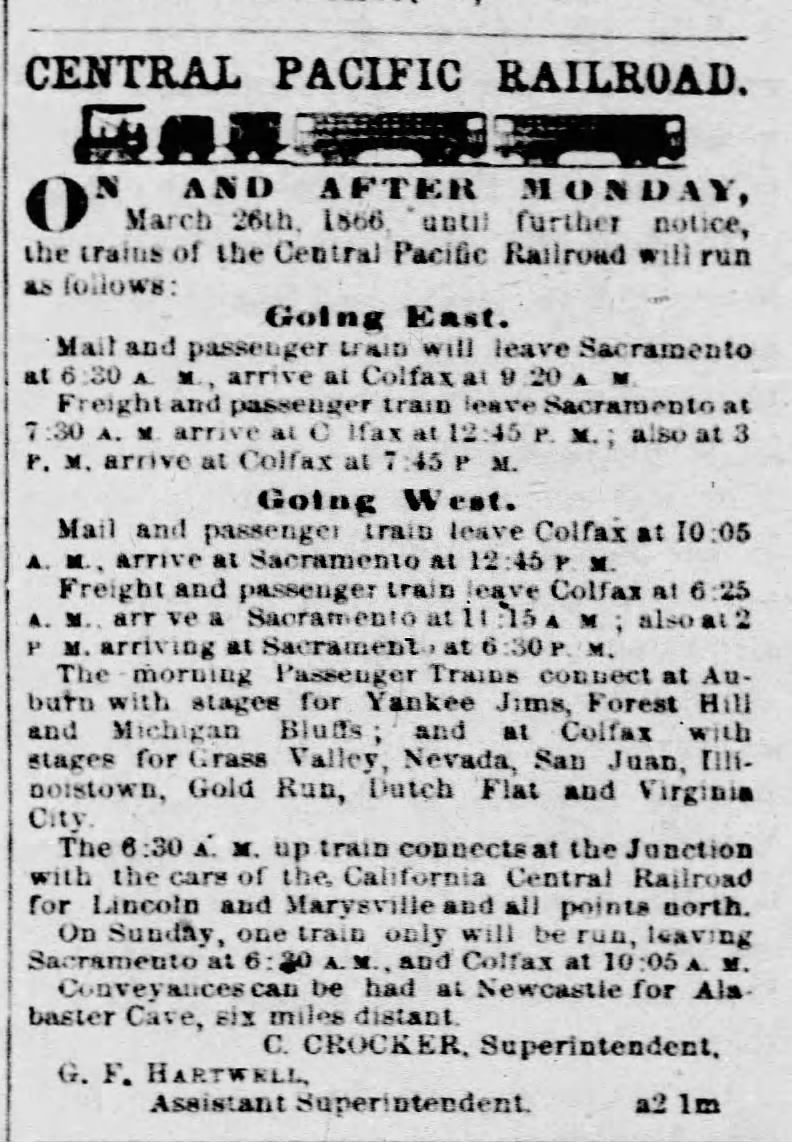
The Sacramento Bee, 30 April 1866.
Partial transcription:
Going East.
Mail and passenger train will leave Sacramento at 6:30 A. M., arrive at Colfax at 9:20 A. M.
Freight and passenger train leave Sacramento at 7:30 A. M. arrive at Colfax at 12:45 P. M.; also at 3 P. M. arrive at Colfax at 7:45 P. M.The morning Passenger Trains connect at Auburn with stages for Yankee Jims, Forest Hill, and Michigan Bluffs; and at Colfax with stages for Grass Valley, Nevada, San Juan, Illinoistown, Gold Run, Dutch Flat and Virginia City.
Sometime prior to May 1866, the “Old Charbonneau” of Auburn, California, decided to embark on yet another adventure. That he was considered old—yet “full of life and fun as any boy of 18″—in 1851 gives us pause to reflect on his state of health and mind. At 62 years of age, he left the relative comforts of his home of over 15 years, summited the snowy Sierra Mountains, and crossed the harsh Nevada desert. He intended to reach a “new gold field, Montana” and return “to familiar scenes”[1]The Placer Herald, 7 July 1866, Chronicling America: Historic American Newspapers. Lib. of Congress, chroniclingamerica.loc.gov/lccn/sn82014998/1866-07-07/ed-1/seq-2/; 17 May 1851, A Buckeye in the … Continue reading. He could have had one of several possible diggings in mind, but he succumbed to illness before reaching the Montana Territory.
Jean Baptiste may have become disenfranchised with Auburn. With the arrival of the western branch of the Central Pacific Railroad on 13 May 1865, the once booming mining town was rapidly becoming a transportation hub. When he left Auburn, there were three daily trains—except for one on Sundays—from Sacramento stopping in Auburn.[2]“Central Pacific Railroad”, Wikipedia, en.wikipedia.org/wiki/Central_Pacific_Railroad, accessed 20 May 2025; Central Pacific Railroad Advertisement, The Sacramento Bee, 30 April 1866. When the railroad reached Colfax in 1866, freighting companies quickly abandoned their Placerville routes and trucked goods through the Donner Pass travel corridor. Jean Baptiste’s route across the Sierras was likely along the new and improved wagon road they had built.[3]Victor Goodwin, “William C. (Hill) Beachey: Nevada-California-Idaho Stagecoach King”, Nevada Historical Society Quarterly Spring 1967, vol. 10 no. 1, 18–29.
Because Jean Baptiste and his traveling partners were following roads sometimes used by stagecoaches, many believe they were passengers on one of them. In May 1866, however, there were no stage companies providing service between Virginia City and Boise, Idaho. Two stage companies had operated the previous traveling season: John Mullan‘s Chico and Idaho Stage Company and Hal Beachey’s California and Idaho Stage and Fast Freight Company. Due to depredations on each company’s buildings, pastures, and livestock—mainly by the Paiute, neither company would re-start their stage services until late summer 1866.[4]At the time of Jean Baptiste’s trip, the Pioneer Stage Company ran two stage lines over the Sierras, one via Placerville and Lake Tahoe, and the other on the newly improved Donner Lake route. … Continue reading
With no stage service, Jean Baptist’s small group would have had to provide their own transportation or work with one of the freight companies supplying the Nevada and Idaho mines. After crossing at Donner Lake, they likely descended along the Truckee River, crossed the Great Basin, and then followed the Humboldt River—a reverse migration of those who previously used this route to reach California by wagon. Roughly, they were following present I-80 and U.S. Highway 95, also known as the Idaho-Oregon-Nevada (ION) highway.
Before he left, Jean Baptiste’s health may have been in decline. Traveling by horse or mule across the bleak Nevada desert could have contributed to that decline. (In May, the average low temperature at Winnemucca, for example, is only 38°) When crossing the Owyhee River—typically swollen and frigid from melting snows that time of year—he fell in and became sick, probably with pneumonia. Other travelers took him to the next station—Inskip—with hopes he would recover.[5]The Placer Herald. He died there having nearly reached the booming mines at Ruby, later known as Silver City, Idaho.
Obituary
Jean Baptiste Charbonneau Gravesite, Donner Oregon
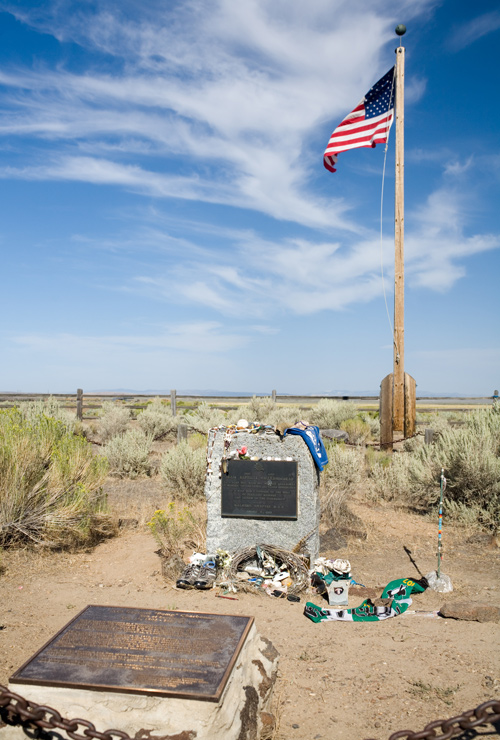
By WikiCommons user Javedgerton. Permission to use granted under the Creative Commons Attribution-ShareAlike 3.0 Unported license.
Text on headstone:
1805 – 1866
Jean Baptiste Charbonneau
As a baby was with his mother Sacajawea a member of the Lewis and Clark Expedition.
As a man was a pioneer of the west, of pleasant manner, and esteem in the community
Placed by Malheur Chapter D.A.R., August 6, 1974
A lone newspaper article reporting the death of Jean Baptiste—despite some significant historical inaccuracies—is worthy of repeating in its entirety:
The Placer Herald
Auburn, July 7, 1866
Death of a California Pioneer. — We are informed by Mr. Dana Perkins, that he has received a letter announcing the death of J. B. Charbonneau, who left this county some weeks ago, with two companions, for Montana Territory. The letter is from one of the party, who says Mr. C., was taken sick with mountain fever, on the Owyhee, and died after a short illness.
Mr. Charbonneau was known to most of the pioneer citizens of this region of country, being himself one of the first adventurers (into the territory now known as Placer county) upon the discovery of gold; where he has remained with little intermission until his recent departure for the new gold field, Montana, which, strangely enough, was the land of his birth, whither he was returning in the evening of life, to spend the few remaining days that he felt was in store for him.
Mr. Charbonneau was born in the western wilds, and grew up a hunter, trapper, and pioneer, among that class of men of which Bridger, Beckwourth, and other noted trampers of the woods were the representatives. He was born in the country of the Crow Indians—his father being a Canadian Frenchman, and his mother a half breed of the Crow tribe. He had, however, better opportunities than most of the rough spirits, who followed the calling of trapper, as when a young man he went to Europe and spent several years, where he learned to speak, as well as write several languages. At the breaking out of the Mexican war he was on the frontiers, and upon the organization of the Mormon battalion he was engaged as a guide and came with them to California. Subsequently upon the discovery of gold, he, in company with Jim Beckworth, came upon the North Fork of the American river, and for a time it is said were mining partners.
Our acquaintance with Charbonneau dates back to ’52, when we found him a resident of this county, where he has continued to reside almost continuously since— having given up frontier life. The reported discoveries of gold in Montana, and the rapid peopleing of the Territory, excited the imagination of the old trapper, and he determined to return to the scenes of his youth.— Though strong of purpose, the weight of years was too much for the hardships of the trip undertaken, and he now sleeps alone by the bright waters of the Owyhee.
Our information is very meager of the history of the deceased—a fact we much regret, as he was of a class that for years lived among stirring and eventful scenes.
The old man, on departing for Montana gave us a call, and said he was going to leave California, probably for good, as he was about returning to familiar scenes. We felt then as if we met him for the last time.
Mr. Charbonneau was of pleasant manners, intelligent, well read in the topics of the day, and was generally esteemed in the community in which he lived, as a good meaning and inoffensive man.[6]Ibid.
Final Words
Interpretive Sign, Donner, Oregon

Photo by Mark McLain, 2010.
The interpretive sign at Jean Baptiste’s grave site helps clarify the circumstances surrounding his death:
Oregon History
Jean Baptiste Charbonneau
1805–1866
This site marks the final resting place of the youngest member of the Lewis and Clark expedition. Born to Sacajawea and Toussaint Charbonneau at Fort Mandan (North Dakota) on February 11, 1805. Baptiste and his mother symbolized the peaceful nature of the “Corps of Discovery.” Educated by Captain William Clark at St. Louis, Baptiste at age 18, traveled to Europe where he spent six years, becoming fluent in English, German, French, and Spanish. Returning to America in 1829, he ranged the Far West for nearly four decades, as a mountain man, guide, interpreter, magistrate and forty niner. In 1866, he left the California gold fields for a new strike in Montana, contracted pneumonia enroute, reached “Inskip’s Ranche”, here, and died on May 16, 1866.
Jean Baptiste Charbonneau had lived a long and full life. He traveled with the Lewis and Clark Expedition, was educated in St. Louis under the patronage of William Clark, and he had worked in Europe for Duke Paul of Würrtemberg. At the Knife River Indian Villages, he was trained in the traditions of the Northern Plains People. In St. Louis and Europe, he learned the classics, mathematics, and science. He spoke many languages and back in the American West, he was a respected and valued participant in the Fur Trade. During the Spanish War, he helped guide the Mormon Battalion—an endeavor that altered the destiny of what would become the Southwest United States. In Southern California, he served as an alcalde—a type of civilian magistrate and Indian sub-agent—before leaving for the California gold fields circa 1849. In Auburn, he had become a well-liked and respected member of the community. That he wanted to return to “familiar scenes” hints that he had a premonition that this would be his final adventure. He likely savored every moment.
Further Reading
- W. Dale Nelson, Interpreters with Lewis and Clark: The Story of Sacagawea and Toussaint Charbonneau (Denton, Texas: University of North Texas Press, 2003)
- Susan M. Colby, Sacagawea’s Child: The Life and Times of Jean-Baptiste Charbonneau (Spokane, Washington: The Arthur H. Clark Company, 2005).
- HannaLore Hein, “The Final Journey of Jean Baptiste Charbonneau,” We Proceeded On 49, no. 3 (August 2023): 31–41.
Experience the Lewis and Clark Trail
The Lewis and Clark Trail Experience—our sister site at lewisandclark.travel—connects the world to people and places on the Lewis and Clark Trail.
Plan a trip related to The Final Journey of Jean Baptiste Charbonneau:
Notes
| ↑1 | The Placer Herald, 7 July 1866, Chronicling America: Historic American Newspapers. Lib. of Congress, chroniclingamerica.loc.gov/lccn/sn82014998/1866-07-07/ed-1/seq-2/; 17 May 1851, A Buckeye in the Land of Gold: The Letters and Journal of William Dennison Bickham, Randall E. Ham, ed. (Spokane, Washington: The Arthur H. Clark Company, 1996), 159. |
|---|---|
| ↑2 | “Central Pacific Railroad”, Wikipedia, en.wikipedia.org/wiki/Central_Pacific_Railroad, accessed 20 May 2025; Central Pacific Railroad Advertisement, The Sacramento Bee, 30 April 1866. |
| ↑3 | Victor Goodwin, “William C. (Hill) Beachey: Nevada-California-Idaho Stagecoach King”, Nevada Historical Society Quarterly Spring 1967, vol. 10 no. 1, 18–29. |
| ↑4 | At the time of Jean Baptiste’s trip, the Pioneer Stage Company ran two stage lines over the Sierras, one via Placerville and Lake Tahoe, and the other on the newly improved Donner Lake route. Both these stage lines essentially ended at Virginia City. (See their advertisements such as the one in Gold Hill Daily News, 15 March 1866, p. 1.) Ben Holladay’s Overland Stage Line provided consistent service between Virginia City and Montana by way of Salt Lake City—nowhere near the Jordan Valley where Jean Baptiste’s grave is located. (See their advertisement in The Oregonian, 19 April 1866, p. 1.) In March 1866, Light & Haviland briefly advertised a stage service from Virginia City to Boise. The company was primarily known as a livery service and horse broker, and it appears their stage line ran for less than a month—if at all. In May 1866, they were no longer advertising this stage line (See Gold Hill Daily News, 14 March 1866, p. 1.) In May 1866, Beachey was fulfilling his mail contract from Boise to Star City, Nevada via pony express. (“Half a Century Ago”, The Oregonian, 18 October 1915, p. 6; Goodwin, 18–29.) See also John F. Due, “Road Transport in Nevada: Wagon Freights and Stagecoaches, 1860–1895, Nevada Historical Society Quarterly Winter 37 No. 4 (1999) and Thomas F. Howard, Sierra Crossing: First Roads to California (Berkeley, California: University of California Press: 1998). |
| ↑5 | The Placer Herald. |
| ↑6 | Ibid. |