Sweating Private Bratton
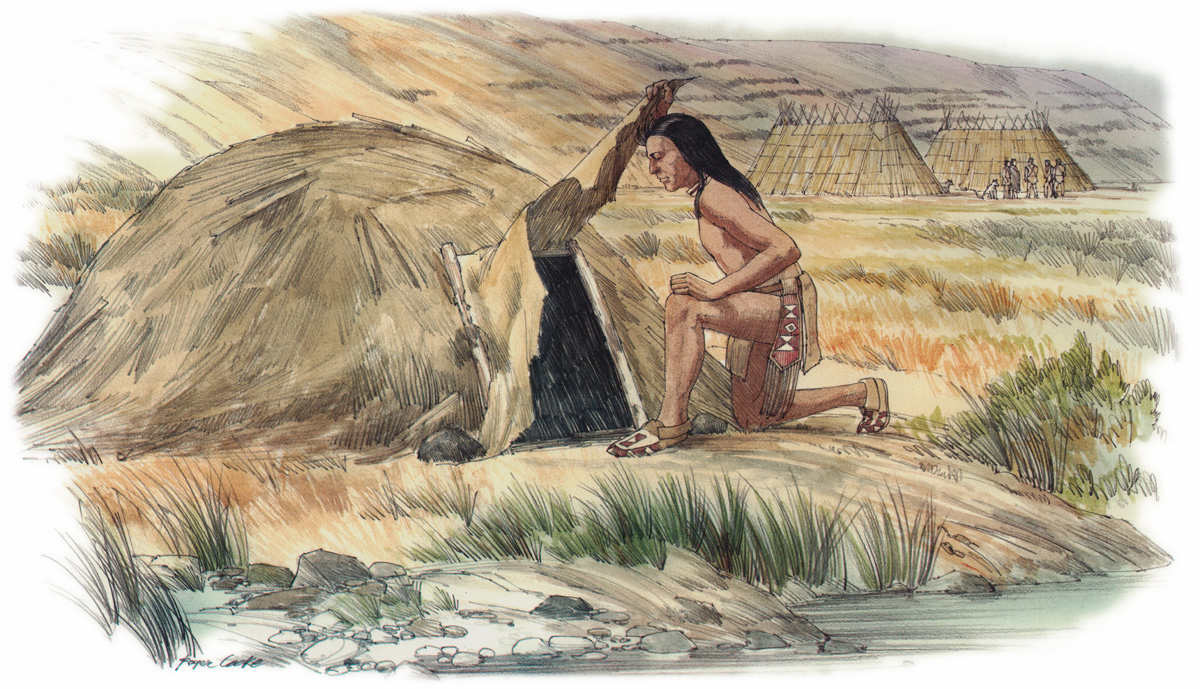
The captains mention Nez Perce sweat lodges multiple times along the Clearwater and Snake Rivers. The lodges were typically built near water where they could find willows for frames, stones for heating, and cold water for plunging after a good sweat. Above, the artist depicts a Palouse man entering a sweat lodge along the Snake River as described by William Clark on 11 October 1805.
Private William Bratton‘s “tedious illness” began at Salt Makers camp at present-day Seaside, Oregon in February 1806. On 24 May at Long Camp, a frustrated Meriwether Lewis reported that Bratton was:
so weak in the loins that he is scarcely able to walk, nor can he set upwright but with the greatest pain. we have tryed every remidy which our engenuity could devise, or with which our stock of medicines furnished us, without effect.[1]William Clark, The Definitive Journals of Lewis & Clark, Gary Moulton, ed. (Lincoln: University of Nebraska Press, 2002), 7:282–3. It appears that Lewis was conflating Bratton’s treatment … Continue reading
Pvt. John Shields recommended “violent sweats” using a sweat house much in the manner of their hosts, the Nez Perce:
Sheilds sunk a circular hole of 3 feet diamiter and four feet deep in the earth. he kindled a large fire in the hole and heated well, after which the fire was taken out a seat placed in the center of the hole for the patient with a board at bottom for his feet to rest on; some hopps of willow poles were bent in an arch crossing each other over the hole, on these several blankets were thrown forming a secure and thick orning of about 3 feet high. the patient being striped naked was seated under this orning in the hole and the blankets well secured on every side. the patient was furnished with a vessell of water which he sprinkles on the bottom and sides of the hole and by that means creates as much steam or vapor as he could possibly bear, in this situation he was kept about 20 minutes after which he was taken out and suddonly plunged in cold water twise and was then immediately returned to the sweat hole where he was continued three quarters of an hour longer then taken our covered up in several blankets and suffered to cool gradually.[2]Moulton, 7:283.
Shields also recommended that Bratton ingest a diaphoretic—a perspiration inducing medicine—in the form of tea. He specifically recommended Seneca snakeroot (Senega officinalis, previously Polygala Seneca) that grows in southern Canada and Central and Eastern United States. It had long been used as a diaphoretic among the Cherokee.[3]Daniel E. Moerman, Native American Ethnobotany (Portland, Oregon: Timber Press, 1988), 421; “Senega Officinalis”, Wikipedia, en.wikipedia.org/wiki/Senega_officinalis, accessed 26 June … Continue reading Because snakeroot did not grow in the West, they made their diaphoretic tea from another familiar plant that they knew as “horse mint”.
Common to Our Country
Bee Balm
Monarda fistulosa
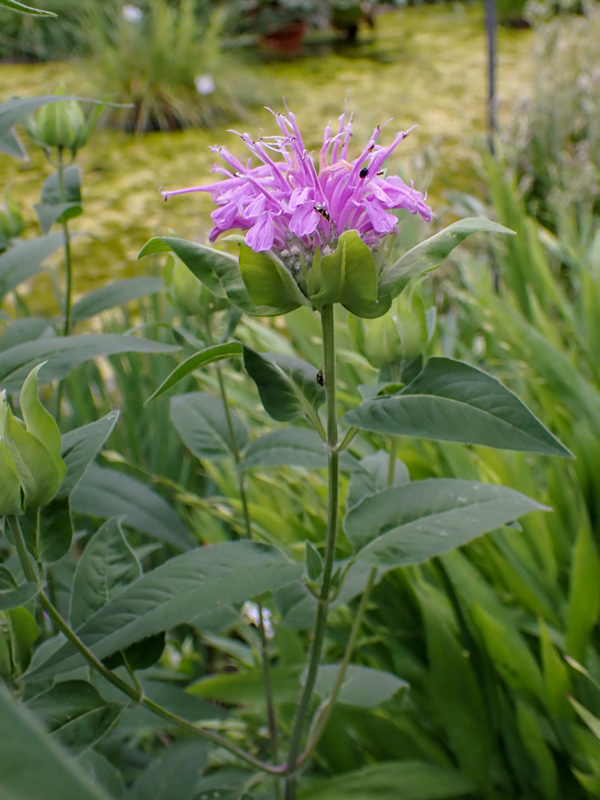
© 2022 by Krzystof Ziarnek. Permission to use granted under the Creative Commons Attribution-Share Alike 4.0 International license.
On 6 June 1806, Lewis listed several plants “common to our contry” including “horsemint”. Today, when searching “horsemint” or “horse mint,” the predominant results are from the genus Monarda. All species in that genus can be commonly called horsemint. Other plants with that appellation include nettle-leaf hyssop (Agastache urticifolia), St. John’s horsemint (Mentha longifolia), Poleo Mint (Mentha arvensa), and downy wood mint—also called Ohio horsemint (Blephilia ciliata). All these horsemints are in the mint (Lamiaceae) family. When they gave Bratton his diaphoretic tea, which plant did they mean?
Both the botanical and ethnobotanical record indicate that Bratton’s tea came from bee balm (Monarda fistulosa). When interviewing Flathead Salish herbologists, botanist Jeff Hart learned how they used[4]When referring to the ethnobotanical record, past tense will most often be used. This does not imply the plant is no longer in use in the manner described. bee balm to promote sweating. Pete Beaverhead from Ronan, Montana told Hart that “the patient should drink about a quart of it, then cover himself with blankets. He will begin to sweat profusely.” Not surprisingly, Hart identified Bratton’s tea as coming from Monarda fistulosa.[5]Jeff Hart, Montana Native Plants and Early Peoples (Helena: Montana Historical Society Press, 1992), 137; Hamel and Chiltoskey also documented this application among the Cherokee, Moerman, 346.
Fistulosa is native across North America and known to grow around Long Camp in present Kamiah, Idaho. On 24 July 1946, R.F. Daubenmire collected and preserved Monarda fistulosa L. var. menthifolia (Graham) Fernald at Kooskia—roughly 8 miles from Long Camp. On 11 July 1957, Kyle E. Laughlin also collected and preserved this species at Kamiah.[6]“Monarda fistulosa L. var. menthifolia (Graham) Fernald”, PNW Herbaria, https://www.pnwherbaria.org/; Catalog #176987, Washington State University Marion Ownbey Herbarium, … Continue reading Moulton suggested their horsemint was either nettle-leaf hyssop (Agastache urticifolia) or Poleo Mint (Mentha arvensa). Earle and Reveal suggest only the former.[7]Moulton, 7:285n4; A. Scott Earle and James L. Reveal, Lewis and Clark’s Green World: The Expedition and its Plants (Helena, Montana: Farcountry Press, 2003), 183–4. Nettle-leaf hyssop does grow in the plains high above Kamiah, i.e. Camas Prairie (elev. 3727 ft.) and Weippe Prairie (elev. 3028 ft.).[8]PNW Herbaria; Marion Ownbey Herbarium. Earle and Reveal reason that “there is only one plant, Agastache urticifolia, in the mountains of Idaho that fits that description.” The problem with that logic is that Kamiah, Idaho has an elevation of 1243 feet. Simply, Long Camp was near, but not in the mountains of Idaho. It is doubtful that someone would travel all the way up to the prairies above Kamiah when the plant that they already knew to be a diaphoretic—bee balm—was growing locally.
Had their horsemint been nettle-leaf hyssop, Lewis would most likely have recognized it as a species new to science and then, collected specimens and described the plant. His record for perceiving minute differences between species was remarkable. Conversely, bee balm is native throughout North America[9]“Monarda fistulosa L.”, USDA PLANTS Database, plants.usda.gov/plant-profile/MOFI, accessed 7 July 2025. and would likely have already been familiar to him. Botanical elaboration would have been superfluous.
Medicine and Food
Great Spangled Fritillary on Bee Balm
Speyeria cybele
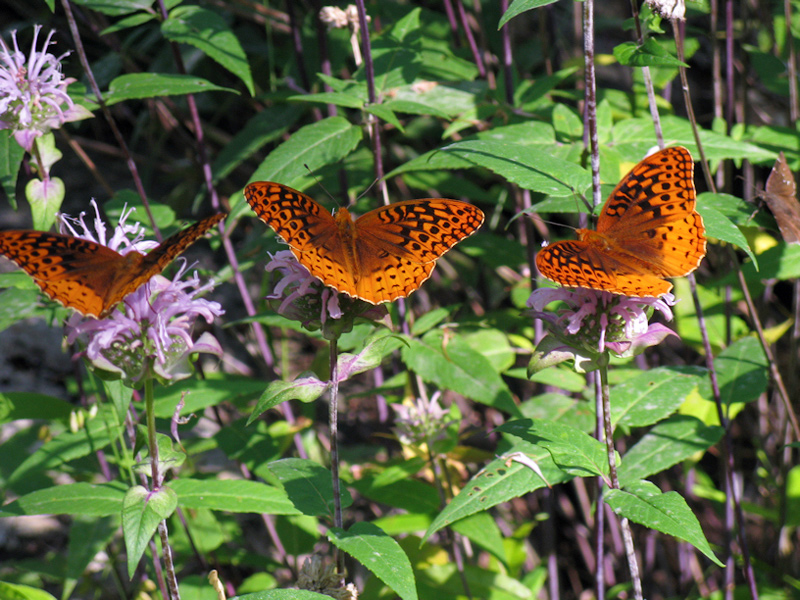
© 2013 by Todd Crabtree, U.S. Fish and Wildlife Service.
Today, bee balm is a standard addition to pollinating gardens.
Bee balm was used both by Natives and pioneers and was included in the United States Dispensatory (1882–1950) and National Formulary since 1950. In addition to its use as a diaphoretic, Blackfeet, Dakota, Lakota, and other Sioux made infusions from the plant to treat colds and coughs. Flathead Salish used it to promote menstrual flow and to expel afterbirth. Some Sioux used it for flatulence—something the captains apparently needed after eating camas and cous. For the Cheyenne, bee balm was a ceremonial plant.[10]Hart, 137–38.
Another common name for bee balm is wild bergamot because it tastes like the bergamot oil that is added to Earl Grey tea giving it its distinctive flavor.[11]“Earl Grey Tea”, Wikipedia, en.wikipedia.org/wiki/Earl_Grey_tea, accessed 25 June 2025. Bee balm contains Thymol, the active compound in thyme (Thymus vulgaris), and it was a common spice among several Southwest Nations including Acoma, Apache, and Hopi. Many nations including the Omaha and Crow made perfume from the leaves.[12]Moerman, 346–47.
Nomenclature
Monarda was named for Spanish botanist Nicolás Monardes (1493–1588) who wrote the Historia medicinal de las cosas que se traen de nuestras Indias Occidentales—Medicinal history of products brought from our West Indies.[13]Published in three volumes and several editions with various titles starting 1865. “Historia_medicinal_de_las_cosas_que_se_traen_de_nuestras_Indias_Occidentales”, Wikipedia“, … Continue reading The genus has both annual and perennial plants with over twenty species. All Monarda species are sometimes called horsemint, but bee balm is more common because the plants attract pollinators like bees, butterflies, moths, and hummingbirds.[14]“Monarda”, Wikipedia, en.wikipedia.org/wiki/Monarda. Fistulosa is Latin for fistulous, or having a fistula, the hollow tube-like structure of the flowers.[15]William T. Stearn, Botanical Latin, 4th ed. s.v. “fistulosus”.
Bratton’s Recovery
Another testament to the effectiveness of bee balm came with Bratten’s recovery. Lewis wrote that “Bratton feels himself much better and is walking about today and says he is nearly free from pain.—” They then applied the same remedy to an old Nez Perce man they had been doctoring. On the 29th: “Bratton is recovering his strength very fast;” and two weeks later, Lewis declared “we cannot well consider him an invalid any longer.”[16]Moulton, 24 May 1806, 7:283, 302, 8 June 1806, 346. After the expedition, he became a keelboat freighter and fathered eight sons and two daughters.
Notes
| ↑1 | William Clark, The Definitive Journals of Lewis & Clark, Gary Moulton, ed. (Lincoln: University of Nebraska Press, 2002), 7:282–3. It appears that Lewis was conflating Bratton’s treatment into one day’s journal entry. The sweating likely started the previous day—23 May 1806. See Sgt. Ordway’s entry for that day. |
|---|---|
| ↑2 | Moulton, 7:283. |
| ↑3 | Daniel E. Moerman, Native American Ethnobotany (Portland, Oregon: Timber Press, 1988), 421; “Senega Officinalis”, Wikipedia, en.wikipedia.org/wiki/Senega_officinalis, accessed 26 June 2025. |
| ↑4 | When referring to the ethnobotanical record, past tense will most often be used. This does not imply the plant is no longer in use in the manner described. |
| ↑5 | Jeff Hart, Montana Native Plants and Early Peoples (Helena: Montana Historical Society Press, 1992), 137; Hamel and Chiltoskey also documented this application among the Cherokee, Moerman, 346. |
| ↑6 | “Monarda fistulosa L. var. menthifolia (Graham) Fernald”, PNW Herbaria, https://www.pnwherbaria.org/; Catalog #176987, Washington State University Marion Ownbey Herbarium, intermountainbiota.org/, both accessed 26 June 2025. |
| ↑7 | Moulton, 7:285n4; A. Scott Earle and James L. Reveal, Lewis and Clark’s Green World: The Expedition and its Plants (Helena, Montana: Farcountry Press, 2003), 183–4. |
| ↑8 | PNW Herbaria; Marion Ownbey Herbarium. |
| ↑9 | “Monarda fistulosa L.”, USDA PLANTS Database, plants.usda.gov/plant-profile/MOFI, accessed 7 July 2025. |
| ↑10 | Hart, 137–38. |
| ↑11 | “Earl Grey Tea”, Wikipedia, en.wikipedia.org/wiki/Earl_Grey_tea, accessed 25 June 2025. |
| ↑12 | Moerman, 346–47. |
| ↑13 | Published in three volumes and several editions with various titles starting 1865. “Historia_medicinal_de_las_cosas_que_se_traen_de_nuestras_Indias_Occidentales”, Wikipedia“, en.wikipedia.org/wiki/Historia_medicinal_de_las_cosas_que_se_traen_de_nuestras_Indias_Occidentales accessed 7 July 2025. |
| ↑14 | “Monarda”, Wikipedia, en.wikipedia.org/wiki/Monarda. |
| ↑15 | William T. Stearn, Botanical Latin, 4th ed. s.v. “fistulosus”. |
| ↑16 | Moulton, 24 May 1806, 7:283, 302, 8 June 1806, 346. |
Experience the Lewis and Clark Trail
The Lewis and Clark Trail Experience—our sister site at lewisandclark.travel—connects the world to people and places on the Lewis and Clark Trail.
Discover More
- The Lewis and Clark Expedition: Day by Day by Gary E. Moulton (University of Nebraska Press, 2018). The story in prose, 14 May 1804–23 September 1806.
- The Lewis and Clark Journals: An American Epic of Discovery (abridged) by Gary E. Moulton (University of Nebraska Press, 2003). Selected journal excerpts, 14 May 1804–23 September 1806.
- The Lewis and Clark Journals. by Gary E. Moulton (University of Nebraska Press, 1983–2001). The complete story in 13 volumes.
This site is provided as a public service by the
Lewis and Clark Trail Alliance
with additional funding from the following: