Manuel Lisa (1772–1820)
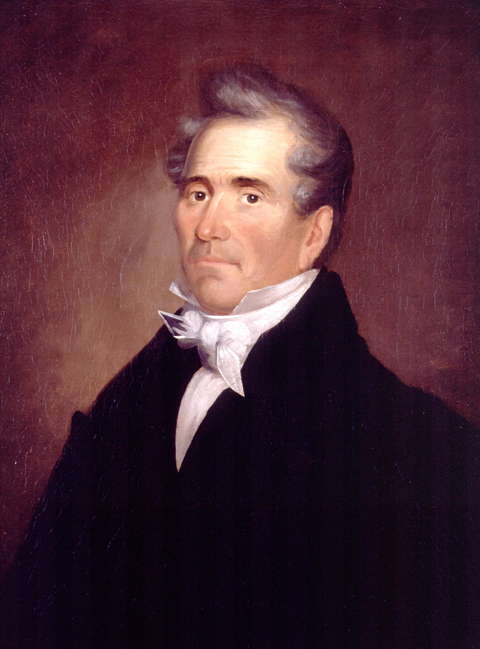
Artist unknown (1818). Oil on canvas, 28 x 21 inches.
Missouri Historical Society, St. Louis, Acc. No. 1979.97.1
When the Lewis and Clark Expedition arrived in St. Louis in 1803, Spanish citizen Manuel Lisa (8 September 1772–12 August 1820) had four years prior established himself in the fur trade there. Most often in direct competition with Pierre and Auguste Chouteau, Lisa worked with Nations living north of the Platte River such as the Omaha, Ponca, and Lakota [Teton] Sioux. He became an Indian Agent and in 1814 married Mitane, a daughter of a principle chief of the Omahas, thus solidifying his trade relations with that nation.[1]“Manuel Lisa”, Wikipeida, en.wikipedia.org/wiki/Manuel_Lisa, accessed 10 March 2025.
During the winter of 1803–04, William Clark—working at camp on the Wood River—negotiated with some of Lisa’s boatmen to help with the first stage of the Missouri River. Meriwether Lewis—working in St. Louis—gave Clark his approval in a letter dated February 18 but mentions that Lisa would need to give his approval.
Relations with Lisa deteriorated just a week before departure. Lewis was very angry with Lisa:
Damn Manuel [Manuel Lisa] and triply Damn Mr. B. [Francis Marie Benoit] They give me more vexation and trouble than their lives are worth.[2]Lewis to Clark, 18 February 1804 in Letters of the Lewis and Clark Expedition with Related Documents: 1783–1854, ed. Donald Jackson (Urbana: University of Illinois Press, 1978), 179.
The reason for Lewis’s anger is unknown, but in the years following the expedition, Clark managed to work with the sometimes-wily Lisa. After founding the Missouri Fur Company (1807-1814), in which William Clark was a participant, Manuel Lisa left St. Louis for the Upper Missouri in 1807. Pressing far upstream, he established Fort Raymond at the mouth of the Big Horn River on the Yellowstone River in present-day Montana. This strategic location enabled trade with the Crow and other indigenous tribes, fostering economic growth and cultural exchanges.
During the 1809 season, he built a second post above the Mandan and Hidatsa villages, which served as a crucial trading hub and a point of contact between European traders and the native populations. This post facilitated the exchange of goods such as pelts, beads, and tools with American traders.
One of Lisa’s most famous posts, Fort Manuel Lisa, was built almost astride the modern boundary between North Dakota and South Dakota. Occupied for only a few months, it was abandoned in 1812 when its residents fled back downriver, including Toussaint Charbonneau, whose wife—likely Sacagawea—had recently died there of “a putrid fever”.[3]John C. Luttig, Journal of a Fur-Trading Expedition on the Upper Missouri, 1812-1813, ed. Stella M. Drumm (St Louis: Missouri Historical Society, 1920), 106.
Fort Manuel Lisa, though short-lived, played a significant role in the fur trade and in the history of the region. Its establishment marked an important moment in the expansion of European influence into the northern plains and the complexities of interactions with the native tribes.
Lisa dominated the upriver trade until his death in 1820. His profits stimulated other parties to focus on the Missouri River, leading to increased competition and the establishment of new trading posts. However, despite much opposition, he maintained a near monopoly on the river for thirteen years, a testament to his strategic acumen and determination.
Related Pages
Fur Trade after the Expedition
by W. Raymond Wood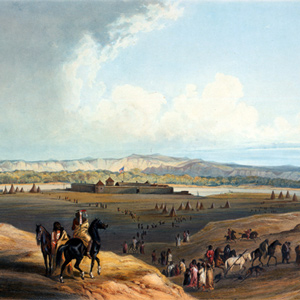
The Louisiana Purchase and the lure of its beaver population led to a veritable flood of traders and trappers moving toward the Upper Missouri and the Northern Rocky Mountains and the slow abandonment of the overland trade in the United States by Canadian and British interests.
Lisa’s Fur Trade Forts
And the deaths of Potts and Drouillard
by W. Raymond Wood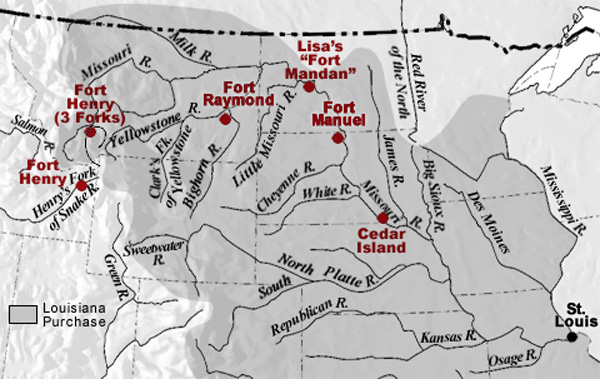
Manuel Lisa’s men at Fort Raymond not only encouraged the Crows to come trade with them, but they set out parties to trap beaver on their own. It was the latter effort that led to hostilities with the Blackfeet that affected Potts, Drouillard, and Colter.
February 17, 1804
Manuel Lisa's engagés
by Kristopher K. Townsend
In St. Louis, Clark negotiates with trader Manuel Lisa to hire some of his French engagés—mostly boatmen from St. Charles. Across the Mississippi at Wood River, Lewis records weather data.
May 3, 1804
Chouteau's Osage delegation
by Kristopher K. Townsend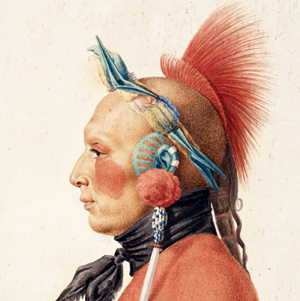
In St. Louis and Camp River Dubois, Lewis and Clark write letters of introduction for Pierre Chouteau who will soon take an Osage delegation to Washington City. At winter camp, the bottom of the barge is inspected, influential trader Manuel Lisa visits, and Sgt. Floyd brings letters to Clark.
May 6, 1804
Clark's commission
by Kristopher K. Townsend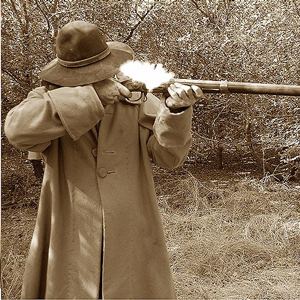
Working in St. Louis, Lewis sends Clark’s commission for second lieutenant—not for captain as promised. He also expresses a strong opinion regarding traders Manuel Lisa and Francis Benoit. Across the Mississippi at Camp River Dubois, the enlisted men win shooting contests held with several of the local people.
Notes
| ↑1 | “Manuel Lisa”, Wikipeida, en.wikipedia.org/wiki/Manuel_Lisa, accessed 10 March 2025. |
|---|---|
| ↑2 | Lewis to Clark, 18 February 1804 in Letters of the Lewis and Clark Expedition with Related Documents: 1783–1854, ed. Donald Jackson (Urbana: University of Illinois Press, 1978), 179. |
| ↑3 | John C. Luttig, Journal of a Fur-Trading Expedition on the Upper Missouri, 1812-1813, ed. Stella M. Drumm (St Louis: Missouri Historical Society, 1920), 106. |
Experience the Lewis and Clark Trail
The Lewis and Clark Trail Experience—our sister site at lewisandclark.travel—connects the world to people and places on the Lewis and Clark Trail.
Discover More
- The Lewis and Clark Expedition: Day by Day by Gary E. Moulton (University of Nebraska Press, 2018). The story in prose, 14 May 1804–23 September 1806.
- The Lewis and Clark Journals: An American Epic of Discovery (abridged) by Gary E. Moulton (University of Nebraska Press, 2003). Selected journal excerpts, 14 May 1804–23 September 1806.
- The Lewis and Clark Journals. by Gary E. Moulton (University of Nebraska Press, 1983–2001). The complete story in 13 volumes.
This site is provided as a public service by the

Lewis and Clark Trail Alliance
with additional funding from the following: