De L’Isle’s 1708 Map (Detail)
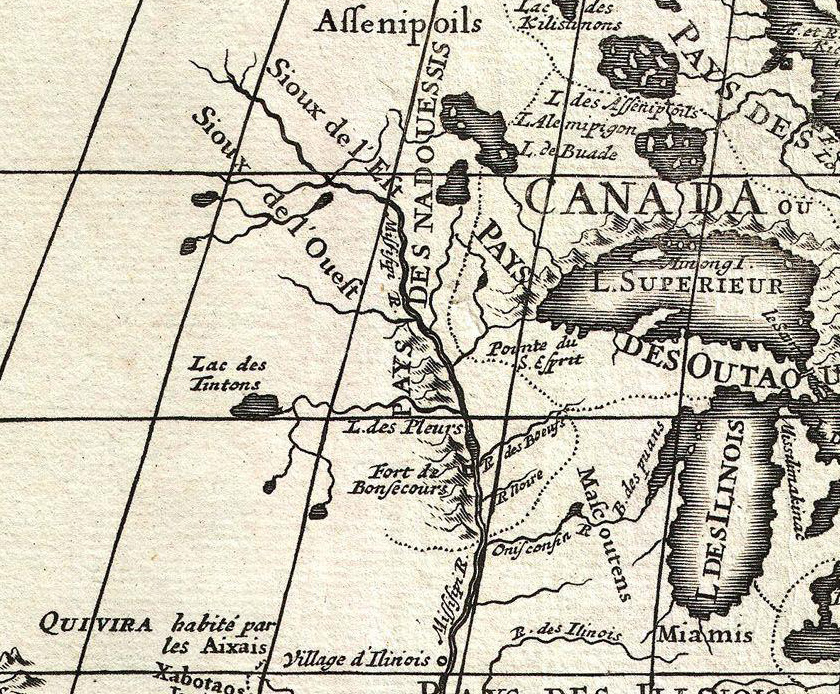
Provided to Wikimedia Commons by Geographicus Rare Antique Maps. Public domain.
The Sioux country in De L’Isle’s map above is labeled ‘Sioux of the East’, ‘Sioux of the West’, and PAYS DES NANDOUESSIS, Sioux country. Nandouessis is a variation of the Ottawa name for the Sioux which the French typically mispronounced. Except for the features shown near the Mississippi River, the map is completely blank north of the Platte River and west of the Mississippi.
Sioux is an exonym,[1]An exonym is a name by which one Indian tribe or nation refers to another, and by which the group so named doesn’t use for itself. “Nez Perce,” for example, is an exonym meaning … Continue reading or foreign, in this case French Canadian name via an Ottawa Indian exonym, Nadoueessioux (“Enemies”), for a large and varied nation of native American tribes that migrated westward from the sources of the Mississippi River in the late 1600s. On 31 August 1804, Clark, frustrated in his attempt to draw a clear picture of the Sioux, summarized what he did know. “This Nation is Divided into 20 Tribes possessing Seperate interests . . . . Collectively they are noumerous Say from 2 to 3000 men, there interests are so unconnected that Some bands are at war with Nations which other bands are on the most friendly terms.” However, he learned only 12 “names of the Different Tribes . . . of the Sceoux or Dar co tar Nation. . . . The names of the other bands neither of the Souex’s interpters could inform me.”[2]Moulton, Journals, 3:419-20; 3:354-57.
When grouped by language, then political bands, the following outline of Siouan-speaking peoples results:[3]Linguistic groupings from Douglas R. Parks and Robert L. Rankin, Handbook of North American Indians: Plains Vol. 13, ed. Raymond J. DeMallie (Washington, D.C.: Smithsonian Institution, 2001), … Continue reading
- Mandan
- Hidatsa
- Assiniboine
- Stoney
- Chiwere
- Dhegiha
- Sioux proper
- Lakota (Teton)
- Brulé (Sičháŋǧu, Sicangu People, Burned Thighs Nation)
- Oglala (Oglála, “They Scatter Their Own”)
- Saone
- Yankton-Yanktonai (Western Dakota)
- Yankton (Iháŋktȟuŋwaŋ)
- Yanktonai (Iháŋktȟuŋwaŋna)
- Santee-Sisseton (Eastern Dakota)
- Santee (Isáŋyáthi: Bdewákhathuŋwaŋ, Waȟpékhute)
- Sisseton (Sisíthuŋwaŋ, Waȟpéthuŋwaŋ)
- Lakota (Teton)
Siouan Nations Encountered
The Iowas
by Kristopher K. Townsend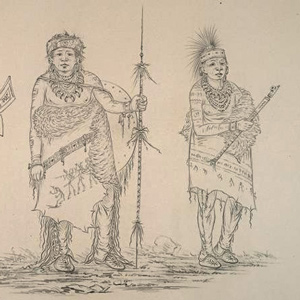
Iowa culture blended lifeways and customs of their neighbors: Horticulture and a well-defined, patrilineal class system was learned from the Sioux, a clan system was adapted from Algonquian-speaking neighbors, and like the Plains culture, they practiced the summer village method of hunting the American bison.
The Mandans
by Kristopher K. Townsend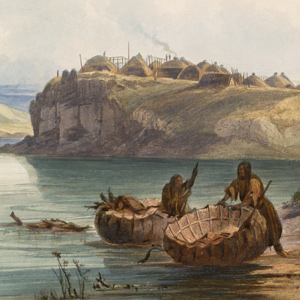
After the 1781 smallpox epidemic, the Mandan had moved into to a more defensible position in two villages immediately south of the Hidatsa at the Knife River. The Mandan-Hidatsa alliance had developed many years prior, and the two tribes previously shared their large hunting territory to the west.
The Osages
by Joseph A. Mussulman, Kristopher K. Townsend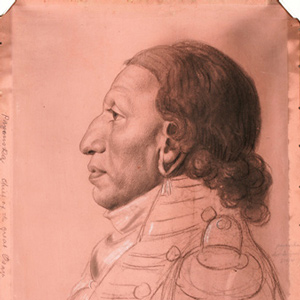
The Osage were experienced traders, exchanging horses and Indian slaves for French guns, knives, axes, kettles, and other metal objects. After the 1760s, the Osage adopted a new economic system of planting gardens in permanent villages, summer hunts in the plains, and fur-trapping in the winter.
The Lakotas
by Kristopher K. Townsend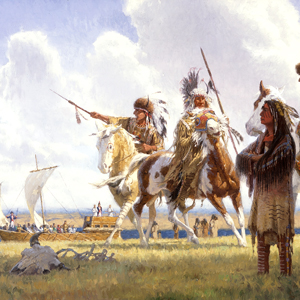
Presently known as the Lakota people, Lewis and Clark most often called them the Tetons. There were three main groups: Oglala, Brule, and Saone. The bands typically lived separately, hunted freely within each other’s territory, and came together for community events.
The Hidatsas
by Kristopher K. Townsend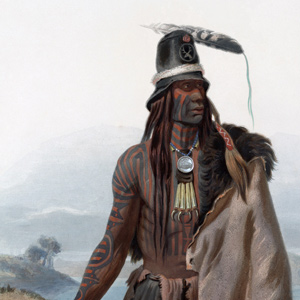
Prior to the expedition, the Hidatsa had settled in three villages just north of two Mandan villages in a complex now called the Knife River Villages. There, they practiced horticulture and hunting in the manner of the Plains Village tradition.
The Poncas
by Kristopher K. Townsend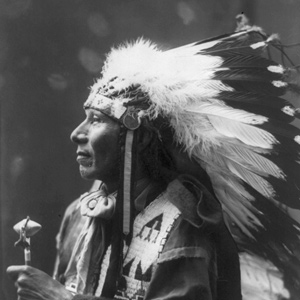
On 5 September 1804, the captains sent John Shields and George Gibson to the Ponca villages. The privates reported that the people were away hunting buffalo and that they had not planted their gardens.
The Yankton Sioux
by Kristopher K. Townsend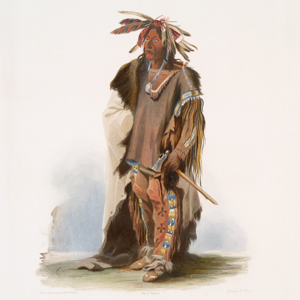
The Yankton along with the Yanktonai make up the Western Dakota division of the Dakota People. Although the Yankton and Yanktonai sometimes considered themselves to be one people, their separate locations resulted in a unique history for each.
The Crows
The Raven Nation
by Kristopher K. Townsend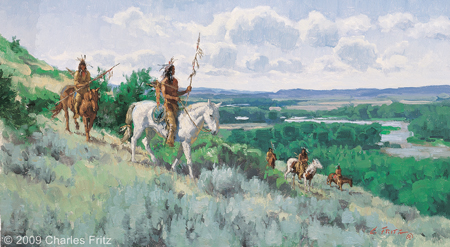
The Mountain Crow and Awatixa Hidatsa share a common ancestry as do the River Crow with the Hidatsa proper. During the expedition, no one would see any Crow people, but those people certainly noticed the expedition passing through stealing all the horses Clark had with him.
The Omahas
by Kristopher K. Townsend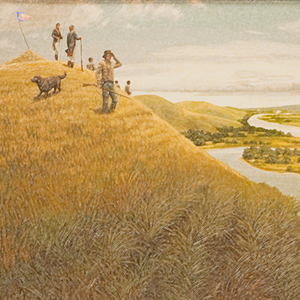
The captains appeared eager to meet with the Omaha. They tried to find them at their two biggest villages and planted a flag at the gravesite of the chief who for many years had controlled trade in the region, the infamous Blackbird.
The Kansas
by Kristopher K. Townsend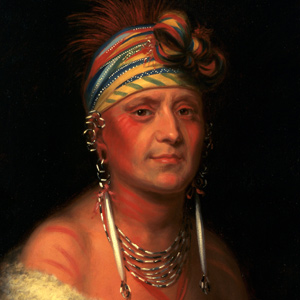
Known in the journals as Kanzas, Kansas, Kansias, Kansies, Kar sea, and Kah they are popularly called the ‘People of the South Wind’. At the mouth of the Kansas River, the captains ordered a defensive wall built, but no Kansa warriors appeared.
The Otoes and Missourias
by Kristopher K. Townsend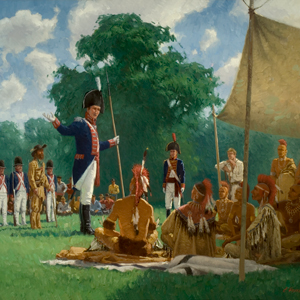
At the time of the expedition, the nation from which the Missouri River derived its name were so reduced by smallpox and attacks that they had abandoned their villages and merged with other tribes—Kansas, Osages, but primarily, the Otoes.
The Assiniboines
by Kristopher K. Townsend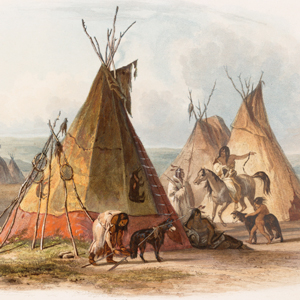
The Assiniboines were nomadic hunter-gatherers roaming primarily along the rivers in Saskatchewan and western Manitoba. They often dropped south into present-day Montana and North Dakota, especially in their role as middle-men between the English trading companies and the Hidatsas to the south.
Notes
| ↑1 | An exonym is a name by which one Indian tribe or nation refers to another, and by which the group so named doesn’t use for itself. “Nez Perce,” for example, is an exonym meaning “pierced noses.” But they have always called themselves Nimeepoo, which means “The People.” |
|---|---|
| ↑2 | Moulton, Journals, 3:419-20; 3:354-57. |
| ↑3 | Linguistic groupings from Douglas R. Parks and Robert L. Rankin, Handbook of North American Indians: Plains Vol. 13, ed. Raymond J. DeMallie (Washington, D.C.: Smithsonian Institution, 2001), 94–102. Sioux bands and sub-band etymology from “Lakota People,” Wikipedia, https://en.wikipedia.org/wiki/Lakota_people accessed on 12 November 2020 and Raymond J. DeMallie, Handbook, 794. |
| ↑4 | Not to be confused with the Algonquian-speaking Blackfeet. |
Experience the Lewis and Clark Trail
The Lewis and Clark Trail Experience—our sister site at lewisandclark.travel—connects the world to people and places on the Lewis and Clark Trail.
Discover More
- The Lewis and Clark Expedition: Day by Day by Gary E. Moulton (University of Nebraska Press, 2018). The story in prose, 14 May 1804–23 September 1806.
- The Lewis and Clark Journals: An American Epic of Discovery (abridged) by Gary E. Moulton (University of Nebraska Press, 2003). Selected journal excerpts, 14 May 1804–23 September 1806.
- The Lewis and Clark Journals. by Gary E. Moulton (University of Nebraska Press, 1983–2001). The complete story in 13 volumes.
This site is provided as a public service by the
Lewis and Clark Trail Alliance
with additional funding from the following: