Lewis continues his experiment with fog, and they move down the river and enter Ohio. The pirogue springs a serious leak, and a new canoe is purchased. It also leaks. Articles are inspected and dried, and a new crew member is hired. Camp is near Newell in present West Virginia.
Elsewhere, the lease needed to build Fort Kaskaskia—strategically located near the Louisiana Colony—is signed.
Lewis’s Fog Experiment
at ¼ past 8 the murcury rose in the open air to 68° the fogg dispeared and we set out; the difference therefore of 5° in temperature between the warter and air is not sufficient to produce the appearance of fogg—
—Meriwether Lewis
Leaving Pennsylvania
Little Beaver and Ohio Rivers
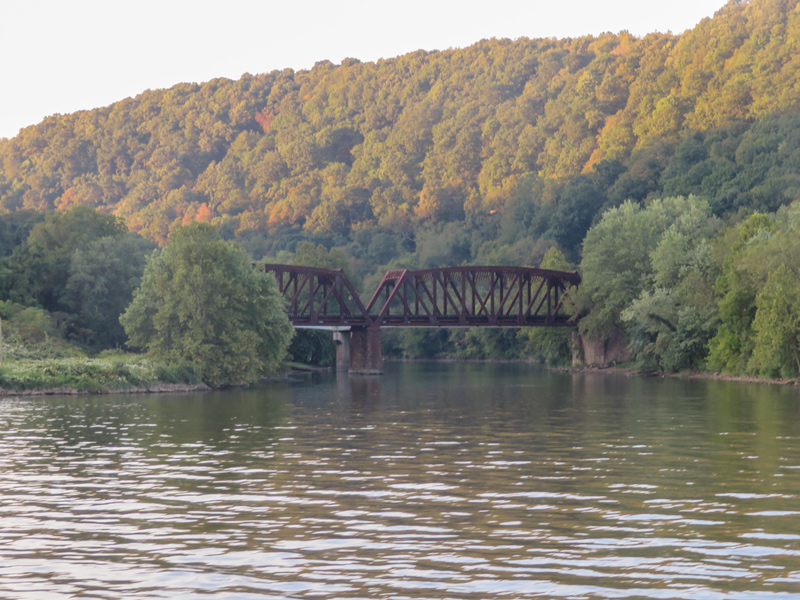
Generated from the original © 2021 by Robert Heacock. Used by permission.
passed the line, which divides the States of Virginia and Pensylvania on the east side of the river and on the West that of Pensylvania from the State of Ohio;
—Meriwether Lewis
Prior to 1863, West Virginia was a part of Virginia.
A Serious Leak
the Perogue was loaded as his been my practice since I left Pittsburgh, in order as much as posseble to lighten the boat, the [man or men] who conducted her called as in distress about an hour after we had got under way, we came too and waaited her coming up found she had sprung a leek and had nearly filled; this accedent was truly distressing, as her load consisting of articles of hard-ware, intended as presents to the Indians got wet and I fear are much damaged
—Meriwether Lewis
A New Canoe
purchased a canoe compleat with two paddles and two poles for which I gave 11$, found that my new purchase leaked so much that she was unsafe woithout some repairs
—Meriwether Lewis
A New Hand
opened the articles which had got wet and exposed them to the sun; set some of my hands to repareing the canoes which I effected before night had the articles well oiled and put up in oilcloth baggs and returned to the casks in which they were previously were, hired another hand to go with me as far as Wheeling— the articles were not as much injured as I had supposed—
—Meriwether Lewis
A Great Number of Fish
The water is so low and clear that we see a great number of Fish of different kinds, the Stergeon, Bass, Cat fish, pike, &c. we fixed some spears after the indian method but have had too much to attend to of more importance than gigging fish.—
—Meriwether Lewis
Fort Kaskaskia Lease
This Indenture made this fourth day of September Eighteen hundred and three, by and between Henry Dearborn Secretary of the Department of War of the United States on the one part, and John Edgar of Kaskaskias in the Indiana Territory, on the other part, Witnesseth, That the said John Edgar on his part, for the consideration hereafter mentioned, doth hereby release and quitclaim to the said Henry Dearborn, in his said capacity, and to bis successor in said Office, for the term of three years (rom the date of these presents, the following tract or parcel of land, situated, lying and being on the east side of Kaskaskias River, opposite to the village of Kaskaskias aforesaid . . . . containing by estimation, One hundred and twenty acres more or less, releasing, and quitclaiming to the said Henry Dearborn in his said capacity, and to his successor in said office, the right of erecting a Garrison on said premises, of procuring such quantity of stone, of making such quantity of brick and of cutting such quantity of timber and of taking such other materials as may be necessary to complete said Garrison . . . .[2]Clarence E. Carter, The Territorial Papers of the United States (Washington, DC: United States Government Printing Office, 1948), 7:154–155, digitized by Google books.
Experience the Lewis and Clark Trail
The Lewis and Clark Trail Experience—our sister site at lewisandclark.travel—connects the world to people and places on the Lewis and Clark Trail.
Plan a trip related to September 4, 1803:
- Fort McIntosh (Beaver, Pennsylvania)
Notes
| ↑1 | Gary Moulton, The Definitive Journals of Lewis and Clark (Lincoln and London: University of Nebraska Press, 1986), 2:72n7. |
|---|---|
| ↑2 | Clarence E. Carter, The Territorial Papers of the United States (Washington, DC: United States Government Printing Office, 1948), 7:154–155, digitized by Google books. |