Today, the crews manage to move the barge down the Ohio without the aid of horses or oxen. Lewis stops for the night at an island opposite present Weirton, West Virginia. When the two canoes fail to arrive, the sounding horn is blown and they answer back.
Already stationed on the Mississippi, the expedition’s future Sergeant of the Guard, John Ordway, writes home.
In present South Dakota, trader Pierre-Antoine Tabeau describes treaties and personalities of three Tribal Nations that the expedition will encounter moving up the Missouri.
Deeper Water
Weirton, West Virginia
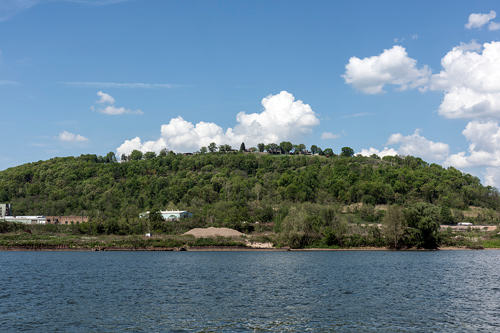
Generated from an original by Carol M. Highsmith, Library of Congress, loc.gov/pictures/resource/highsm.31932/.
Again foggey, loaded both my canoes and waited till the fogg disappeared set out at 8 OCl. had some difficulty in passing several riffles today but surmounted it without having recorse to horses or oxen—
—Meriwether Lewis
Sounding the Trumpet
Sounding Horn
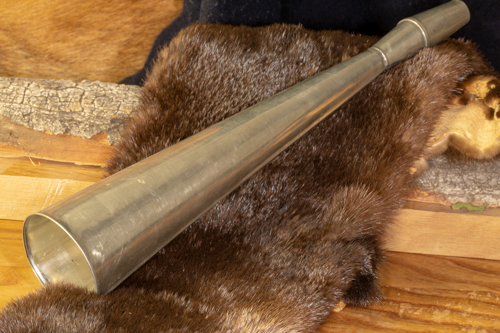
© 2018 by Kristopher K. Townsend. Permission to use granted under the Creative Commons Attribution-Share Alike 4.0 International license.
Took up at the head of Brown’s Island; it grew very dark and my canoes which had on board the most valuable part of my stores had not come up, ordered the trumpet to be sound and they answered.— they came up in a few minutes after . . . .
—Meriwether Lewis
Canoes Leak Considerably
[The canoes] still leaked considerably notwithstanding the repairs which I had made on them; we came 16 miles this day;
—Meriwether Lewis
Rainy Night
rained at six this evening and continued with some intervals through the night to rain pretty heard . . . . the stores in the canoes being well secured with oil cloth I concluded to let them remain on board and directed that the water which they maid should be bailed out of them occasionally through the night, which was done—
—Meriwether Lewis
Dear Brother
John Ordway—likely not yet aware of the Expedition heading his way—writes a letter to his brother Stephen from his frontier post at Kaskaskia.
Kaskaskias Indiana Territory 5 Sept. 1803.
Sir,
. . . . .
Give my love to my Parents & brethren & Compliments to all my acquaintances—I enjoy an uninterrupted State of health & retain my usual Spirits with an unusual degree of contentment & vivacity . . . .
I have nothing to fear while I enjoy the common blessings of Divine Providence.
John Ordway Searj in
Russell Bissells Compy 1st Regt.P.S. This is a very old Town with about 200 houses in it and the ruins of many more. We lie on a hill in Site of the Town within a quarter of a mile, and we have built a Garrison hear . . . .
Tribal Politics
In the employ of Régis Loisel, trader Pierre-Antoine Tabeau records a diplomatic encounter between the Lakota, Omaha, and Ponca nations. He also describes Torto-honga (Partisan)—a Sioux chief that the Lewis and Clark Expedition would encounter on their way up the Missouri River in September 1804.
The 5th of September, 1803, Black Bull, urgently entreated by the Mahas and Poncas near the James River, accepts their invitation and arranges to speak to them of peace; but, in order not to leave any pretext for the machinations of the Partisan after his own departure, he announces publicly his intentions and consults him himself.
. . . . .
This man called the Partisan, the chief of a band of the Bois Brulés, the largest after that of Black Bull, is a true Proteus, who is seen in the selfsame day faint-hearted and bold, audacious and fearful, proud and servile, conciliator and firebrand.
—Pierre-Antoine Tabeau[1]Pierre-Antoine Tabeau, Tabeau’s Narrative of Loisel’s Expedition to the Upper Missouri River, ed. Annie Heloise Abel, translated from French by Rose Abel Wright, (Norman: University of … Continue reading
Experience the Lewis and Clark Trail
The Lewis and Clark Trail Experience—our sister site at lewisandclark.travel—connects the world to people and places on the Lewis and Clark Trail.
Plan a trip related to September 5, 1803:

Notes
| ↑1 | Pierre-Antoine Tabeau, Tabeau’s Narrative of Loisel’s Expedition to the Upper Missouri River, ed. Annie Heloise Abel, translated from French by Rose Abel Wright, (Norman: University of Oklahoma Press, 1939), 110,111. |
|---|