Near this date, Lewis and company travel along Logan’s branch of the Wilderness Road between Danville and Crab Orchard. Perhaps they stopped to visit or stay with the renowned ‘Indian Fighter’ William Whitley at his fortified mansion two miles west of Crab Orchard.[1]Traveling with Meriwether Lewis to Washington City is a Mandan delegation from the Knife River Villages—Chief Sheheke, his wife Yellow Corn, and their son. Speaking Mandan and French was … Continue reading
Whitley House
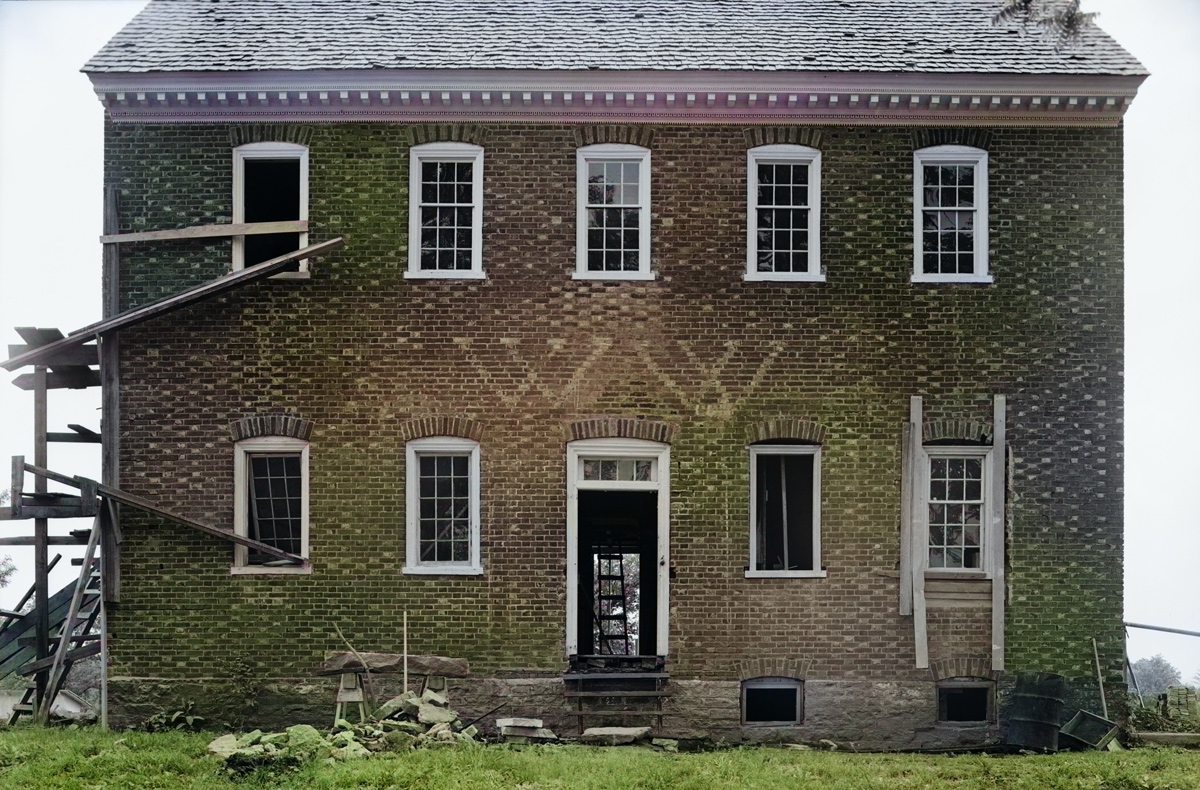
Colorized from the original provided by U.S. Library of Congress, www.loc.gov/pictures/item/ky0096.photos.071420p/.
Safety in Numbers
History books are full of personal accounts of skirmishes with Cherokees, Shawnees, and other tribes along the Wilderness Road. However, shortly after the 1795 Battle of Fallen Timbers—where both William Clark and Meriwether Lewis first served as regular army officers— the ‘Indian menace’ ended. The Wilderness Road became dotted with homes, and travelers could expect to find a tavern every night.[2]Robert L. Kincaid, The Wilderness Road (Indianapolis: The Bobbs-Merrill Company, 1947), 202, available at archive.org/details/wildernessroad00kinc. Prior to 1795, Crab Orchard was the typical assembly point for travelers heading south. People waited there until they had enough partners to travel through “the Great Wilderness” safely.[3]H. Addington Bruce, Daniel Boone and the Wilderness Road (New York: The Macmillan Company, 1910), 290, available at www.archive.org/details/danielboonewilde00bruc.
In 1793, Thomas Jefferson‘s first Western explorer, André Michaux was among a group of travelers assembling at Crab Orchard:
The 11th of November 1793, started from Crab Orchard in company with 12 persons who had assembled at that place to pass through the Woods inhabited and frequented by the Savages. The tract between Crab orchard and Houlston settlement is 130 Miles wide and is called The Wilderness.
—André Michaux[4]André Michaux, Journal of Travels into Kentucky: July 15, 1793–April 11, 1796 in Reuben G. Thwaites, Travels West of the Alleghanies (Cleveland: The Arthur H. Clark Co., 1904), 3:45, available at … Continue reading
Guardian of the Road
Sometime between 1787 and 1794, William and Esther Whitley replaced their log station near Crab Orchard with one of the first brick houses west of the Allegheny Mountains. The above photo shows the William Whitley house during the restoration that occurred between 1948 and 1955. The bricks are laid in a Flemish bond and glazed to form a diamond pattern across the entire face. William’s initials appear prominently above the front and Esther’s initials display above the rear door.[5]Ed Henson, The Kentucky Encyclopedia, John E. Kleber, ed. (University of Kentucky Press, 1992), s.v. “Historic Sites”; “William Whitley House State Shrine: Sportsman’s … Continue reading
The house had to serve as both a home and a fort. Defensive measures included high windows, thick walls, a stairway hidden from view, rifle ports, and heavy shutters. Near the house, the Whitley’s built what many historians think was the first racetrack in Kentucky. Consequently, the house became known as “Sportsman’s Hill”. The horse races attracted many visitors including Kentucky celebrities such as George Rogers Clark, Kentucky’s first governor Isaac Shelby, and James Harrod.[6]Charles G. Talbert, The William Whitley House (Frankfort: Kentucky Department of Parks reprint, nd), 10, available at archive.org/details/williamwhitleyho00talb.
Whitley’s connection to the Clark family was deep. On 6 August 1785, he gave William Clark a receipt for two tracts given to him as a private’s allotment for military service in Illinois. The 108 acres were part of George Rogers Clark’s military land grant on the north bank of the Falls of the Ohio.[7]Ibid., 9.
In November 1806, some new celebrities passed by Sportsman’s Hill—Meriwether Lewis and the Mandan delegation. Newspapers had announced the return of the Lewis and Clark Expedition (see October 9, 1806), and word from Frankfort may have recently reached Crab Orchard informing Whitley that Lewis and his party would soon be arriving. Perhaps Whitley sent out an invitation—or perhaps John Ordway went ahead to arrange a visit at William and Esther’s fortified mansion. The Mandans would not be the first Native American to spend a night there.
Notes
| ↑1 | Traveling with Meriwether Lewis to Washington City is a Mandan delegation from the Knife River Villages—Chief Sheheke, his wife Yellow Corn, and their son. Speaking Mandan and French was interpreter René Jusseaume who brought one of his wives and two children. Expedition private François Labiche was included to translate between French and English. Finally, records indicate expedition sergeant John Ordway was serving as Lewis’s assistant. |
|---|---|
| ↑2 | Robert L. Kincaid, The Wilderness Road (Indianapolis: The Bobbs-Merrill Company, 1947), 202, available at archive.org/details/wildernessroad00kinc. |
| ↑3 | H. Addington Bruce, Daniel Boone and the Wilderness Road (New York: The Macmillan Company, 1910), 290, available at www.archive.org/details/danielboonewilde00bruc. |
| ↑4 | André Michaux, Journal of Travels into Kentucky: July 15, 1793–April 11, 1796 in Reuben G. Thwaites, Travels West of the Alleghanies (Cleveland: The Arthur H. Clark Co., 1904), 3:45, available at archive.org/details/travelswestofall00thwarich/page/n9/mode/2up. |
| ↑5 | Ed Henson, The Kentucky Encyclopedia, John E. Kleber, ed. (University of Kentucky Press, 1992), s.v. “Historic Sites”; “William Whitley House State Shrine: Sportsman’s Hill”, National Register of Historic Places nomination form (Lincoln County, Kentucky). |
| ↑6 | Charles G. Talbert, The William Whitley House (Frankfort: Kentucky Department of Parks reprint, nd), 10, available at archive.org/details/williamwhitleyho00talb. |
| ↑7 | Ibid., 9. |
Experience the Lewis and Clark Trail
The Lewis and Clark Trail Experience—our sister site at lewisandclark.travel—connects the world to people and places on the Lewis and Clark Trail.
Discover More
- The Lewis and Clark Expedition: Day by Day by Gary E. Moulton (University of Nebraska Press, 2018). The story in prose, 14 May 1804–23 September 1806.
- The Lewis and Clark Journals: An American Epic of Discovery (abridged) by Gary E. Moulton (University of Nebraska Press, 2003). Selected journal excerpts, 14 May 1804–23 September 1806.
- The Lewis and Clark Journals. by Gary E. Moulton (University of Nebraska Press, 1983–2001). The complete story in 13 volumes.
This site is provided as a public service by the
Lewis and Clark Trail Alliance
with additional funding from the following: