Near this date, Lewis and company travel along the Wilderness Road between Crab Orchard and Livingston entering Kentucky’s Mountain physiographic region. On John Filson’s map of Kentucky, the route is labeled as “The Road from the Old settlements in Virginia to Kentucky thro’ the great Wilderness”.[1]Traveling with Meriwether Lewis to Washington City is a Mandan delegation from the Knife River Villages—Chief Sheheke, his wife Yellow Corn, and their son. Speaking Mandan and French was … Continue reading
The Great Wilderness
A Map of Kentucky Drawn from Actual Observations by John Filson
(cropped and key moved)
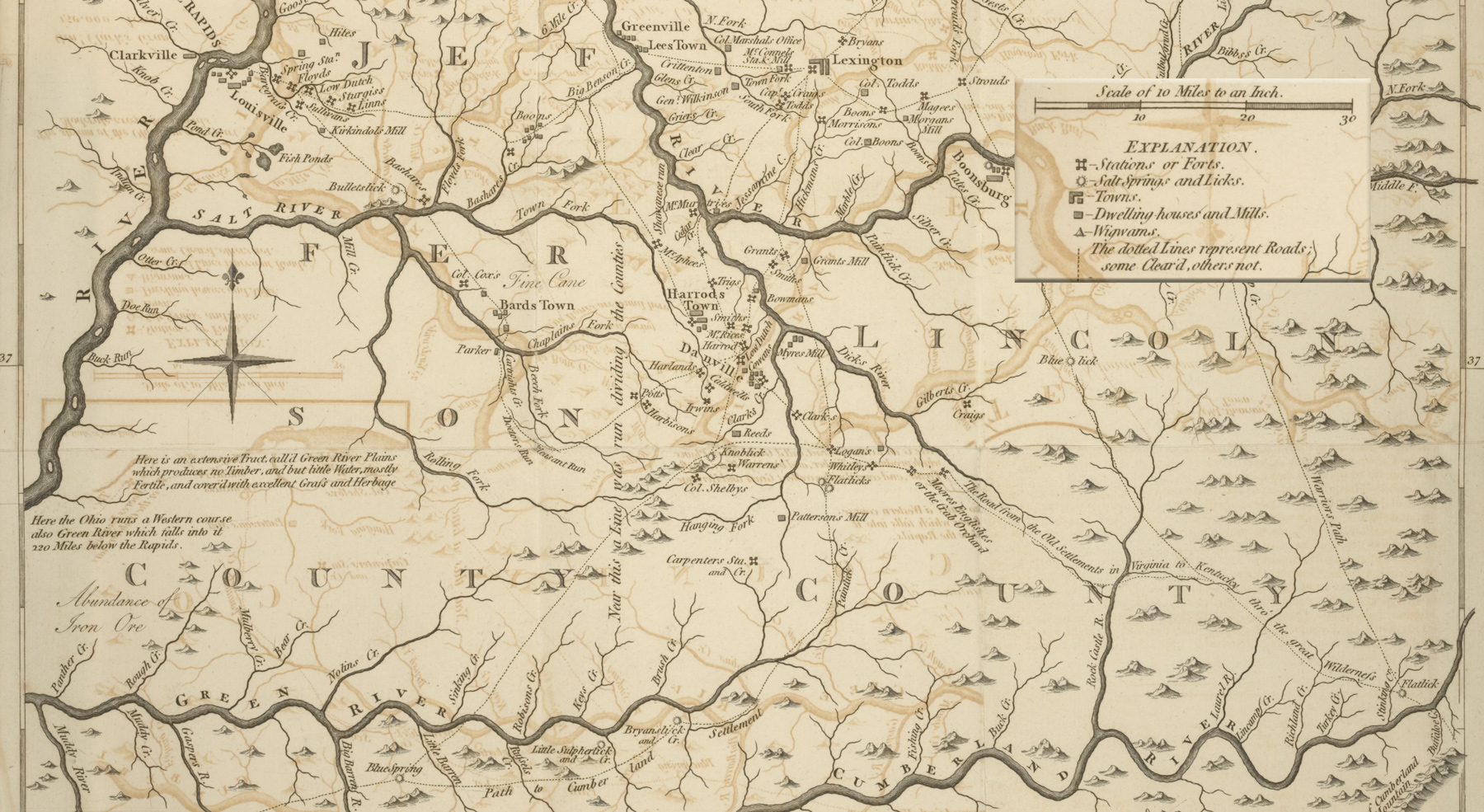
1793 edition. Lionel Pincus and Princess Firyal Map Division, The New York Public Library, New York Public Library Digital Collections, digitalcollections.nypl.org/items/61933260-c5d4-012f-c09e-58d385a7bc34 accessed 15 January 2026.
At the top of his original 1784 map, Filson wrote the following inscription:
While this Work Shall live let this Inscription remain a Monument of the Gratitude of the Author to Col.ls Dan.l Boone, Levi Todd, & Ja.s Harrod, Capt.s Christ.r Greenup, [J]n.o Cowan, and W.m Kennedy, Esq.rs, of Kentucke: for the distinguish’d Assistance, with which they have honor’d him, in its Composition: & a testimony that it has received the Approbation of those whom he justly Esteems the best qualified to Judge of its Merit.
- John Filson (c. 1747–1788) is considered by many to be the first formal historian of Kentucky. He arrived in Kentucky in 1783 and the next year published his book The Discovery, Settlement and Present State of Kentucke . . . (printed in Wilmington, Delaware) and his map (printed in Philadelphia, Pennsylvania).
- Daniel Boone (1734–1820) is generally credited with establishing the Wilderness Road through the Cumberland Gap. However, his route went to Boonesville, not Louisville.
- Levi Todd (1756–1807) was a soldier, pioneer, and politician. He served as a county clerk and was one of the founders of Lexington.
- James Harrod founded what many consider to be the first permanent white settlement in Kentucky—Harrodsburg. He disappeared while on a hunting trip in the wilderness in 1792.
- Christopher Greenup (c. 1750–1818) served as a U.S. Representative and the third governor of Kentucky.
- John Cowan was an early pioneer with a farm above the Falls of the Ohio who “in 1773, saw Captain Bullitt run the lines of the Connelly tract, on which the great city of Louisville was afterward built.”[2]Reuben T. Durrett, John Filson: the First Historian of Kentucky . . . (Louisville, Kentucky: John P. Morton & Co., 1884), 23, available at archive.org/details/johnfilsonfirsth00durr_0.
- William Kennedy was one of the earliest Kentucky settlers, woodsman, and a member of the 1785 and 1787 conventions separating Kentucky from Virginia.
The Wilderness ‘Wagon’ Road
In 1806, both Lewis and Clark said they would take the “Wilderness Road” on their way to Washington City. In 1796, that name first appeared in print in a banner ad at the bottom of a Lexington newspaper:
THE ‘WILDERNESS ROAD from Cumberland Gap to the settlements in Kentucky is now compleated. Waggons loaded with a ton weight, may pass with case. with four good horses.—Travellers will find no difficulty in procuring such necessaries as they stand in need of on the road; and the abundant crop now growing in Kentucky, will afford the emigrants a certainty of being supplied with every necessary of life on the most convenient terms. JOSEPH CROCKETT (this and next are left aligned JAMES KNOX Commissioners [3]Kentucky Gazette (Lexington, Kentucky), 15 October 1796, page 5.
The Wilderness ‘Pack’ Road
Two months after the above Crockett and Knox announcement, Moses Austin gave a very different opinion of the suitability of the Wilderness Road for wagon traffic:
Much Work with many Bridgs may make a good road, but its not to be expected for many years altho the road has been lately opend for waggons and much work don on it[.] much more must be don to make it Tolerable.[4]Moses Austin, The American Historical Review 5, no. 3 [April 1900], 525, available at https://www.jstor.org/stable/1835241.
Definitions of what separates trails from wagon roads vary, but at least one historian says that “the Wilderness Road remained little more than a pack road until 1818, when definite legislative steps were taken to widen the roadway and to improve the fords.”[5]Thomas D. Clark, A History of Kentucky (Lexington, Kentucky: The John Bradford Press, 1950), 180, available at archive.org/details/historyofkentuck0000thom.
The Road in 1861
During the Civil War, soldiers in the Illinois 33rd Infantry Regiment expected a good wagon road to keep troops mobile and well-supplied. They appear to have been disappointed.
The turnpike road and level country terminates at Crab Orchard. Beyond, the country is mountainous, the road rough and difficult, muddy and rocky, running over immense ridges, and winding along and around the edges of frightful precipices . . . . There was not a bridge south of Crab Orchard.[6]David Stevenson, Indiana’s Roll of Honor, vol. 1 (Indianapolis: A. D. Streight, Publisher, 1864) 537, 540, available at archive.org/details/indianasrollofho01stev.
Notes
| ↑1 | Traveling with Meriwether Lewis to Washington City is a Mandan delegation from the Knife River Villages—Chief Sheheke, his wife Yellow Corn, and their son. Speaking Mandan and French was interpreter René Jusseaume who brought one of his wives and two children. Expedition private François Labiche was included to translate between French and English. Finally, records indicate expedition sergeant John Ordway was serving as Lewis’s assistant. |
|---|---|
| ↑2 | Reuben T. Durrett, John Filson: the First Historian of Kentucky . . . (Louisville, Kentucky: John P. Morton & Co., 1884), 23, available at archive.org/details/johnfilsonfirsth00durr_0. |
| ↑3 | Kentucky Gazette (Lexington, Kentucky), 15 October 1796, page 5. |
| ↑4 | Moses Austin, The American Historical Review 5, no. 3 [April 1900], 525, available at https://www.jstor.org/stable/1835241. |
| ↑5 | Thomas D. Clark, A History of Kentucky (Lexington, Kentucky: The John Bradford Press, 1950), 180, available at archive.org/details/historyofkentuck0000thom. |
| ↑6 | David Stevenson, Indiana’s Roll of Honor, vol. 1 (Indianapolis: A. D. Streight, Publisher, 1864) 537, 540, available at archive.org/details/indianasrollofho01stev. |
Experience the Lewis and Clark Trail
The Lewis and Clark Trail Experience—our sister site at lewisandclark.travel—connects the world to people and places on the Lewis and Clark Trail.
Discover More
- The Lewis and Clark Expedition: Day by Day by Gary E. Moulton (University of Nebraska Press, 2018). The story in prose, 14 May 1804–23 September 1806.
- The Lewis and Clark Journals: An American Epic of Discovery (abridged) by Gary E. Moulton (University of Nebraska Press, 2003). Selected journal excerpts, 14 May 1804–23 September 1806.
- The Lewis and Clark Journals. by Gary E. Moulton (University of Nebraska Press, 1983–2001). The complete story in 13 volumes.
This site is provided as a public service by the
Lewis and Clark Trail Alliance
with additional funding from the following: