Indian Gifts and Expedition Equipage
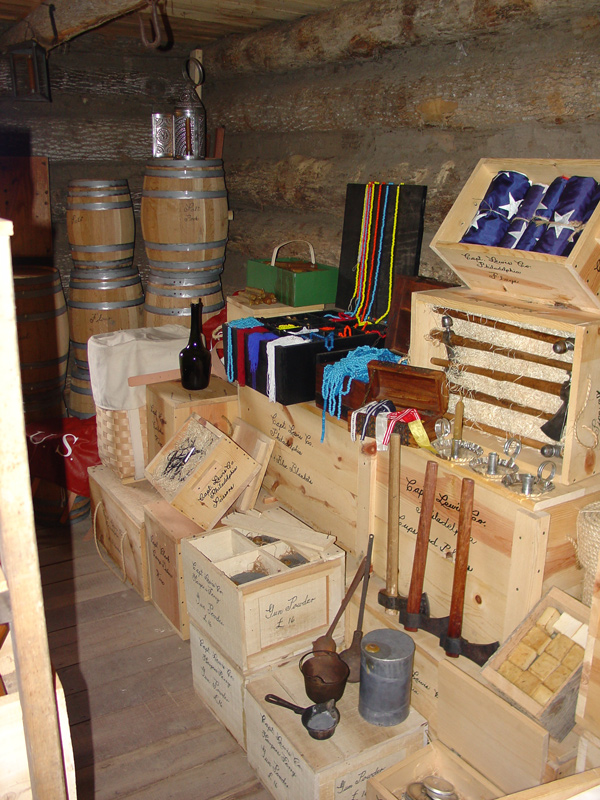
Photo provided by Lewis & Clark State Historic Site, Hartford, Illinois. Used by permission.
John Hay first came to the attention of Lewis and Clark through a letter from Illinois Governor William Henry Harrison dated 13 November 1803. Harrison mentioned a map owned by Hay from the James Mackay and John Evans Expedition, indicating Hay’s significant involvement in fur trading and exploration. Hay and his partner Todd operated a trading post in the Assiniboine and Red River country, making them well-known figures in the fur trade.
As a fur trader for the Northwest Company and Postmaster of Cahokia, Hay played a crucial role in supporting the captains. He provided Lewis with a copy of the Mackay-Evans Expedition’s journal of their 1795 to 1797 journey up the Missouri River. Additionally, Hay and fellow Cahokian, Nicholas Jarrot, acted as translators when Lewis met the Spanish Governor of Upper Louisiana, Carlos Dehault Delassus, in St. Louis.
Hay’s extensive experience with Native American Nations and the fur trade along the Missouri and Mississippi rivers proved invaluable to the expedition. He offered significant information and advice, particularly in procuring the appropriate types and quantities of gifts for the Native Americans they would encounter. His knowledge ensured that the captains were well-prepared to foster positive relations with the various tribes.
In late April 1803, Hay assisted the captains at Wood River, helping them package the Indian gifts into separate bundles, each designated for a specific Nation they would meet. His involvement was a testament to his expertise and his commitment to the success of the expedition.[1]Gary Moulton, The Definitive Journals of Lewis and Clark (Lincoln and London: University of Nebraska Press, 1986), 2:127n1, 167n2, 225n1; Stephanie Ambrose-Tubbs and Clay S. Jenkinson, The Lewis and … Continue reading
Related Pages
David Thompson
A convergence with Lewis, Clark, and Jefferson
by Jack Nisbet
The life and times of these three explorers intertwined in a number of odd and interesting ways, often brought together by far-reaching hand of Thomas Jefferson. Tracing these connections opens a window onto every conceivable aspect of the period.
Jews Harps
by Joseph A. Mussulman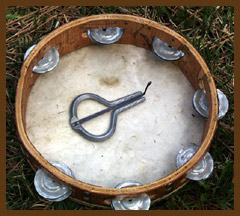
Although nobody can determine how this tiny musical instrument was named, we do know Lewis included them in his list of Indian gifts. Whitehouse records the merriment of the Yankton Sioux playing them and dancing.
November 13, 1803
Leaving Fort Massac
by Kristopher K. Townsend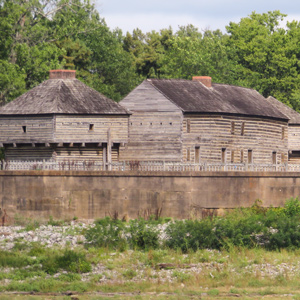
The expedition leaves Fort Massac moving about three miles down the Ohio, and Lewis is “siezed with a violent ague”. The Indiana Territorial Governor pens a letter introducing John Hay of Cahokia.
December 7, 1803
Cahokia arrivals
by Kristopher K. Townsend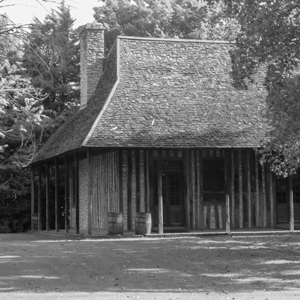
Lewis travels by land and Clark by river to arrive at Cahokia, Illinois. Lewis meets John Hay and Nicholas Jarrot who help him negotiate with the Spanish Lt. governor of Upper Louisiana.
December 8, 1803
Spanish resistance
by Kristopher K. Townsend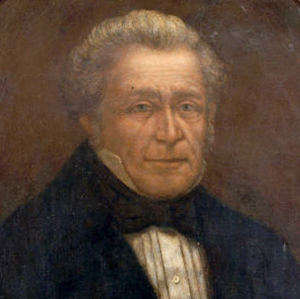
On this or the previous day, Lewis meets with Dehault Delassus, the Spanish Lt. Governor of Upper Louisiana, and all agree that the expedition should spend the winter near Cahokia.
December 28, 1803
Mackay and Evans journals
by Kristopher K. Townsend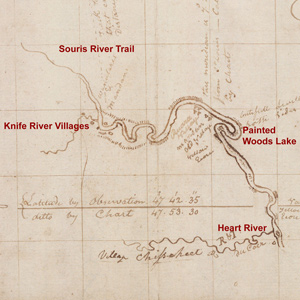
At Wood River, Clark reports “nothing remarkable to day”. Elsewhere, Lewis tells President Jefferson that he has a census of Louisiana and journals and maps from explorers John Evans and James Mackay.
January 30, 1804
Lewis comes to camp
by Kristopher K. Townsend
After working in Cahokia and St. Louis for nearly two months, Lewis comes to winter camp on the Wood River. On or near this date, Clark draws and labels a side elevation of the barge.
February 2, 1804
Hays and Hay depart
by Kristopher K. Townsend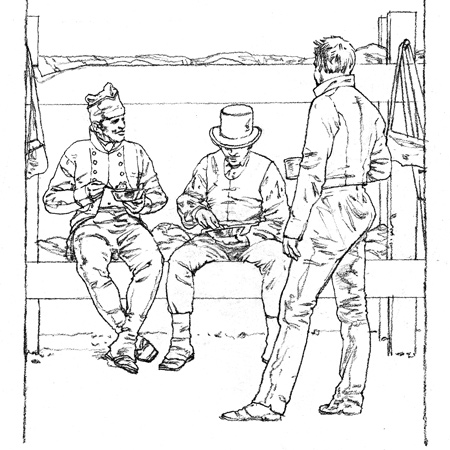
William Clark and Meriwether Lewis accompany John Hay and John Hays part-way back to Cahokia before returning to winter camp at Wood River. Clark’s poor health continues.
April 26, 1804
A killing frost
by Kristopher K. Townsend
At Camp River Dubois across the Mississippi River from St. Louis, fur trader and Cahokia Postmaster John Hay arrives to help prepare what the journalists called ‘Indian gifts’. He reports that frost has killed much of the Cahokia area fruit crop.
April 27, 1804
Preparing Indian goods
by Kristopher K. Townsend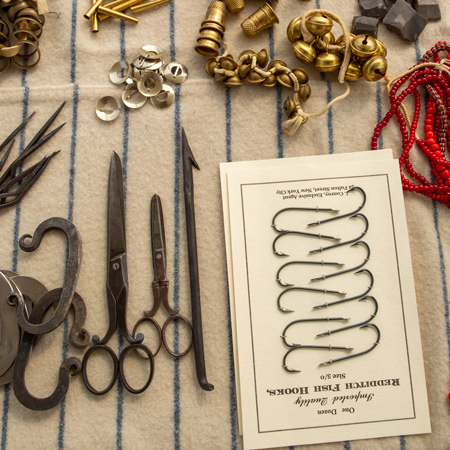
At Camp River Dubois in Illinois, Clark and fur trader John Hay organize the many goods that will be used as diplomatic gifts for the Native Nations the expedition will soon meet. Popular gifts include scissors, fishhooks, iron strikers, and metallic buttons.
April 28, 1804
Shooting for money
by Kristopher K. Townsend
At Camp River Dubois, several local settlers lose their money in marksmanship contests with the enlisted men. John Hay works with “Indian goods” and all hands prepare for their imminent journey up the Missouri. Lewis continues working in St. Louis.
April 29, 1804
Packing Indian goods
by Kristopher K. Townsend
Several Kickapoo chiefs and a boat captain from Louisville visit Clark at Camp River Dubois. Fur trader John Hay continues to pack “Indian goods”, and Lewis continues across the Mississippi at St. Louis.
April 30, 1804
"Indian goods" nearly ready
by Kristopher K. Townsend
At Camp River Dubois, the enlisted men are busy making ready for their voyage up the Missouri. Fur trader John Hay and Cpt. Clark nearly finish sorting and packing the diplomatic gifts into bundles—each designated to be given to a specific Nation. Across the Mississippi, Cpt. Lewis works in St. Louis.
Notes
| ↑1 | Gary Moulton, The Definitive Journals of Lewis and Clark (Lincoln and London: University of Nebraska Press, 1986), 2:127n1, 167n2, 225n1; Stephanie Ambrose-Tubbs and Clay S. Jenkinson, The Lewis and Clark Companion: An Encyclopedic Guide to the Voyage of Discovery (New York: Henry Hold and Company, 2003), 146. |
|---|
Experience the Lewis and Clark Trail
The Lewis and Clark Trail Experience—our sister site at lewisandclark.travel—connects the world to people and places on the Lewis and Clark Trail.
Discover More
- The Lewis and Clark Expedition: Day by Day by Gary E. Moulton (University of Nebraska Press, 2018). The story in prose, 14 May 1804–23 September 1806.
- The Lewis and Clark Journals: An American Epic of Discovery (abridged) by Gary E. Moulton (University of Nebraska Press, 2003). Selected journal excerpts, 14 May 1804–23 September 1806.
- The Lewis and Clark Journals. by Gary E. Moulton (University of Nebraska Press, 1983–2001). The complete story in 13 volumes.
This site is provided as a public service by the
Lewis and Clark Trail Alliance
with additional funding from the following: