Bulrushes
Bulrushes (Tules)
Schoenoplectus sp.
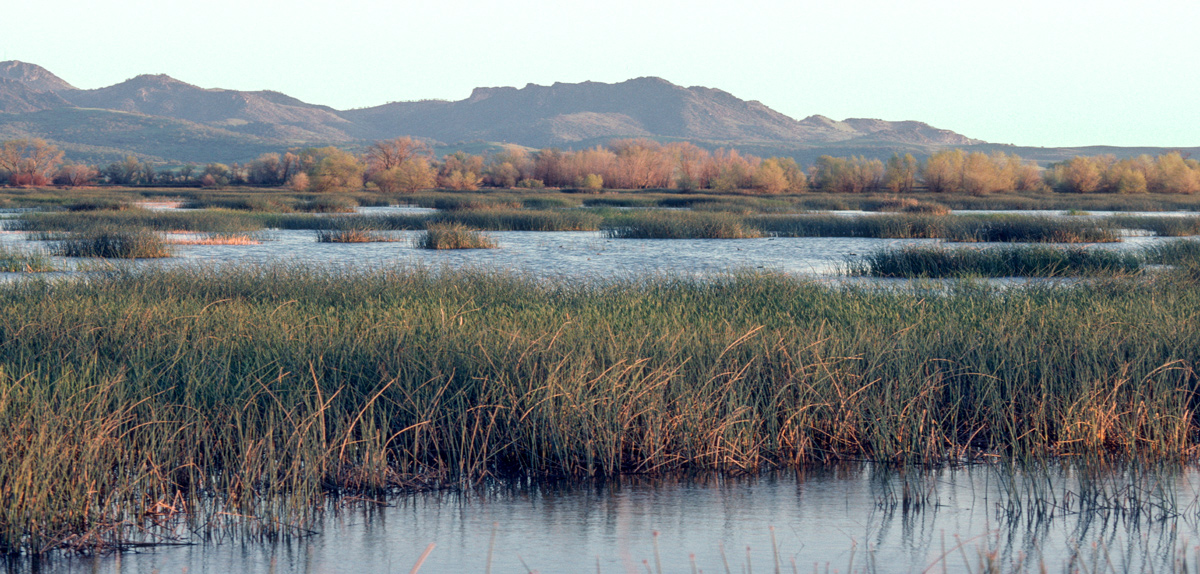
Gray Lodge Waterfowl Management Area, Sutter County, California, 30 March 1991. © Mark W. Skinner.
Hardstem Bulrush
Schoenoplectus acutus

From Vascular Plants of the Pacific Northwest.
Bulrushes—those tall reed-like sedges often growing in large colonies at margins of low-elevation ponds, lakes and still backwaters—are common across North America and were known to the Lewis and Clark Expedition members. Little attention appears to be made of them until Meriwether Lewis specifically mentions the “bull rush” and “Cattail flag” approaching present Townsend, Montana.[1]23 July 1805, The Definitive Journals of Lewis & Clark, Gary Moulton, ed. (Lincoln: University of Nebraska Press, 2002), 4:420. Bulrushes are in the Schoenoplectus genus and should not be confused with cattails of the Typhus genus. They do share similar habitats, but bulrushes prefer to grow in shallow water while cattails prefer mudflats. Adding to the confusion: what Americans call cattails, the English call bulrushes.[2]C. Leo Hitchcock, Arthur Cronquist, Marion Ownbey, and J. W. Thompson, Vascular Plants of the Pacific Northwest (Seattle: University of Washington Press, 1955–69), 1:370–71; … Continue reading
Bulrushes grow up to 10 feet tall making them ideal habitat for fish, muskrats, raccoons, waterfowl, and shore birds seeking cover and food. Previously, bulrushes were members of the Scirpus genus but phylogentics—determining relationships among species using DNA and protein amino acid sequences—revealed that they needed to be placed in a new genus. Schoenoplectus and Scirpus remain in the same family: Cyperaceae—a large family of sedges with true sedges being the genus Carex. In many books including the Moulton edition of the Journals of Lewis and Clark, bulrushes are listed as Scirpus. Of its numerous accepted species, those that are common along the Lewis and Clark Trail are hardstem bulrush (S. acutus), American bulrush (S. americanus), and softstem bulrush (S. tabernaemontani). The softstem species can better tolerate salinity while hardstem is better suited to periods of draught and flooding.[3]“Hardstem Bulrush: Schoenoplectus acutus (Muhl. ex Bigelow) A. Löve & D. Löve”, Plant Guide (USDA Natural Resources Conservation Service), … Continue reading
Mat Lodges
“Indian Camp on the Columbia River at Umatilla Station”
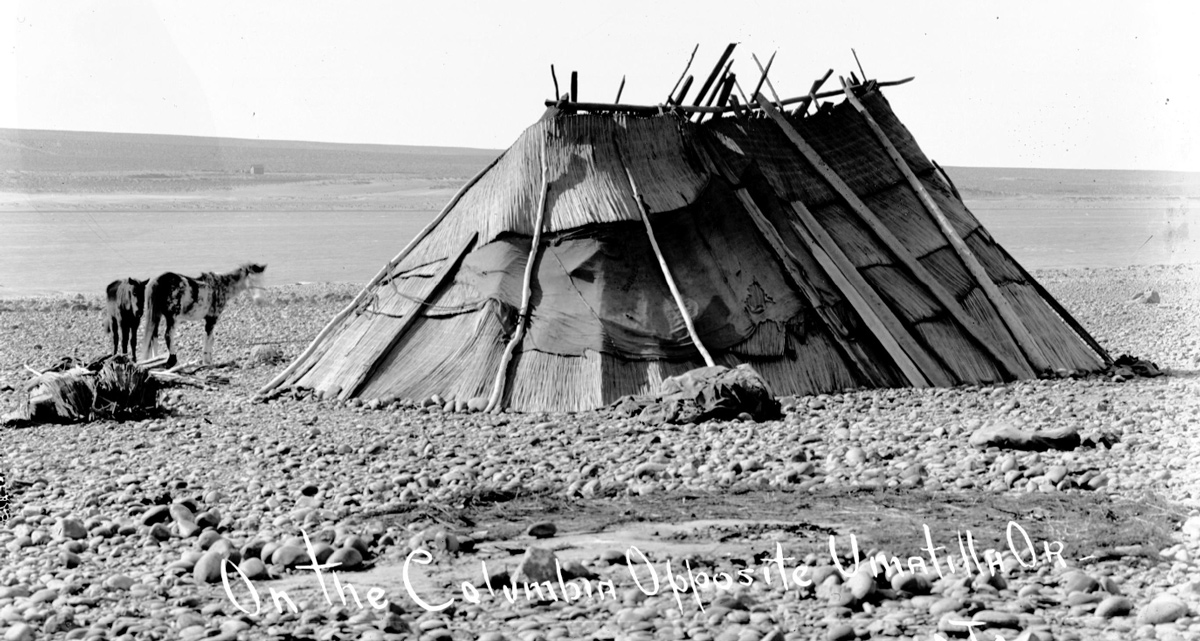
Photo by Lee Moorhouse.[4]Lee Moorhouse (1850-1926) photographs, 1888-1916, University of Oregon. “On the Columbia opposite Umatilla OR” Oregon Digital. Accessed 2025-07-12. … Continue reading
Bulrush Stem Cross-section

© 2010 by WikiCommons User Bb143143. Permission to use granted under the Creative Commons Attribution-ShareAlike 3.0 Unported license.
Bulrushes are often called tules [TOO-lee sing. and TOO-lees pl.]. The word came to California via the Spanish who had learned the term tullin from the Nahuati—a People native to present Mexico. “Out in the tules” comes from California miners and settlers and connotes “where no one wants to be or live”. Ironically, tule mat shelters were exactly where the Plateau Nations encountered by the Lewis and Clark Expedition wanted[5]When referring to the ethnobotanical record, past tense will most often be used. This does not imply the plant is no longer in use in the manner described. to live. The Plateau Peoples routinely harvested bulrushes, dried them, and sewed the stems together to make large mats to cover their wood-framed lodges.
Until Euro-American cloth goods became abundant, bulrush mats were the best option for covering shelters. They were surprisingly insulating, lightweight and portable, and readily available. In the hot summers the reeds shrink, leaving gaps that let in breezes. During winter months, the swollen stems expand to make a tight seal keeping warmth in and precipitation out. The stems are filled with a spongy, cellular material that traps air—the working method of insulation. To make bulrush mats, the stems were collected and slowly dried. The dried reeds were laid together alternating the wider basal ends with the narrower tips. Ethnobiologist Eugene Hunn explains that these “segments are then sewed, with Indian hemp twine [dogbane (Apocynum sp.)] and greasewood (Sarcobates vermiculatus) needles . . . .”[6]Eugene S. Hunn, Nch’i-Wána: “The Big River” Mid-Columbia Indians and their Land (Seattle: University of Washington Press: 1990–2001), 189–196.
Lewis did not collect or describe bulrushes, nor does it appear he ever learned how they were used as a food source. The journalists did mention mat lodges among the Plateau Nations from Lawyer’s Canyon in Kamiah, Idaho to The Dalles, Oregon. Many of these scenes can be viewed on this website as interpreted by artist Roger Cooke. When William Clark frightened a Umatilla family by entering uninvited into their abode, it was a tule mat lodge. When Yellepit gave Clark a white horse on their 1806 return, they were staying at the chief’s village of “15 large mat lodges”. At Broken Arm’s Nez Perce village near present Kamiah, Idaho, Lewis described their longhouse constructed with bulrush mats:
The village of the broken arm as I have heretofore termed it consists of one house only which is 150 feet in length built in the usual form of sticks matts and dry grass. it contains twenty four fires and about double that number of families.[7]10 May 1806, Moulton, 7:239.
The journalists also mention mat lodges among the Palouse, Yakamas, Walla Wallas, and Teninos. Some Wanapum and Yakama families lived in mat lodges well into the 20th-century. Today, the tradition is still alive and can be seen at visitor centers such as the Wanapum Dam Heritage Center near Beverly, Washington and the Tamástslikt Cultural Institute between Umatilla and Pendleton, Oregon.
Other Uses
Yakama Tule (Bulrush) Mat

National Museum of the American Indian, americanindian.si.edu/collections-search/object/NMAI_416072.
Bulrushes were also used to make sleeping mats and to line canoe bottoms as cushions for paddlers’ knees. The Potawatomi, Omaha, Pawnee, Ponca and Lakota made mats, rugs, and bedding from softstem bulrush. The Dakota and Montana Indians did the same with hardstem bulrush. The Dakota and Cheyenne cut the fresh stems, eating them raw. In the Pacific Northwest, the Coastal Salish ate fresh stems from American bulrush (S. americanus). The dried rootstalks of hardstem and softstem bulrushes can be beaten to make flour. Its pollen and seeds were also made into flour for breads and mushes. Young softstem roots could be boiled to make a sweet syrup that quenched thirst.[8]Daniel E. Moerman, Native American Ethnobotany (Portland, Oregon: Timber Press, 1988), 521–24; “Softstem Bulrush (USDA)”; “Hardstem Bulrush” (USDA).
Experience the Lewis and Clark Trail
The Lewis and Clark Trail Experience—our sister site at lewisandclark.travel—connects the world to people and places on the Lewis and Clark Trail.
Plan a trip related to Bulrushes (Tules):
Notes
| ↑1 | 23 July 1805, The Definitive Journals of Lewis & Clark, Gary Moulton, ed. (Lincoln: University of Nebraska Press, 2002), 4:420. |
|---|---|
| ↑2 | C. Leo Hitchcock, Arthur Cronquist, Marion Ownbey, and J. W. Thompson, Vascular Plants of the Pacific Northwest (Seattle: University of Washington Press, 1955–69), 1:370–71; “Schoenoplectus”, Wikipedia, en.wikipedia.org/wiki/Schoenoplectus accessed 11 July 2025. |
| ↑3 | “Hardstem Bulrush: Schoenoplectus acutus (Muhl. ex Bigelow) A. Löve & D. Löve”, Plant Guide (USDA Natural Resources Conservation Service), plants.usda.gov/DocumentLibrary/plantguide/pdf/cs_scta2.pdf; “Softstem Bulrush: Schoenoplectus tabernaemontani (K.C. Gmel.) Palla”, Plant Guide, (USDA Natural Resources Conservation Service), plants.usda.gov/DocumentLibrary/plantguide/pdf/pg_scac3.pdf both accessed 11 July 2025. |
| ↑4 | Lee Moorhouse (1850-1926) photographs, 1888-1916, University of Oregon. “On the Columbia opposite Umatilla OR” Oregon Digital. Accessed 2025-07-12. oregondigital.org/concern/images/df70nb834. |
| ↑5 | When referring to the ethnobotanical record, past tense will most often be used. This does not imply the plant is no longer in use in the manner described. |
| ↑6 | Eugene S. Hunn, Nch’i-Wána: “The Big River” Mid-Columbia Indians and their Land (Seattle: University of Washington Press: 1990–2001), 189–196. |
| ↑7 | 10 May 1806, Moulton, 7:239. |
| ↑8 | Daniel E. Moerman, Native American Ethnobotany (Portland, Oregon: Timber Press, 1988), 521–24; “Softstem Bulrush (USDA)”; “Hardstem Bulrush” (USDA). |