Sacagawea & Baptiste
by Mari Bolen, Hamilton, Montana
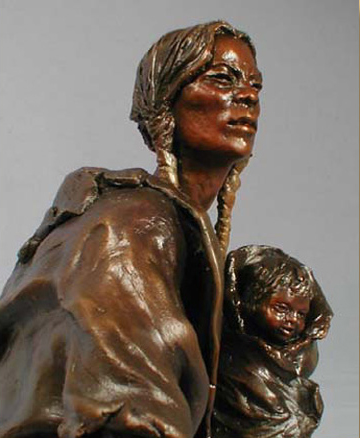
Photo by Mari Bolen.
As with the majority of expedition members, Sacagawea’s likeness was not described or captured. For more artistic renditions, see on this site The Faces of Sacagawea.—Ed.
Three main accounts of Sacagawea’s[1]The authors use Sacagawea as the de facto spelling unless discussing the spellings associated with Hebard’s Shoshone accounts pre- and post-Expedition life exist. The existence of three differing accounts demonstrates the way in which various groups seek to claim Sacagawea as their own. It also compels researchers and the public to conduct a thorough and careful analysis and interpretation of primary sources, oral histories, tribal identities, and family relationships in seeking to know Sacagawea for themselves.
The three accounts of Sacagawea’s birth, life, and death have ties to different Indigenous tribes, and each account is associated with a different rendition of her name.[2]For more names attributed to Sacagawea, see on this site Sacagawea’s Many Names. An analysis of the various spellings and meanings of Sacagawea is given in Irving W. Anderson and Blanche … Continue reading Her death in 1812 at Fort Manuel and burial near the Missouri River in present-day northern South Dakota is considered the most historically accurate by scholars who rely on contemporary written primary sources of the early nineteenth century.[3]William Clark made a list of the expedition members between 1825 and 1828 and recorded that Sacagawea was dead. “Clark’s List of Expedition Members,” Donald Jackson, ed., Letters of … Continue reading They support the Hidatsa derivation of her name “Sacagawea,” meaning “Bird Woman,” since she identified herself as such to Meriwether Lewis and William Clark. Many Lemhi and Eastern Shoshones prefer calling her “Sacajawea,” which means “Boat Launcher.”[4]Brigham D. Madsen, The Lemhi: Sacajawea’s People (Caldwell, ID: Caxton Printers, Ltd., 1990).
The Eastern Shoshone-Comanche account chronicles additional journeys and adventures Sacajawea supposedly had while living with Shoshone and Comanche groups in Wyoming, Colorado, and Oklahoma over many decades. Oral histories claim she died in 1884 and is buried in the Sacajawea Cemetery in Fort Washakie, Wind River Indian Reservation, in Wyoming.[5]Grace Raymond Hebard, Sacajawea: Guide and Interpreter of Lewis and Clark (1933; reprint, Mineola, NY: Dover, 2002), 90, 93, 288-89. Hebard was one of her first biographers. Other biographies … Continue reading
The Hidatsa-Crow account uses “Sacagawea” or “Sakakawea”, both meaning “Bird Woman”, or “Maeshuwea” meaning “Eagle Woman” as her name. Oral histories place her death in 1869 near the Upper Missouri River in Montana.[6]Sacagawea Project Board of the Mandan, Hidatsa & Arikara Nation, Our Story of Eagle Woman Sacagawea, 64.
1812 Fur Trade Account
In August 1812, the Charbonneaus, likely accompanied by the Sheheke-shote family, journeyed downstream to Manuel Lisa‘s newly constructed Fort Manuel, built on a bluff twelve miles south of the Arikara villages near modern-day Mobridge, South Dakota, arriving on August 27. The Charbonneau family lived at the fort, which was completed on November 19. Sacagawea experienced chills, fever, vomiting, diarrhea, and other symptoms. On a clear and moderate winter Sunday, 20 December 1812, John C. Luttig, the clerk at Fort Manuel, recorded that “this Evening, the Wife of Charbonneau a Snake Squaw, died of a putrid fever she was a good and the best Women in the fort, aged abt 25 years she left a fine infant girl.”[7]John C. Luttig, Journal of a Fur-trading Expedition, 106. For “Squaw”, see on this site Defining ‘Squaw’.
Clark was therefore in close enough contact with the Charbonneau family that he should have been aware of the whereabouts of Sacagawea just as he was of her husband and children. In William Clark’s cash book and journal kept between 1825 and 1828, Clark made a list of the expedition members and their current whereabouts according to his knowledge. He recorded: “Se car Ja we au Dead.”[8]Larry E. Morris, “The War and the Corps: An Expedition Roster, 1812,” We Proceeded On 44:1 (February 2018): 12, lewisandclark.org/wpo/pdf/vol44no1.pdf. Clark, who employed her husband and served as the legal guardian of her children and met with the fur traders and tribal delegations who visited him in St. Louis, was in a position to know Sacagawea’s fate better than anyone else.
1884 Eastern Shoshone-Comanche Account
Sacajawea Headstone
Fort Washakie, Wyoming
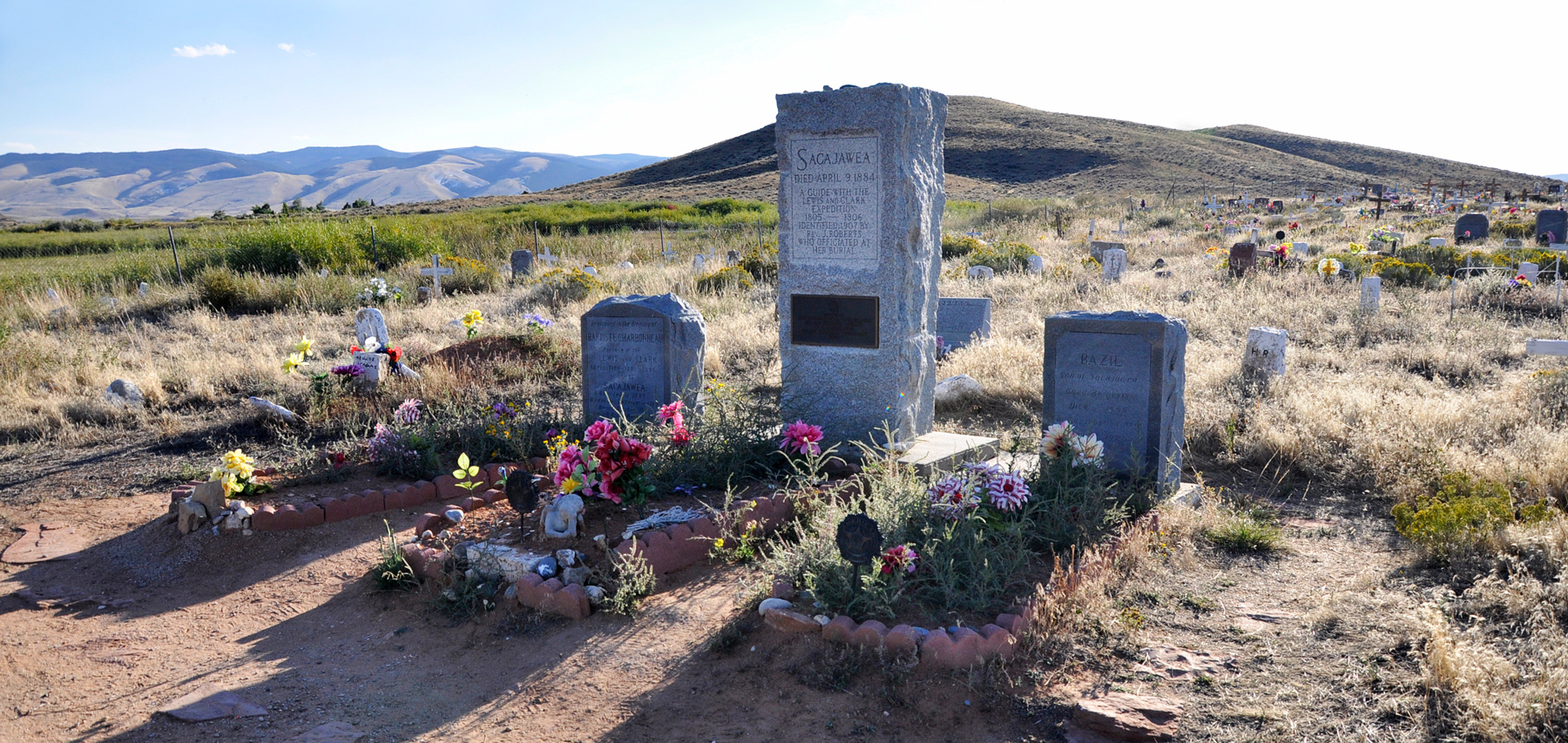
© 2014 by Paul Hermans. Permission to use granted under the Creative Commons Attribution-Share Alike 4.0 International license.
Transcription:
Sacajawea
Died April 9, 1884
A guide with the
Lewis and Clark
Expedition
1805—1806
Identified, 1907 by
Rev. J. Roberts
who officiated at her burial.
University of Wyoming historian Grace Raymond Hebard interviewed several Eastern Shoshones on the Wind River Indian Reservation in the early twentieth century. She also incorporated the research and oral histories gathered by Santee Dakota physician and writer Ohiye S’a, Dr. Charles Eastman. Hebard wove together interviews and suppositions, sometimes without corroborating evidence, about an astonishing one-hundred-year-old Shoshone named Porivo who actually claimed to be Sacajawea—the spelling and pronunciation Hebard privileged in her interviews, writing, and biography—into a narrative account published as Sacajawea in 1933.
At some point—the timing of which remains unclear in this account—Charbonneau married a young Ute woman with whom Sacajawea did not get along. After quarrelling, he sided with his new wife and beat Sacajawea. Humiliated, she left him, never to return.[9]Hebard, Sacajawea, 153-54. She wandered around the west for an uncertain length of time until she joined with some Comanches. She married a Comanche named Jerk Meat with whom she lived and had five children, only two of whom survived to adulthood. Then, around 1843, Jerk Meat died, and Sacajawea no longer felt she had a place with the Comanches. She left with her two daughters, determined to return to her Shoshone people.[10]Hebard, Sacajawea, 154-55. While looking for them, she traveled with John C. Fremont for a time until finding Eastern Shoshones at Fort Bridger in present-day Wyoming.[11]Hebard, Sacajawea, 156-58.
Although Sacajawea apparently moved around quite a bit, she eventually decided to remain with the Eastern Shoshones, led by Chief Washakie. Somehow, she reunited with her sister’s son Basil, whom she had apparently adopted during the Lewis and Clark Expedition.[12]Dr. Eastman thought that Basil was Toussaint’s son Toussaint, the son of Charbonneau and Otter Woman. Clark and Edmonds, Sacagawea of the Lewis and Clark Expedition, 121. Her son Jean Baptiste also lived with this group. They were present at the 1868 treaty at Fort Bridger when the Eastern Shoshones were assigned their new home on the Wind River Indian Reservation in central Wyoming.[13]Hebard, Sacajawea, 166-69. In 1871, she and her sons moved to the reservation and remained there for the rest of their lives (even though Jean Baptiste actually died in Danner, Oregon, on 16 May 1866).[14]Hebard, Sacajawea, 166-69. Hebard’s Shoshone informants knew Sacajawea by many names, including Porivo or Chief Woman, Lost Woman, Water-White-Man, and Sacajawea, meaning Boat or Canoe Launcher.[15]Hebard, Sacajawea, 292. The Shoshones and Americans she lived around greatly respected her, and occasionally she told them stories about her journey to the ocean with the American explorers, although they sometimes thought her stories were unbelievable.[16]Hebard, Sacajawea, 175. She was found dead in her teepee on the morning of 9 April 1884, and was buried in the cemetery that was eventually renamed the Sacajawea Cemetery in Fort Washakie, Wyoming.[17]Hebard, Sacajawea, 207–8. To be fair to Hebard, Luttig’s journal (published in 1920) had not specifically indicated which of Charbonneau’s wives died in 1812 and Stella Drumm, the … Continue reading
1869 Hidatsa-Crow Account
Lucy Evans
Daughter of Bulls Eye
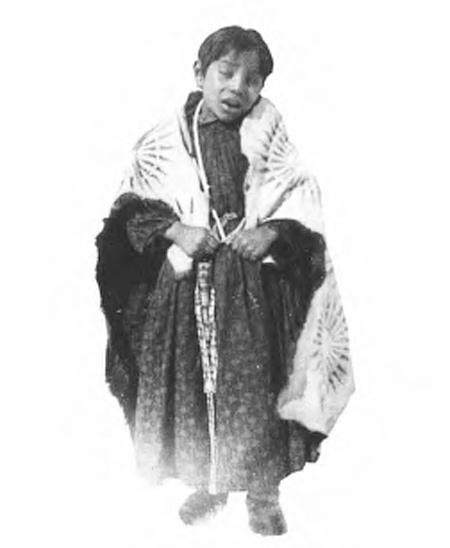
Courtesy of Sacagawea Project Board of the Mandan, Hidatsa & Arikara Nation, Our Story of Eagle Woman.
According to Hidatsa history, Charbonneau’s other wife at the time Lewis and Clark arrived was Otter Woman, an older sister of Sacagawea. Otter Woman was the mother of Toussaint, a boy born a few years before the Expedition. Just as the 1884 account claims, they believe it was Sacagawea’s sister Otter Woman who died in 1812 at Fort Manuel.[18]Sacagawea Project, Eagle Woman, 161. The Hidatsas insist that Sacagawea returned to the Knife River village with Charbonneau in 1813. In 1815, Charbonneau and Sacagawea traveled to St. Louis to visit their son before joining Auguste Chouteau’s 1816–1817 fur-trapping expedition along the Arkansas River. By 1825 the couple were back among the Hidatsas. That same year her father Smoked Lodge signed the Atkinson-O’Fallon Treaty with Clark’s nephew Benjamin O’Fallon.[19]Sacagawea Project, Eagle Woman, 274.
Charbonneau and Sacagawea survived the smallpox epidemic of 1837 that decimated the Mandan and Hidatsa and then moved to Fort Clark. Shortly thereafter, she gave birth to three daughters in an effort to rebuild the tribes’ population. Sacagawea was in her early fifties when these children were born. Charbonneau headed downriver in 1839 to claim his last paycheck in St. Louis and died a few years later in 1843.[20]Sacagawea Project, Eagle Woman, 278.
Sacagawea apparently moved back and forth between living with her Crow relatives in Montana and Hidatsa relatives in North Dakota since the Hidatsas and Crows were cousins. Sacagawea lived near her daughters Otter Woman and Cedar Woman.[21]Sacagawea Project, Eagle Woman, 278. Bulls Eye—Sacagawea’s grandson through her daughter Otter Woman—claimed to have been present when Sacagawea died. He recounted his grandmother became quite addicted to coffee and traveled great distances to trading posts to buy more when her supply ran low. On one such occasion in 1869 she traveled with her daughter Otter Woman and four-year-old grandson Bulls Eye along with a company of a few wagons to a trading post near present-day Wolf Point, Montana. Enroute, the company was attacked one night, and several of the party, including his mother Otter Woman, were killed. Sacagawea grabbed Bulls Eye and hid with him in a nearby gulch. In the process, a bullet hit Sacagawea in the side. Despite the injury, she took her grandson and walked to a nearby fort or trading post. Seven days later, his grandmother Sacagawea died from her wound. Oral histories disagree on her burial place along the Missouri River. One account suggests she was buried at a trading post near Wolf Point; another says it was near Culbertson, Montana; and a third believes it was near Fort Buford in North Dakota.[22]Calvin Grinnell, “Another View of Sakakawea,” We Proceeded On 25:2 (May 1999): 16-19, lewisandclark.org/wpo/pdf/vol25no2.pdf; Sacagawea Project, Eagle Woman, 52-54, 61-62, 64-65, 67, … Continue reading
This is an extract from Maren C. Burgess and Jay H. Buckley, “Seeking Sacagawea: A Comparison of the Principal Accounts of the Birth, Life, and Death of Bird Woman”, We Proceeded On 35, no. 3 (August 2009), 8–19. We encourage the dedicated scholar to read the complete, original article at lewisandclark.org/wpo/pdf/vol49no3.pdf—Ed.
Notes
| ↑1 | The authors use Sacagawea as the de facto spelling unless discussing the spellings associated with Hebard’s Shoshone accounts |
|---|---|
| ↑2 | For more names attributed to Sacagawea, see on this site Sacagawea’s Many Names. An analysis of the various spellings and meanings of Sacagawea is given in Irving W. Anderson and Blanche Schroer, “Sacagawea, Sacajawea, or Sakakawea: How Do You Spell Birdwoman?” We Proceeded On 38:3 (August 2012): 10–11, lewisandclark.org/wpo/pdf/vol38no3.pdf. |
| ↑3 | William Clark made a list of the expedition members between 1825 and 1828 and recorded that Sacagawea was dead. “Clark’s List of Expedition Members,” Donald Jackson, ed., Letters of the Lewis and Clark Expedition with Related Documents, 1783-1854, 2nd ed. (Urbana: University of Illinois Press, 1978), 2:638-39; John C. Luttig, Journal of a Fur-trading Expedition on the Upper Missouri, 1812–1813, Stella M. Drumm, ed. (New York: Argosy-Antiquarian, 1964), 106; Larry E. Morris, The Fate of the Corps: What Became of the Lewis and Clark Explorers After the Expedition (New Haven: Yale University Press, 2004), 106-17, 210–13, 238–41. |
| ↑4 | Brigham D. Madsen, The Lemhi: Sacajawea’s People (Caldwell, ID: Caxton Printers, Ltd., 1990). |
| ↑5 | Grace Raymond Hebard, Sacajawea: Guide and Interpreter of Lewis and Clark (1933; reprint, Mineola, NY: Dover, 2002), 90, 93, 288-89. Hebard was one of her first biographers. Other biographies include: James Willard Schultz, Bird Woman (Sacajawea): The Guide of Lewis and Clark; Her Own Story Now First Given to the World (Boston: Houghton Mifflin, 1918); Harold P. Howard, Sacajawea (Norman: University of Oklahoma Press, 1971); Ella E. Clark and Margot Edmonds, Sacagawea of the Lewis and Clark Expedition (Los Angeles: University of California Press, 1979); and, most recently, Sacagawea Project Board of the Mandan, Hidatsa & Arikara Nation, Our Story of Eagle Woman Sacagawea: They Got It Wrong (Orange, CA: Paragon Agency, 2021). For an account of Sacagawea’s legendary role in American history, see Donna J. Kessler, The Making of Sacagawea: A Euro-American Legend (Tuscaloosa: University of Alabama Press, 1996). For a brief account, see Jay H. Buckley, “Sacagawea,” Encyclopedia Britannica, https://www.britannica.com/biography/Sacagawea, accessed May 11, 2023. |
| ↑6 | Sacagawea Project Board of the Mandan, Hidatsa & Arikara Nation, Our Story of Eagle Woman Sacagawea, 64. |
| ↑7 | John C. Luttig, Journal of a Fur-trading Expedition, 106. For “Squaw”, see on this site Defining ‘Squaw’. |
| ↑8 | Larry E. Morris, “The War and the Corps: An Expedition Roster, 1812,” We Proceeded On 44:1 (February 2018): 12, lewisandclark.org/wpo/pdf/vol44no1.pdf. |
| ↑9 | Hebard, Sacajawea, 153-54. |
| ↑10 | Hebard, Sacajawea, 154-55. |
| ↑11 | Hebard, Sacajawea, 156-58. |
| ↑12 | Dr. Eastman thought that Basil was Toussaint’s son Toussaint, the son of Charbonneau and Otter Woman. Clark and Edmonds, Sacagawea of the Lewis and Clark Expedition, 121. |
| ↑13 | Hebard, Sacajawea, 166-69. |
| ↑14 | Hebard, Sacajawea, 166-69. |
| ↑15 | Hebard, Sacajawea, 292. |
| ↑16 | Hebard, Sacajawea, 175. |
| ↑17 | Hebard, Sacajawea, 207–8. To be fair to Hebard, Luttig’s journal (published in 1920) had not specifically indicated which of Charbonneau’s wives died in 1812 and Stella Drumm, the editor, had made a few suppositions about the wives and children that may have influenced Hebard’s assumptions. William Clark’s list of Expedition members noting that Sacagawea was dead before 1825 was not discovered until 1955 by Dale Morgan, twenty-two years after Hebard’s biography of Sacajawea was published. Clark’s vital list finally appeared in print in Donald Jackson’s Letters of the Lewis and Clark Expedition in the 1960s and again in 1978. |
| ↑18 | Sacagawea Project, Eagle Woman, 161. |
| ↑19 | Sacagawea Project, Eagle Woman, 274. |
| ↑20 | Sacagawea Project, Eagle Woman, 278. |
| ↑21 | Sacagawea Project, Eagle Woman, 278. |
| ↑22 | Calvin Grinnell, “Another View of Sakakawea,” We Proceeded On 25:2 (May 1999): 16-19, lewisandclark.org/wpo/pdf/vol25no2.pdf; Sacagawea Project, Eagle Woman, 52-54, 61-62, 64-65, 67, 69–70, 280. |
Experience the Lewis and Clark Trail
The Lewis and Clark Trail Experience—our sister site at lewisandclark.travel—connects the world to people and places on the Lewis and Clark Trail.
Discover More
- The Lewis and Clark Expedition: Day by Day by Gary E. Moulton (University of Nebraska Press, 2018). The story in prose, 14 May 1804–23 September 1806.
- The Lewis and Clark Journals: An American Epic of Discovery (abridged) by Gary E. Moulton (University of Nebraska Press, 2003). Selected journal excerpts, 14 May 1804–23 September 1806.
- The Lewis and Clark Journals. by Gary E. Moulton (University of Nebraska Press, 1983–2001). The complete story in 13 volumes.
This site is provided as a public service by the
Lewis and Clark Trail Alliance
with additional funding from the following: