Pvt. Labiche returns to Fish Camp near present Homer, Nebraska with news that three Otoe chiefs and the deserter Pvt. Reed will soon arrive. A prairie fire is set to signal any nearby Indians, and Lewis collects a specimen of curly-cup gumweed—now lost.
Deserter Moses Reed Caught
by Yellowstone Public Radio[1]Originally aired weekdays by Yellowstone Public Radio during the Bicentennial observance of 2003-2006. Narrated by Hal Hansen. Scripts by Whit Hansen and Ed Jacobson. Produced by Leni Holliman. © … Continue reading
Three Otoe Chiefs
Prairie Fire
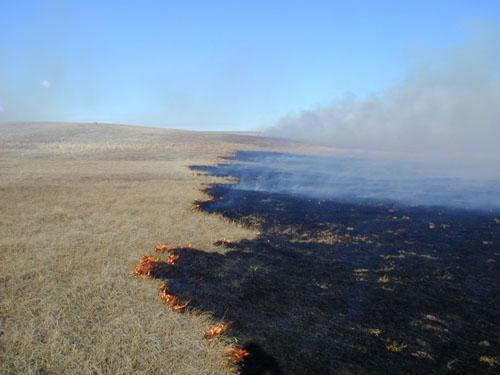
Generated from the original provided by the U.S. National Park Service, Badlands National Park.
the object of those Chiefs comeing forward is to make a peace with the Mahars [Omahas] thro: us—. as the Mahars are not at home this great object cannot be accomplished at this time Set the Praries on fire to bring the Mahars & Soues if any were near, this being the usial Signal.
—William Clark
In 1810, Nicholas Biddle asked William Clark about setting fires as a signal and recorded his reply:
Setting a prairie on fire is the common signal made by traders to apprize the Indians of their arrival at any place. This also made by different nations of Indians & being seen at a distance serves as an indication of any particular subject that they have previously agreed on.[2]“The Nicholas Biddle Notes” in Letters of the Lewis and Clark Expedition with Related Documents: 1783–1854, ed. Donald Jackson (Urbana: University of Illinois Press, 1978), 2:514.
News of Moses Reed
at 6 oClock this evening Labieche one of the Party Sent to the Ottoes joined, and informed that the Party was behind with one of the Deserters M B. Reed and the 3 principal Chiefs of the Nations— La Liberty [La Liberté] they cought but he decived them and got away—
—William Clark
Curly-cup Gumweed
Curly-cup Gumweed
Grindelia squarrosa

Photo © 2005 Cory Maylett. Permission via the GNU Free Documentation License.
No. 40. — Taken at our camp at the Maha vilage August 17th 1804. it is a handsome plant about 3 feet high much branched bears a yellow circular flower . . . . annual plant is covered with a gumlike substance which adheres to the fingers and yealds a pleasent smell.—
—Meriwether Lewis[3]This description comes from the list that Lewis provided with specimens sent from Fort Mandan and recorded in John Vaughn’s 1805 Donation Book. Three sheets in the Lewis and Clark Herbarium … Continue reading
Notes
| ↑1 | Originally aired weekdays by Yellowstone Public Radio during the Bicentennial observance of 2003-2006. Narrated by Hal Hansen. Scripts by Whit Hansen and Ed Jacobson. Produced by Leni Holliman. © 2003 by Yellowstone Public Radio. |
|---|---|
| ↑2 | “The Nicholas Biddle Notes” in Letters of the Lewis and Clark Expedition with Related Documents: 1783–1854, ed. Donald Jackson (Urbana: University of Illinois Press, 1978), 2:514. |
| ↑3 | This description comes from the list that Lewis provided with specimens sent from Fort Mandan and recorded in John Vaughn’s 1805 Donation Book. Three sheets in the Lewis and Clark Herbarium exist. Gary E. Moulton, ed. Journals, “Fort Mandan Miscellany”, vol 3:459, 468. See also, Herbarium, specimen 76. |
Experience the Lewis and Clark Trail
The Lewis and Clark Trail Experience—our sister site at lewisandclark.travel—connects the world to people and places on the Lewis and Clark Trail.
This page was funded in part by the Lewis and Clark National Historic Trail, U.S. National Park Service.
Discover More
- The Lewis and Clark Expedition: Day by Day by Gary E. Moulton (University of Nebraska Press, 2018). The story in prose, 14 May 1804–23 September 1806.
- The Lewis and Clark Journals: An American Epic of Discovery (abridged) by Gary E. Moulton (University of Nebraska Press, 2003). Selected journal excerpts, 14 May 1804–23 September 1806.
- The Lewis and Clark Journals. by Gary E. Moulton (University of Nebraska Press, 1983–2001). The complete story in 13 volumes.
This site is provided as a public service by the

Lewis and Clark Trail Alliance
with additional funding from the following: