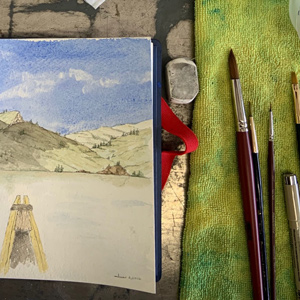
Wayne Wilson

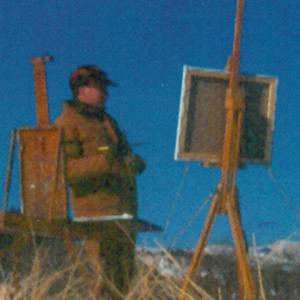
While Wayne has been sketching and painting since high school, it was not until his first paddle trip in 2011 that he started keeping what you would call a ‘Travel Journal’. Watercolors from his Columbia, Missouri, and Yellowstone canoe trips are featured here.
OPEN


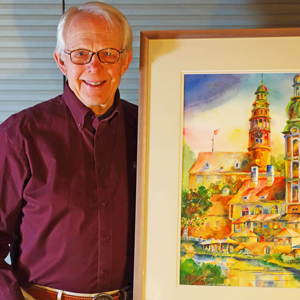
Steve Ludeman

Watercolors and sketches

Steve Ludeman’s watercolors illustrate the Lewis and Clark Expedition’s beginnings from the Eastern seaboard, down the Ohio, and up the Mississippi on their way to winter camp at River Dubois (Wood River) across from St. Louis.

OPEN


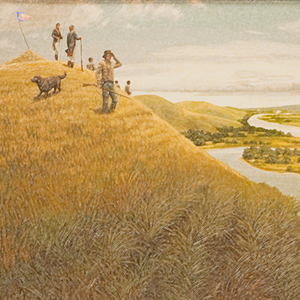
Split Rock Studios

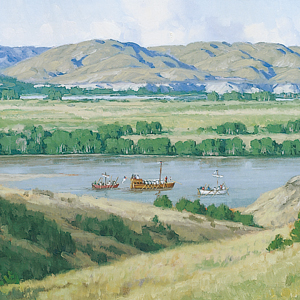
Split Rock Studios created a series of thirty-eight paintings interpreting the Lewis and Clark Expedition’s journey. Several paintings, photographed by Kristopher K. Townsend, illustrate pages on this website.

OPEN


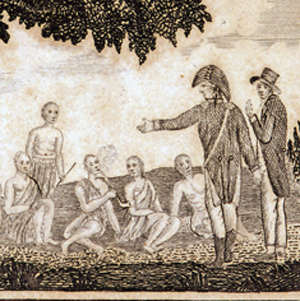
Henry Warre

As part of his secretive instructions from the British government in 1845, Warre made sketches documenting indigenous people of that era.

OPEN


L&C in Literature

The “writingest” American expedition was entangled in the contemporary literature of its time and their successes eventually led to a large literary response.

OPEN


Olin Wheeler

Wheeler’s The Trail of Lewis and Clark, 1804-1904 contained photographic reproductions of 8 portraits; 8 photos of important artifacts, 15 maps, 24 manuscript documents, and 24 copies of paintings by prominent American and Euro-American artists.

OPEN


John Mix Stanley

The American portraitist, artist and illustrator John Mix Stanley (1814-1872), served as one of the official artists with the Stevens railroad survey party to the Northwest. His record of highlights along the route often combined documentary verisimilitude with romantic fantasy.

OPEN


Gustavus Sohon

Gustavus Sohon was a U.S. Army artist for several government-sponsored expeditions, most notably the one led by Isaac Stevens in 1853-1855 to locate potential railroad routes to the Pacific Coast. His hand-tinted lithographs of Western scenes remained an important basis for popular perceptions of the Far West.

OPEN


Charles M. Russell

Born in St. Louis, Missouri, in 1864, Charles M. (“Charlie”) Russell arrived in Montana as a 16-year-old youth, intent on fulfilling his dream of becoming a real, working cowboy. Lewis and Clark Meeting the Flatheads, painted in 1912, is Russell’s largest work.

OPEN


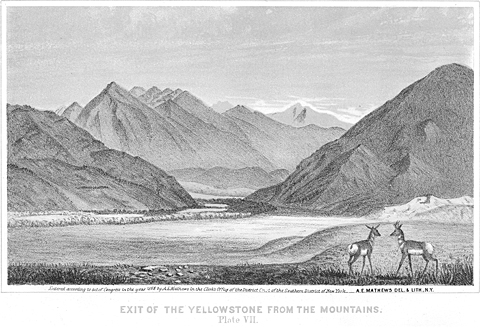
Alfred E. Mathews

Mathews’ reputation still falls somewhat short of greatness in the regard of art historians. Nevertheless, his own self-published lithographs of Colorado and Montana have grown more and more valuable as documentaries of Western topography and history, as the decades have passed. Several of his lithographs are featured on this site.

OPEN


John James Barralet

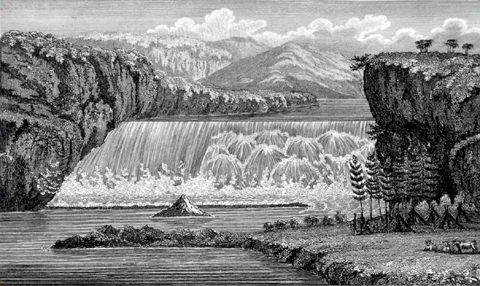
Lewis probably showed Barralet his own sketches of the “stronger features” of the Great Fall of the Missouri and did his best to refine the details verbally, striving to recapture the essence of the “sublime” he had recognized in the scene.

OPEN


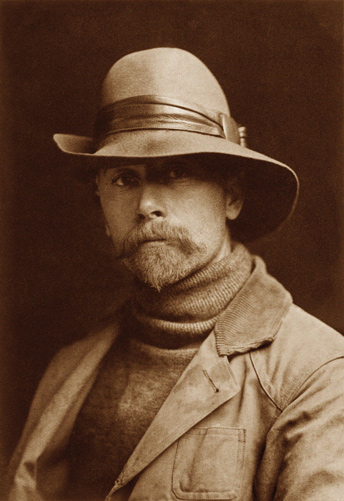
Edward S. Curtis

Sepia-toned photogravure

by

Edward Sheriff Curtis’s monumental collection of photographs was intended to be the ultimate documentation of the then-apparent end of traditional Indian life-ways. The consummation of thirty years’ work, it was enabled by substantial patronage from the wealthy financier J. P. Morgan.

OPEN


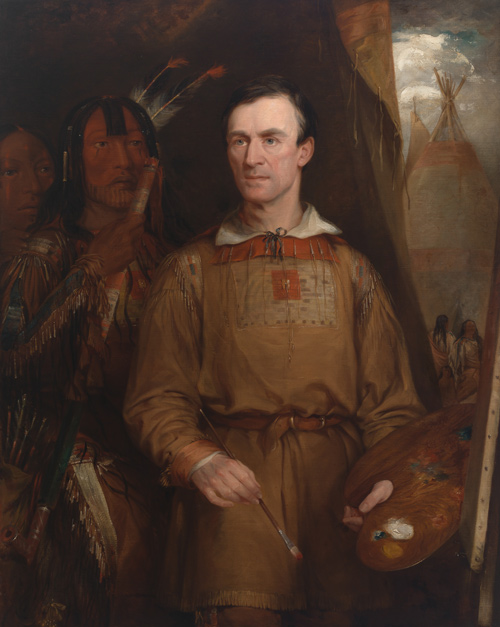
George Catlin

His curiosity sparked by Lewis and Clark artifacts displayed at Peale’s American Museum, George Catlin (1796–1872) began painting American Indians with a trip up the Mississippi with General Clark in 1830. He expanded his travels creating over 500 paintings.

OPEN


Edgar S. Paxson

by

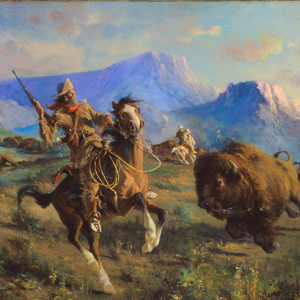
Edgar Paxson captured the essence of the fast-disappearing Old West as he personally experienced it. In 1895, he painted “Over the Trail of Lewis and Clark,” his first known scene from that episode in western history.

OPEN


L&C Artists

Interpreters of the trail

Due to the relative paucity of illustrations in the journals, Lewis and Clark storytellers rely on the drawings, paintings, engravings, statuary, and photographs of early travelers and modern interpreters alike. Listed here are early travelers and modern interpreters with indexes of their artwork used on this site.

OPEN


Roger Cooke

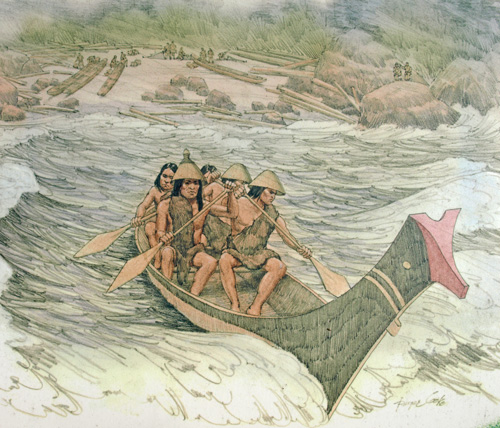
Historical artist Roger Cooke worked with the Washington State Historical Society to recreate several Lewis and Clark scenes during their trek in Washington and Oregon. His artwork is featured on many interpretive signs at waysides throughout this section of the historic trail.

OPEN


Michael Haynes

Michael Haynes’ artwork has been enjoyed by even the most casual Lewis and Clark fan in publications, museum displays, historical re-enactments, and hundreds of interpretive signs along the historic trail.

OPEN


Charles Fritz

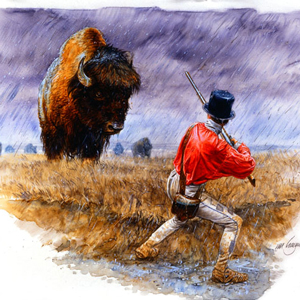
“Historical accuracy is paramount, but there is another obvious component: the art itself . . . . In 100 Paintings Illustrating the Journals of Lewis and Clark, I sought to communicate the storyline accurately.”

OPEN


Discover More

  • The Lewis and Clark Expedition: Day by Day by Gary E. Moulton (University of Nebraska Press, 2018). The story in prose, 14 May 1804–23 September 1806.
  • The Lewis and Clark Journals: An American Epic of Discovery (abridged) by Gary E. Moulton (University of Nebraska Press, 2003). Selected journal excerpts, 14 May 1804–23 September 1806.
  • The Lewis and Clark Journals. by Gary E. Moulton (University of Nebraska Press, 1983–2001). The complete story in 13 volumes.