The Romantic Lens
In 1805, as Lewis beheld the Big Fall of the Missouri River, he “wished for the pencil of Salvator Rosa, or the pen of Thompson” that he might better describe “this truly magnifficent and sublimely grand object . . . .”[1]See Lewis at the Great Fall. Lewis had picked his artist with the knowledge of the Italian Rosa (1615–1673) whose landscapes and seascapes had made him famous during the artist’s lifetime. In England, J. M. W. Turner (1775–1851) was developing the English Romantic school while in France, a young Eugene Delacroix (1798–1863) would thereafter lead the French Romantic school. In 1810 Baltimore, another Romance artist was born—Alfred Jacob Miller (1810–1874).
In 1832, Miller traveled to Paris where he enrolled at École des Beaux Arts. In Paris—and later Rome and likely England—where he studied and sketched works by Salvator Rosa, Delacroix, Rembrandt, and Turner. “He made many notes and studies of light effects, particularly in the manner of Turner.”[2]Marvin C. Ross, The West of Alfred Jacob Miller, xiv–xv. It is no wonder that “Miller saw the West through the lens of the romantic artist, depicting many Indians at the rendezvous as noble savages and the Plains and mountains as a garden.”[3]Ron C. Tyler, “Miller, Alfred Jacob (1810–1874)”, Encyclopedia of the Great Plains, David J. Wishart, ed. (Lincoln, Nebraska: University of Nebraska Press, 2004), 124.
Indians Threatening to Attack the Fur Boats
Alfred Jacob Miller (1810–1874)
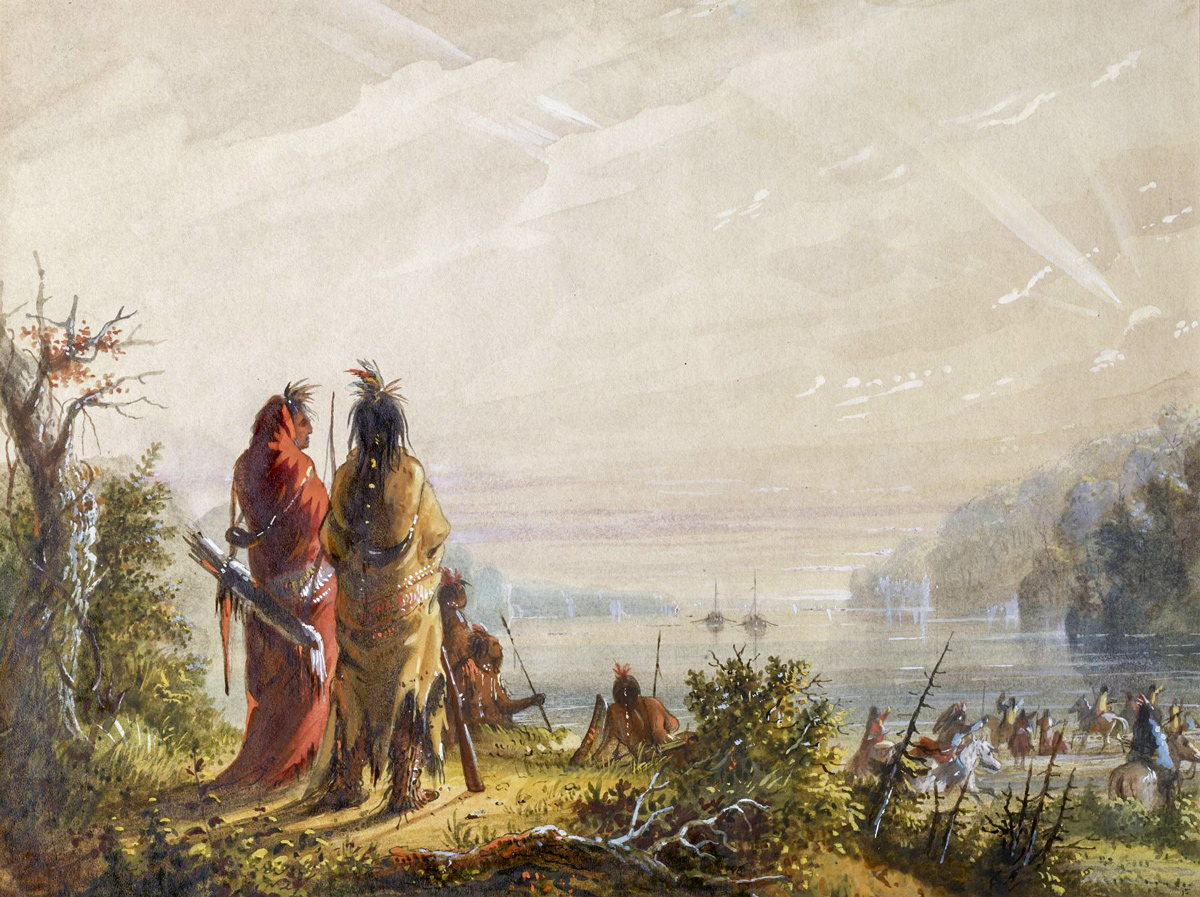
Courtesy The Walters Art Museum, art.thewalters.org/object/37.1940.70/.
Of the above scene, Miller wrote the following description:
In passing down the Platte the American Fur Comp[any]‘s boats are constantly liable to attack from hostile Indians prowling on the banks, and who are pretty well posted in all the movements made by that Company; the utmost the boats can do in the way of retreat, in case the attack is from one side, is to sheet the boat to the opposite bank.
When the body of Indians are strong in numbers, and impossible to be resited, they resort to giving “black-mail” which seems to have a mollifying effect sometimes, at other, hard fighting is resorted to,—the victory of course belonging to those who can pound the hardest.
It is a dark day for the voyageurs if the boat should run aground,—and they are often liable to this from the shallowness of certain portions of the river. A swivel gun which they sometimes carry scatters death and destruction among the enemy, and is a most effectual weapon.[4]Marvin C. Ross, The West of Alfred Jacob Miller, (Norman, Oklahoma: University of Nebraska Press, 1968), 70, available at archive.org.
Into the West
In 1837, Miller established a studio in New Orleans and soon after received a visit from William Drummond Stewart—a Scottish aristocrat, sportsman, and veteran traveler of the American West. Eventually, Stewart hired Miller to accompany him to the 1837 fur-trade rendezvous in the Green River Valley, in what is now western Wyoming. Before leaving, the young artist visited William Clark in St. Louis. In his notes, he speaks of Clark’s influence:
General Clark (one of the pioneers among the Indians), whom I visited frequently in St. Louis, stated some curious facts as regards the acuteness and sagacity of the Indian that are worth noting. For example, they will start on a journey for over a 100 miles, either through forests or over a plain and reach their destination without any material deviation from a straight line . . . .[5]Ross, 160.
During the artists’ only trip into the West—Stewart’s company would join the American Fur Trade Company and because of his prior military experience and natural abilities, the Scot would captain the entire outfit. Of Stewart’s leadership style, Miller wrote:
Nothing could be greater than is the treatment I received here [by comparison] with that experience on the prairies:—there he was the military martinet & rigidly exacted from me all the duties of the camp.[6]From a notebook in the collection of L. Vernon Miller cited in Ross, xx.
Regarding the rigors of camp duties, Miller admitted that Captain Stewart allowed him to “buy out my guard duty at night—& also pay a trapper to set up my tent.[7]Ibid.
Miller’s Contribution
Miller’s reputation rests on his single Green River Rendezvous trip from which he transformed his original sketches and notes into a lifetime of images. His work preserves details of clothing, equipment, camps, transport, and performance. At the same time, his images were made for patrons who valued romance and spectacle. For that reason, Miller should be read carefully. Stewart wanted scenes of adventure. William T. Walters who 20 years later commissioned 200 watercolors at twelve dollars apiece, wanted a collectible record of the West; and later audiences wanted origins for the national myth of expansion. Miller’s art met all three needs. It documented, embellished, and aestheticized the West simultaneously.
Pages with Miller’s Artwork
The Blackfeet Confederacy
Short tempers and long knives
by Jay H. Buckley
Next to grizzly bears and Mother Nature, the most feared enemy of American fur trappers traveling along the upper Missouri River were the Niitsítapi or Blackfeet, the “Original People” or “Prairie People.” Was that Lewis’s fault?
Jean Baptiste, Mountain Man
by Kristopher K. Townsend
Jean Baptiste’s 17-year career as a mountain man comes from a scattering of writings from some of the most notable trappers of the era.
August 19, 1805
Sacagawea's first betrothed
by Kristopher K. Townsend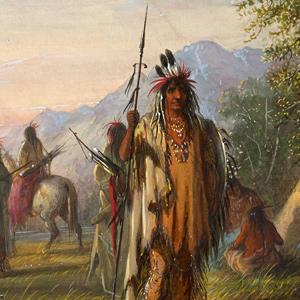
At Fortunate Camp at the end of the Beaverhead River, Lewis starts a multi-day treatise describing Lemhi Shoshone lifeways and manners. Sacagawea’s previously betrothed husband successfully extracts payment from Charbonneau, and some fishermen catch several trout and longnose suckers—a fish new to Lewis.
Clark’s group and several Shoshones cross the Continental Divide. He trades for a mule and camps on Pattee Creek in present Idaho.
Notes
| ↑1 | See Lewis at the Great Fall. |
|---|---|
| ↑2 | Marvin C. Ross, The West of Alfred Jacob Miller, xiv–xv. |
| ↑3 | Ron C. Tyler, “Miller, Alfred Jacob (1810–1874)”, Encyclopedia of the Great Plains, David J. Wishart, ed. (Lincoln, Nebraska: University of Nebraska Press, 2004), 124. |
| ↑4 | Marvin C. Ross, The West of Alfred Jacob Miller, (Norman, Oklahoma: University of Nebraska Press, 1968), 70, available at archive.org. |
| ↑5 | Ross, 160. |
| ↑6 | From a notebook in the collection of L. Vernon Miller cited in Ross, xx. |
| ↑7 | Ibid. |
Experience the Lewis and Clark Trail
The Lewis and Clark Trail Experience—our sister site at lewisandclark.travel—connects the world to people and places on the Lewis and Clark Trail.
Discover More
- The Lewis and Clark Expedition: Day by Day by Gary E. Moulton (University of Nebraska Press, 2018). The story in prose, 14 May 1804–23 September 1806.
- The Lewis and Clark Journals: An American Epic of Discovery (abridged) by Gary E. Moulton (University of Nebraska Press, 2003). Selected journal excerpts, 14 May 1804–23 September 1806.
- The Lewis and Clark Journals. by Gary E. Moulton (University of Nebraska Press, 1983–2001). The complete story in 13 volumes.
This site is provided as a public service by the
Lewis and Clark Trail Alliance
with additional funding from the following: