Lewis, Clark, and their Osage and Mandan delegates[1]For the delegations traveling with Lewis and Clark on this day, see The Osage Delegations and Sheheke’s Delegation. travel across Indiana following the Buffalo Trace, a Vincennes to Louisville trail. On or near this day, they reach the Blue River crossing—a popular camping spot.
In Washington City, President Jefferson writes to his son-in-law to tell him that he expects Lewis to arrive home any day. The National Intelligencer announces the expedition’s return and includes a letter from “a gentleman in St. Charles” who writes about Nez Perce horses and a large bighorn sheep specimen.
Blue River
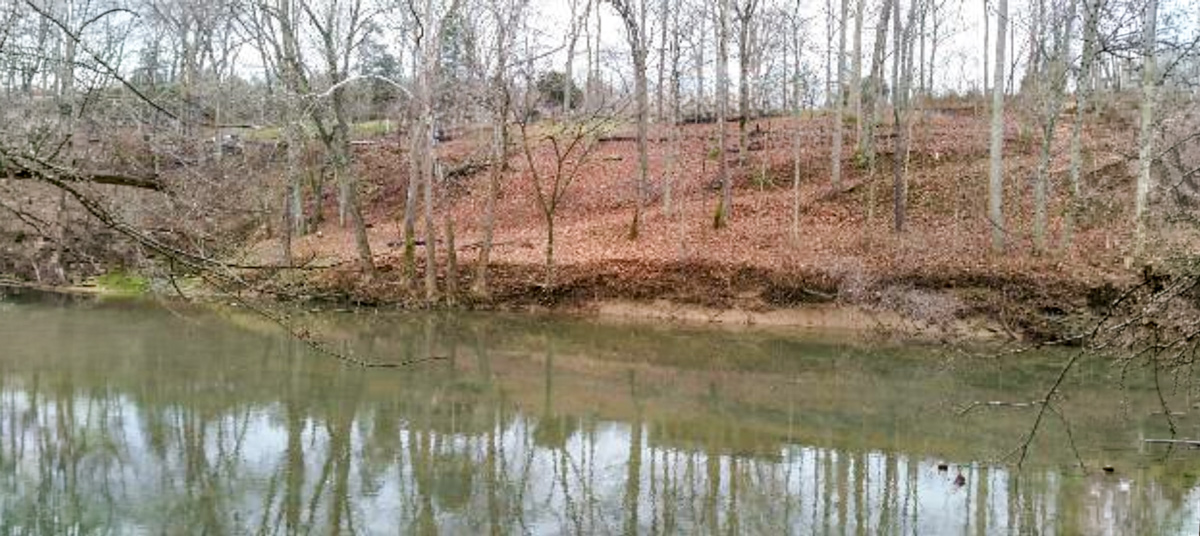
Generated from an original photo by David Ruckman, Hoosier National Forest.
Blue River Camp (1789)
In August 1789, young William Clark served in Captain John Hardin’s militia campaign to Terre Haute. Hardin celebrated his rout of 22 Shawnee men, women, and children by parading in Vincennes. On their return to Louisville, they camped at the Blue River crossing:
We traveled through Indifen [indifferent] Lands this day to Blue River we camped on Blue river about 25 miles from Clarksville
—William Clark, 23 August 1789.[2]Journal of Hardin’s Campaign, 5 Aug 1789–5 Mar 1790, William Clark Papers, Missouri Historical Society.
Meriwether Lewis Expected Soon
Washington Nov. 3. 06
Dear Sir [Thomas Mann Randolph]
Yesterday was sennight I wrote to Reuben Lewis, informing him he might hourly expect his brother there. I meant the next day which was the post day, to have written it to you also, but was in the intervening evening taken with the Autumnal fever so as to be unable to write. the attack was slight, & I am now perfectly recovered, and engaged in taking the repeating doses of bark.
Th: Jefferson[4]Thomas Jefferson to Thomas Mann Randolph, Founders Online, National Archives, founders.archives.gov/documents/Jefferson/99-01-02-4497.
Jefferson had written to the brother of Meriwether Lewis, Reuben Lewis, one week (sennight) prior, on 26 October. Actually, Lewis, William Clark, Mandan chief Sheheke‘s family, and an Osage delegation are traveling on the “Buffalo Trace” between Vincennes and the Falls of the Ohio. Jefferson’s bark medicine was cinchona bark that contained quinine used to treat malaria.
Thomas Mann Randolph Jr. (1 October 1768–20 June 1828) was a member of the American Phil. Society and a U.S. Representative from Virginia’s 21st District. He had married Thomas Jefferson’s eldest daughter Martha (27 September 1772–10 Oct 1836). The couple lived at Varina, originally the estate of John Rolfe, husband of Pocahontas, who had established a strain of tobacco preferred by Europeans—Nicotiana tabacum. For tobacco use during the expedition, see Smoking and Indian Tobacco.[5]“Thomas Mann Randolph Jr.”, Wikipedia, Wikipedia, en.wikipedia.org/wiki/Thomas_Mann_Randolph_Jr.; “Varina Farms”, Wikipedia, en.wikipedia.org/wiki/Varina_Farms; “John … Continue reading
Report from St. Charles
Bighorn Sheep Skull
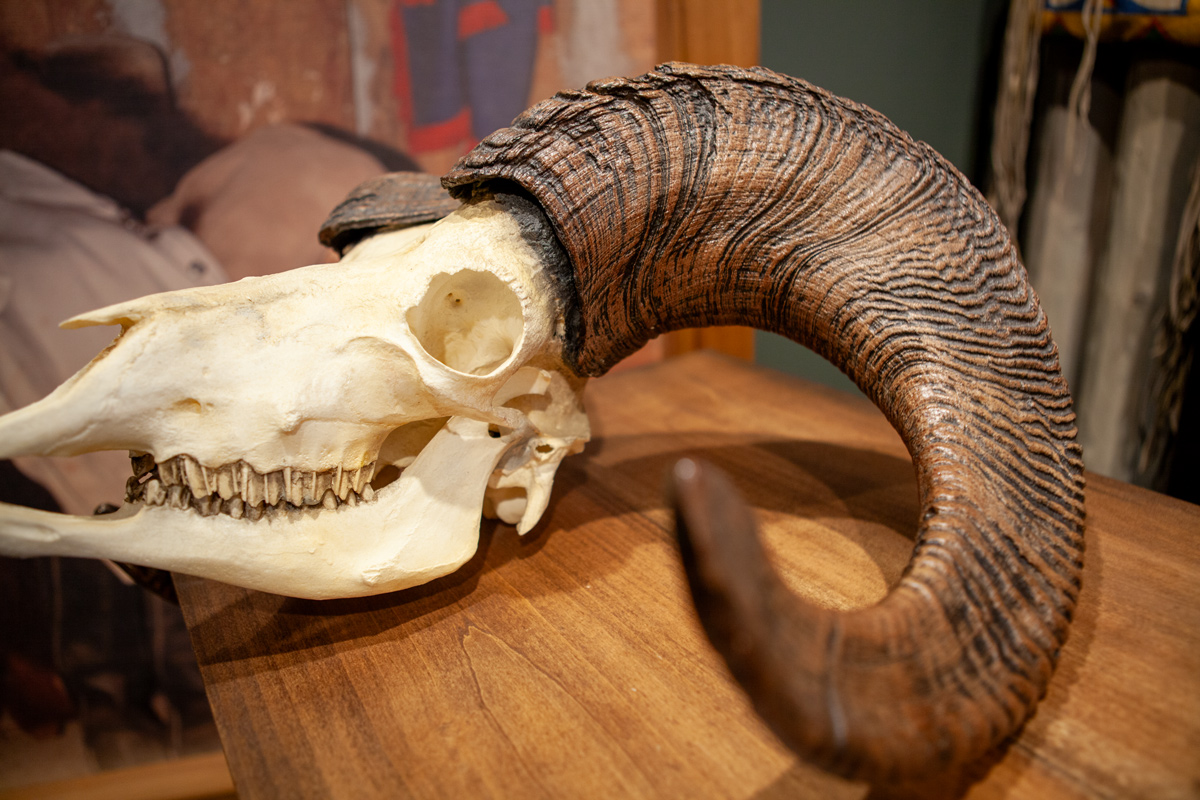
© 2013 Kristopher K. Townsend. Permission to use granted under the Creative Commons Attribution-Share Alike 4.0 International license.
Extract of a letter from a gentleman at St. Charles, to a gentleman in this town, date 23d September, 1806.
I have the pleasure to inform you of the arrival of captains Lewis and Clark.
They were the first white people that ever visited that country, by the best accounts they could get, there are about ninety or one hundred thousand inhabitants, (Indians) on the west side of the Rocky Mountains; horses without number. It is thought to be a very poor Indian that did not own 300 horses. Not an iron tool among them. They erected a fort on the sea shore, and engraved their names. They have brought a number of curiosities; among which is a wild sheep; its head and horns weigh about 80 or 90 pounds He was caught on the Rocky Mountains.[6]Washington National Intelligencer, 3 November 1806.
Notes
| ↑1 | For the delegations traveling with Lewis and Clark on this day, see The Osage Delegations and Sheheke’s Delegation. |
|---|---|
| ↑2 | Journal of Hardin’s Campaign, 5 Aug 1789–5 Mar 1790, William Clark Papers, Missouri Historical Society. |
| ↑3 | “The Buffalo Trace: Retracing One of Indiana’s Oldest Roads”, Hoosier National Forest, storymaps.arcgis.com/stories/f5a110b7448a42018565670a7c0e9d39 accessed 15 April 2026. |
| ↑4 | Thomas Jefferson to Thomas Mann Randolph, Founders Online, National Archives, founders.archives.gov/documents/Jefferson/99-01-02-4497. |
| ↑5 | “Thomas Mann Randolph Jr.”, Wikipedia, Wikipedia, en.wikipedia.org/wiki/Thomas_Mann_Randolph_Jr.; “Varina Farms”, Wikipedia, en.wikipedia.org/wiki/Varina_Farms; “John Rolfe”, Wikipedia, en.wikipedia.org/wiki/John_Rolfe, all accessed 30 December 2025. |
| ↑6 | Washington National Intelligencer, 3 November 1806. |
Experience the Lewis and Clark Trail
The Lewis and Clark Trail Experience—our sister site at lewisandclark.travel—connects the world to people and places on the Lewis and Clark Trail.
Discover More
- The Lewis and Clark Expedition: Day by Day by Gary E. Moulton (University of Nebraska Press, 2018). The story in prose, 14 May 1804–23 September 1806.
- The Lewis and Clark Journals: An American Epic of Discovery (abridged) by Gary E. Moulton (University of Nebraska Press, 2003). Selected journal excerpts, 14 May 1804–23 September 1806.
- The Lewis and Clark Journals. by Gary E. Moulton (University of Nebraska Press, 1983–2001). The complete story in 13 volumes.
This site is provided as a public service by the
Lewis and Clark Trail Alliance
with additional funding from the following: