Lewis, Clark, and their Osage and Mandan delegations[1]For the delegations traveling with Lewis and Clark on this day, see The Osage Delegations and Sheheke’s Delegation. travel across Indiana following a trail between Vincennes and Louisville known as the Buffalo Trace.
In China, Captain Sam Hill of the Lydia reaches Canton with a copy of Lewis and Clark’s notice written 18 March 1806 at Fort Clatsop.
In Washington City, British minister Anthony Merry sends news of the expedition’s return to England.
The Buffalo Trace
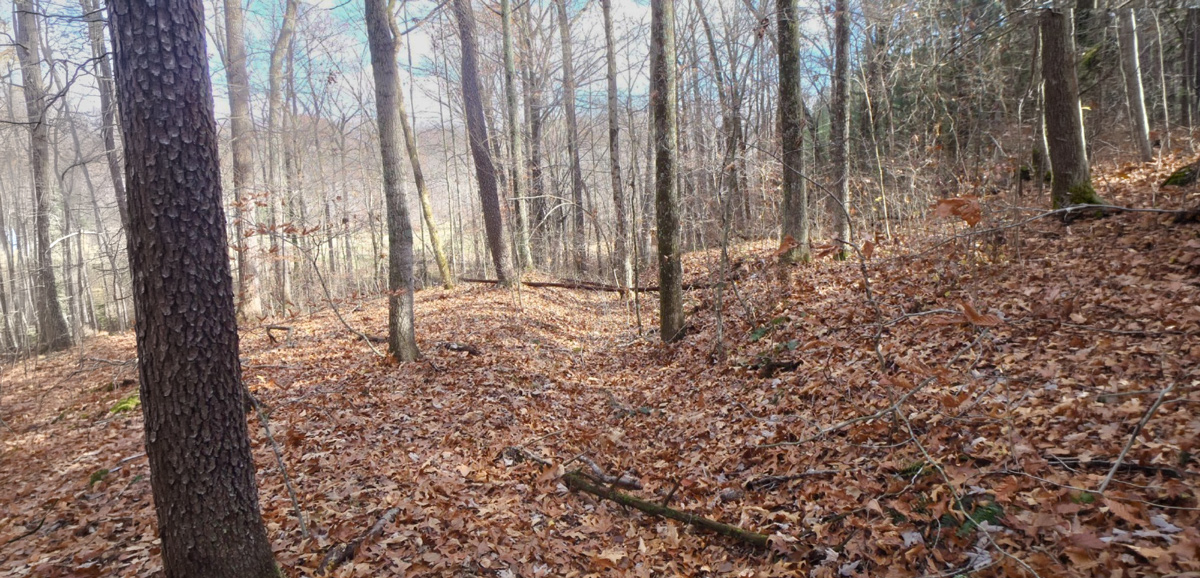
Generated from an original photo in “Lost and Forgotten Historic Roads: The Buffalo Trace: a case study” sponsored by the Hoosier National Forest.
Clark on the Buffalo Trace
As a soldier in Hardin’s 1789 campaign, William Clark wrote of his company’s trek along the Buffalo Trace. At present French Lick, Indiana, his company encountered several buffalo:
22 Day we went up white River a few miles and left the River— went Through Indifrant Land and camped within 3 miles of the big Bufaloe Lick
32. D [23rd] . . . we arrived at the Lick we there Saw about 40 Bufaloes we killd one The Lick appears to be the best I ever Saw it is large and a fine fresh water and salt water springs running with in a few yards of each other a large Creek running close to the Lick the Lands about this Lick was better there
—William Clark[2]Journal of Hardin’s Campaign, 5 Aug 1789–5 Mar 1790, William Clark Papers, Missouri Historical Society.
News Reaches China
Canton, January, 1807.
I wrote you last by the Governor Strong, Cleveland, for Boston; the present is by the brig Lydia Hill, of the same place.
Captain Hill, while on the coast, met some Indian natives near the mouth of the Columbia river, who delivered to him a paper, of which I enclose you a copy. It had been committed to their charge by Captains Clarke and Lewis, who had penetrated to the Pacific ocean. The original is a rough draft with a pen of their outward route, and that which they intended returning by. Just below the junction of Madison’s river, they found an immense fall of three hundred and sixty-two feet perpendicular. This, I believe, exceeds in magnitude any other known. From the natives Captain Hill learned that they were all in good health and spirits; had met many difficulties on their progress, from various tribes of Indians, but had found them about the sources of the Missouri very friendly, as were those on Columbia river and the coast.[3]Nicholas Biddle, History of the Expedition of Captains Lewis and Clark, 1804-5-6, James Hosmer, ed. (Chicago: A. C. McClurg & Co., 1917), 2:216–217, … Continue reading
News Sent to England
Anthony Merry writes to Charles James Fox saying that the two captains are due to arrive in Washington with:
the journals of their interesting Travels, which will, I understand, be communicated to the Public as soon as possible.[4]“Anthony Merry to Charles James Fox, November 2, 1806”, Public Record Office, F05, Vol. 49, pp. 215-221.
Notes
| ↑1 | For the delegations traveling with Lewis and Clark on this day, see The Osage Delegations and Sheheke’s Delegation. |
|---|---|
| ↑2 | Journal of Hardin’s Campaign, 5 Aug 1789–5 Mar 1790, William Clark Papers, Missouri Historical Society. |
| ↑3 | Nicholas Biddle, History of the Expedition of Captains Lewis and Clark, 1804-5-6, James Hosmer, ed. (Chicago: A. C. McClurg & Co., 1917), 2:216–217, archive.org/details/historyofexpedit19172lewi/ |
| ↑4 | “Anthony Merry to Charles James Fox, November 2, 1806”, Public Record Office, F05, Vol. 49, pp. 215-221. |
Experience the Lewis and Clark Trail
The Lewis and Clark Trail Experience—our sister site at lewisandclark.travel—connects the world to people and places on the Lewis and Clark Trail.
Discover More
- The Lewis and Clark Expedition: Day by Day by Gary E. Moulton (University of Nebraska Press, 2018). The story in prose, 14 May 1804–23 September 1806.
- The Lewis and Clark Journals: An American Epic of Discovery (abridged) by Gary E. Moulton (University of Nebraska Press, 2003). Selected journal excerpts, 14 May 1804–23 September 1806.
- The Lewis and Clark Journals. by Gary E. Moulton (University of Nebraska Press, 1983–2001). The complete story in 13 volumes.
This site is provided as a public service by the
Lewis and Clark Trail Alliance
with additional funding from the following: