Wyoming Big Sagebrush
Artemisia tridentata Nutt. ssp. wyomingensis
Eastern Montana Sagebrush Steppe
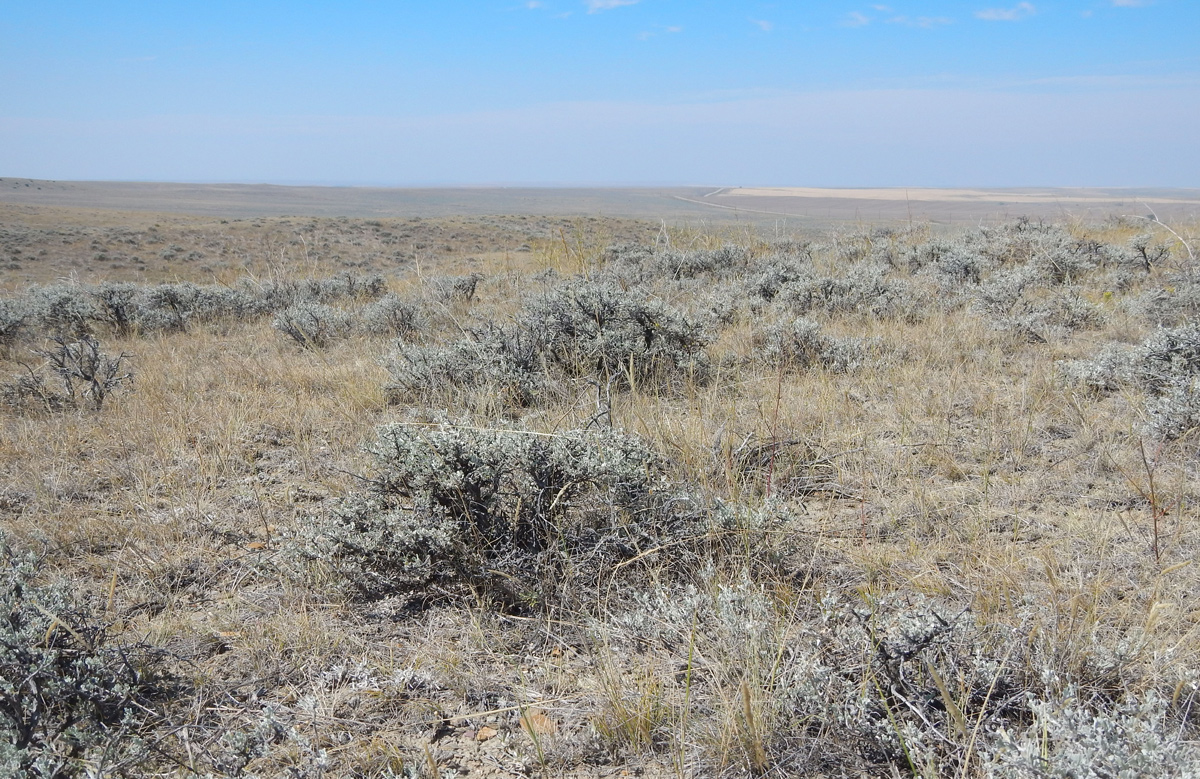
© 2015 by Matt Lavin. Permission to use granted under the Creative Commons Attribution-ShareAlike 2.0 Generic (CC-BY-SA 2.0) license.
Sagebrush—not to be confused with true sage—plays a unique ecological role by providing habitat and food for wildlife across the American West.
Sage encompasses a diverse group of aromatic plants prized for their resilience, silvery foliage, and distinctive fragrance. While the culinary sage commonly used in kitchens belongs to the genus Salvia, the landscape of North America is home to many wild sages. Among these, big sagebrush (Artemisia tridentata) stands out as an iconic shrub of the western landscape, recognized by its tall, woody form and deeply lobed, aromatic leaves. It dominates vast swaths of rangeland, supporting a web of life from pronghorn antelope to sage grouse. Silver Sagebrush (Artemisia cana) with its fine, silvery hairs and slightly smaller stature, flourishes in similar harsh conditions but prefers moister sites like streambanks and foothills. Members of the aster (Asteraceae) family, both species are adept at wind-driven pollination and exemplify ecological adaptation and resilience by enduring drought and growing in poor soils. In 1805 and 1806, both these sagebrush species captured the attention of the Lewis and Clark Expedition journalists.
Early Encounters
On 14 April 1805—a week after leaving Fort Mandan—near Bear Den Creek, North Dakota, the journalists mentioned aromatic sages using terminology they had learned in Eastern North America:
. . . the upland is extreemly broken, chonsisting of high gaulded [galled—meaning barren] nobs as far as the eye can reach on ether side, and entirely destitute of timber. on these hills many aromatic herbs are seen; resembling in taste, smel and appearance, the sage, hysop, wormwood, southernwood, and two other herbs which are strangers to me . . . .
Of these bushes, the two sagebrushes described near Ben Den Creek were likely Wyoming big sagebrush (Artemisia tridentata Nutt. ssp. wyomingensis) and silver sagebrush (Artemisia cana Pursh ssp. cana). Meriwether Lewis continued:
one resembling the camphor in taste and smell, rising to the hight of 2 or 3 feet; the other about the same size, has a long, narrow, smooth, soft leaf of an agreeable smel and flavor; of this last the Atelope [pronghorn] is very fond; they feed on it, and perfume the hair of their foreheads and necks with it by rubing against it.[1]The Definitive Journals of Lewis & Clark, Gary Moulton, ed. (Lincoln: University of Nebraska Press, 2002), 4:35.
Five days later Sgt. Patrick Gass mentioned “hyssop in the vallies” and on 29 April, Sgt. John Ordway mentioned “a great quantity of wild Hop”. Not to be left out, Pvt. Joseph Whitehouse saw “Some Smoth plains under the hills covred with wild hysop” on 11 May.[2]Moulton, 10:81; 9:139; 11:153. According to Moulton, the journalists’ previous experiences with these aromatic plants would have been cultivated garden species introduced from Europe: garden sage (Salvia officinalis L.); hyssop (Hyssopus officinalis L.); wormwood or common mugwort (Artemisia vulgaris L.); and southernwood (Artemisia abrotanum L.)[3]Moulton, 4:40n5 and n6.
Big Sagebrush
Artemisia tridentata
The Dalles, Oregon
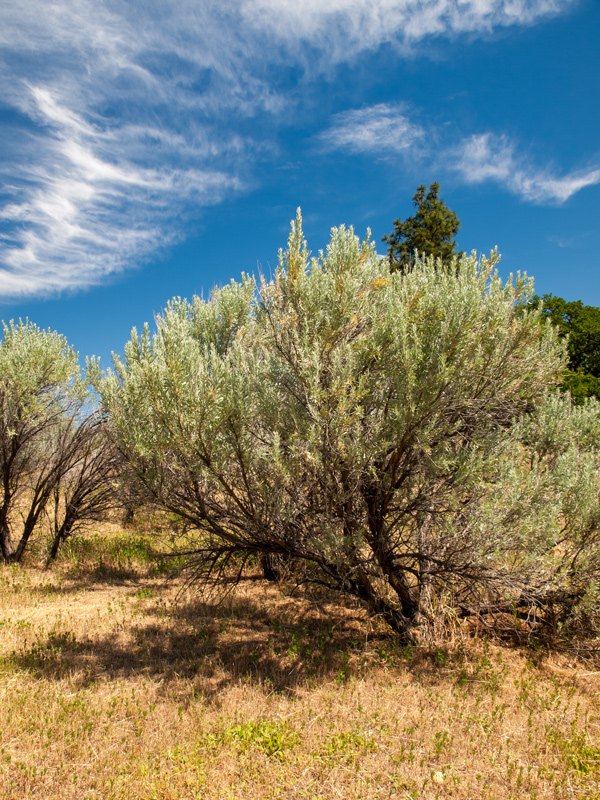
© 2011 by Kristopher K. Townsend. Permission to use granted under the Creative Commons Attribution-Share Alike 4.0 International license.
This big sagebrush is growing in the western limit of sagebrush steppe country. These large varieties grow along the Columbia River in Eastern Washington and Oregon.
Big Sagebrush
With its prevalence throughout the West’s dry regions, it should be no surprise that big sagebrush had[4]When referring to the ethnobotanical record, past tense will most often be used. This does not imply the plant is no longer in use in the manner described. many uses among Native American Indians. It could be used as fuel, and its smoke gave food a distinctive flavor. The smoke also cured new leather. Below the Falls of the Columbia on 20 April 1806, Lewis remarked that some Teninos were burning “southern wood” along with straw and small willows.[5]Moulton, 7:146. The Tenino were called “E-nee-shur” by the captains spelled variously: Enusher, E-ne-chur, and Eneesher. Sage could be made into many types of medicines treating ailments such as colds, infections, gastrointestinal problems, and headaches.[6]Daniel E. Moerman, Native American Ethnobotany (Portland, Oregon: Timber Press, 1988), 101–103. Some varieties could be used for ceremonial smudging although two sageworts were preferred: prairie sagewort (Artemisia frigida) for women and white sagebrush (Artemisia ludoviciana) for men.[7]Jeff Hart, Montana Native Plants and Early Peoples (Helena: Montana Historical Society Press, 1992), 90–92.
Big sagebrush has evolved to minimize evaporation and maximize moisture collection. It has two root systems: shallow, widely dispersed roots to quickly capture fresh precipitation and large deep roots to find moisture deep underground. In early spring, the plant produces a secondary, soft leaf to promote growth. These fall off in the summer releasing a toxic compound into the soil that inhibits competition. In the hottest months, the trident-shaped leaves remain, and the plant becomes nearly dormant. Both types of leaves minimize surface area to slow transpiration. As with many sagebrush steppe plants, the leaves are covered with fine gray hairs to shade the leaf surface.[8]Ronald J. Taylor, Sagebrush Country: A Wildflower Sanctuary (Missoula, Montana: Mountain Press Publishing, 2009), 18.
When Thomas Nuttall named the species—tridentata—he chose to describe the distinctive three-lobed leaves that resemble a trident. The Artemisia genus had already been named by Carl Linnaeus. The genus is named for the Greek queen Artemisia II of Caria (Southwest Asia Minor, c. 395–c. 351 BCE). Perhaps the resiliency of sagebrush inspired Linnaeus to apply this noble appellation.[9]Artemisia I and II were named after the Greek goddess Artemis—the goddess of nature, childbirth, wildlife, healing, animals, and archery. Artemisia II ruled Caria the last years of her life, and … Continue reading
Silver Sagebrush
Artemisia cana
Bozeman, Montana
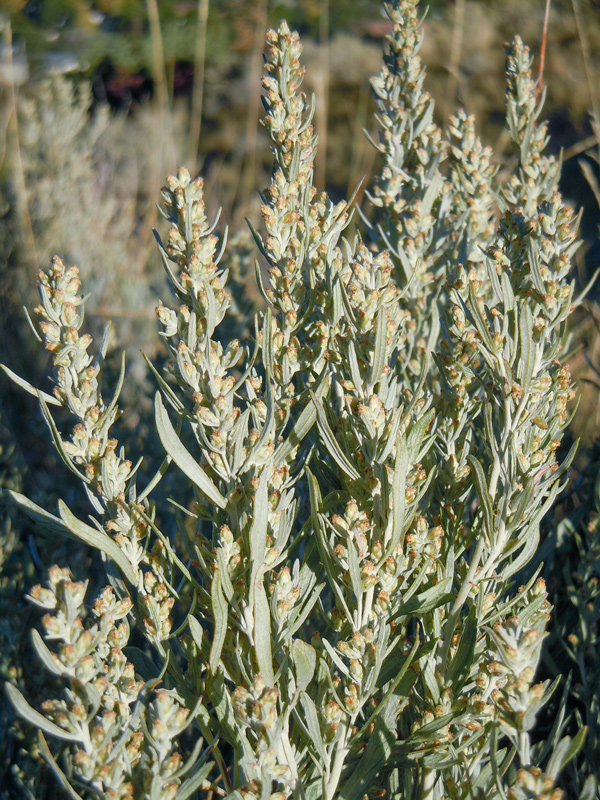
© 2010 by Matt Lavin. Permission to use granted under the Creative Commons Attribution-ShareAlike 2.0 Generic (CC-BY-SA 2.0) license.
The inflorescences (complete flower heads) of silver sagebrush include well-developed bracts (small, modified leaves with flowers). William Clark‘s party would have seen this variety as they approached Bozeman Pass on their way to the Yellowstone River in July 1806.
Silver Sagebrush
Despite its dominance in the sagebrush steppe regions of Montana, Idaho, Washington, and Oregon, no known Lewis and Clark specimen of big sagebrush exists. As for silver sagebrush, the specimens collected by Lewis still serve as the species’ lectotype and paratypes.[10]A lectotype is a specimen that serves as the description and name of a species new to science. A paratype represents the same species as the lectotype but collected at a different time and place. They were collected at or near the mouth of the Cheyenne River on 1 and 2 October 1804. Among the four sheets of specimen material, Lewis’s provided two labels:
No. 60. 1804. October 1st another variety of wild sage growth of high and bottom prairies
No 5[5] October 2ed 1804 growth of the high Bluffs.[11]James L. Reveal, Gary E. Moulton, and Alfred E. Schuyler, “The Lewis and Clark Collections of Vascular Plants: Names, Types, and Comments,” Proceedings of the Academy of Natural Sciences … Continue reading
Blackfeet and Lakota considered silver sagebrush the best fodder for grazing horses in winter, and Montana Indians chewed the leaves to allay thirst.[12]Moerman, 94.
Artemisia cana Pursh signifies that the plant was classified by Frederick Pursh who often relied on Lewis’s specimens, but it is uncertain if he did so for silver sagebrush. One of the plant’s specimen sheets in the Lewis and Clark Herbarium holds plant material collected by Thomas Nuttall—a botanist who followed much of the Lewis and Clark Trail in 1811.[13]Moulton, 12:16. Cana is Latin for gray hair, a survival adaptation common to many sages growing in dry and semi-dry climates. Today, the plant is commonly known as silver sagebrush, silver wormwood, hoary sagebrush, and dwarf sagebrush.[14]“Artemisia cana”, Wikipedia, en.wikipedia.org/wiki/Artemisia_cana, accessed 28 June 2025.
Pygmy Rabbit Feeding on Sagebrush
Sylvilagus idahoensis
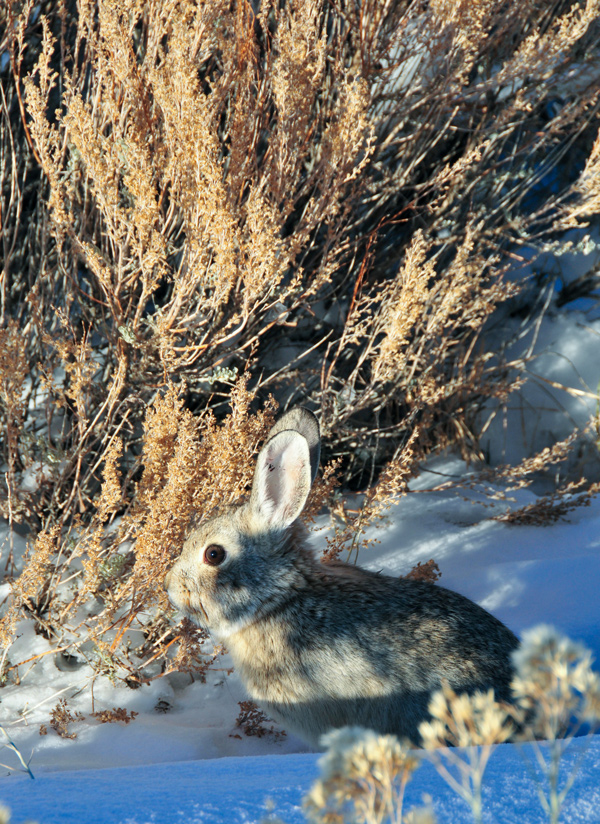
By Tom Koerner, U.S. Fish and Wildlife Service. Public Domain.
Savory Food
On at least two occasions, Lewis observed wildlife eating sagebrush—likely big sagebrush or silver sagebrush. On 26 April 1805—as the expedition moved up the Missouri River between the mouth of the Yellowstone and Culbertson, Montana, he mentioned:
the open bottoms border on the hills, and are covered in many parts by the wild hyssop which rises to the hight of two feet. I observe that the Antelope, Buffaloe [bison,] Elk and deer feed on this herb;[15]Moulton, 4:70.
Pronghorn antelope are the only large mammals to browse extensively on sagebrush, but pygmy rabbits (Sylvilagus idahoensis), mule deer (Odocoileus hemionus), and sage grouse (Centrocercus urophasianus) also eat the plant. Pygmy rabbits and sage grouse depend on big sagebrush for shelter.
Whether cultivated for cooking, admired in the wild, or revered for its historical uses in traditional medicine and ceremony, sage remains an enduring symbol of the natural world’s adaptability and subtle beauty.
Notes
| ↑1 | The Definitive Journals of Lewis & Clark, Gary Moulton, ed. (Lincoln: University of Nebraska Press, 2002), 4:35. |
|---|---|
| ↑2 | Moulton, 10:81; 9:139; 11:153. |
| ↑3 | Moulton, 4:40n5 and n6. |
| ↑4 | When referring to the ethnobotanical record, past tense will most often be used. This does not imply the plant is no longer in use in the manner described. |
| ↑5 | Moulton, 7:146. The Tenino were called “E-nee-shur” by the captains spelled variously: Enusher, E-ne-chur, and Eneesher. |
| ↑6 | Daniel E. Moerman, Native American Ethnobotany (Portland, Oregon: Timber Press, 1988), 101–103. |
| ↑7 | Jeff Hart, Montana Native Plants and Early Peoples (Helena: Montana Historical Society Press, 1992), 90–92. |
| ↑8 | Ronald J. Taylor, Sagebrush Country: A Wildflower Sanctuary (Missoula, Montana: Mountain Press Publishing, 2009), 18. |
| ↑9 | Artemisia I and II were named after the Greek goddess Artemis—the goddess of nature, childbirth, wildlife, healing, animals, and archery. Artemisia II ruled Caria the last years of her life, and she was also a renowned botanist and medical researcher. She is said to have built the Mausoleum at Halicarnassus in memory of her husband Mausolus. It became one of the Seven Wonders of the Ancient World. Taylor, 20; “Artemis”, Wikipedia, en.wikipedia.org/wiki/Artemis; “Mausolus”, Wikipedia, en.wikipedia.org/wiki/Mausolus; “Artemisia II of Caria”, Wikipedia, en.wikipedia.org/wiki/Artemisia_II_of_Caria; “Artemisia (Plant)”, Wikipedia, en.wikipedia.org/wiki/Artemisia_(plant), all accessed 22 June 2025. |
| ↑10 | A lectotype is a specimen that serves as the description and name of a species new to science. A paratype represents the same species as the lectotype but collected at a different time and place. |
| ↑11 | James L. Reveal, Gary E. Moulton, and Alfred E. Schuyler, “The Lewis and Clark Collections of Vascular Plants: Names, Types, and Comments,” Proceedings of the Academy of Natural Sciences of Philadelphia 149 (29 January 1999): 10. |
| ↑12 | Moerman, 94. |
| ↑13 | Moulton, 12:16. |
| ↑14 | “Artemisia cana”, Wikipedia, en.wikipedia.org/wiki/Artemisia_cana, accessed 28 June 2025. |
| ↑15 | Moulton, 4:70. |
Experience the Lewis and Clark Trail
The Lewis and Clark Trail Experience—our sister site at lewisandclark.travel—connects the world to people and places on the Lewis and Clark Trail.
Discover More
- The Lewis and Clark Expedition: Day by Day by Gary E. Moulton (University of Nebraska Press, 2018). The story in prose, 14 May 1804–23 September 1806.
- The Lewis and Clark Journals: An American Epic of Discovery (abridged) by Gary E. Moulton (University of Nebraska Press, 2003). Selected journal excerpts, 14 May 1804–23 September 1806.
- The Lewis and Clark Journals. by Gary E. Moulton (University of Nebraska Press, 1983–2001). The complete story in 13 volumes.
This site is provided as a public service by the
Lewis and Clark Trail Alliance
with additional funding from the following: