On or near this day, Captain Lewis, civilian William Clark, and two delegations[1]For the delegations traveling with Lewis and Clark on this day, see The Osage Delegations and Sheheke’s Delegation. leave Fort Kaskaskia bound for Vincennes. Their path follows the traces made over thousands of years by bison migrating across present Illinois. To avoid deep river crossings and miry swamps, these trails typically crossed forests and meadows along the higher elevations. Transitory Native Americans took full advantage of these trails as did early Americans traveling through the states and territories bordering the Ohio River.[2]It is possible, though not probable, that Lewis and Clark were following the old trace that went directly east from St. Louis to Vincennes. See the note for October 21, 1806.
On the Arkansas River near present Great Bend, Kansas, explorer Zebulon Pike prepares to take celestial observations and completes the frame of a “skin Canoe”.
Sketch Map of Part of Illinois
Showing Routes of George Rogers Clark
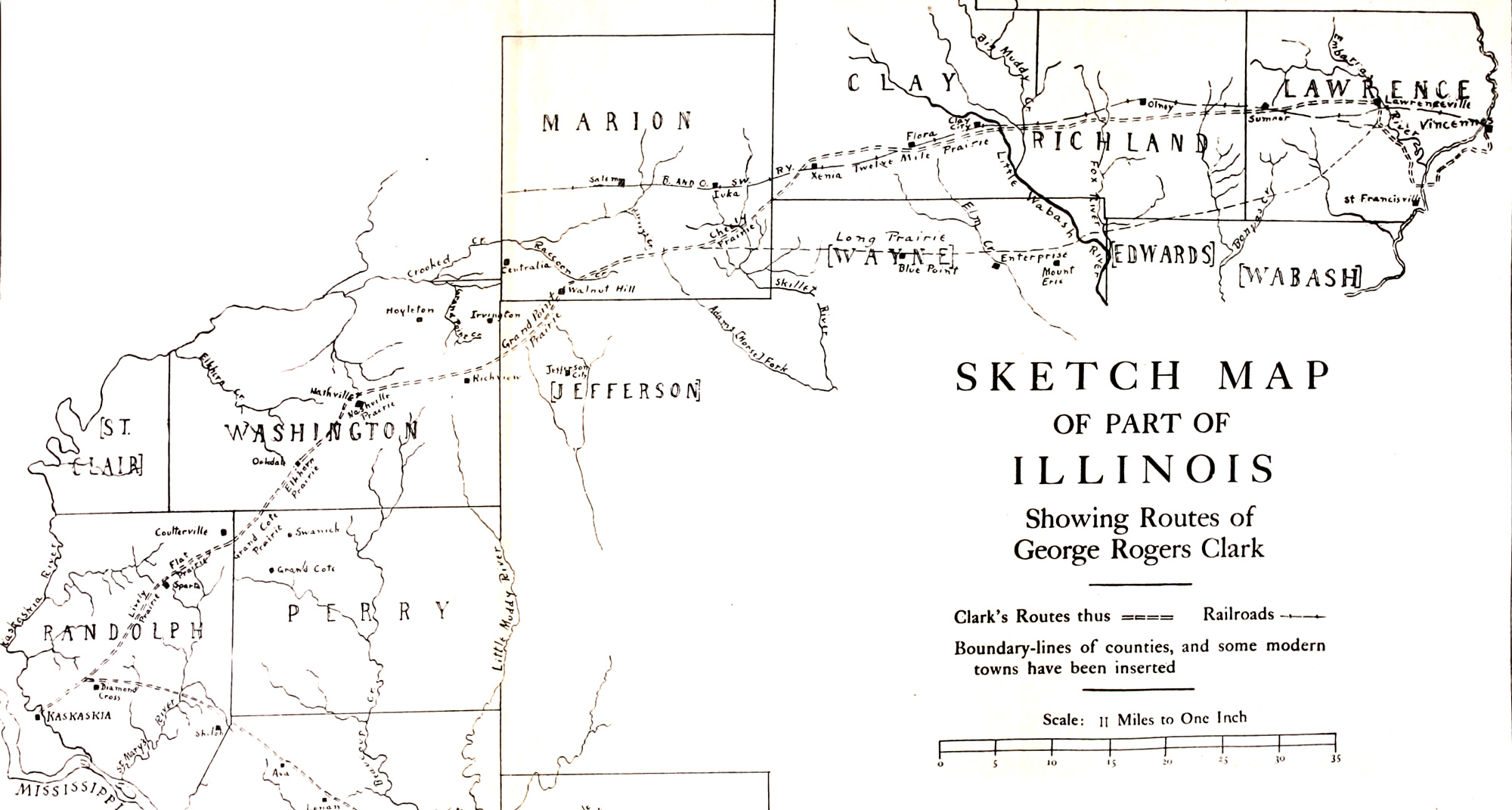
Derived from the original in Hulbert, Historic Highways of America: Military Highways of America.
After wresting Cahokia and Kaskaskia away from British control in 1779, Col. George Rogers Clark left Kaskaskia for Vincennes following buffalo traces similar to the route of Lewis and Clark in October 1806.
Leaving Fort Kaskaskia
In 1806, the feats of William Clark’s older brother, George Rogers Clark, in taking Illinois during the Revolutionary War were legendary. Major Joseph Bowman, George’s second-in-command, recorded the battalion’s first day out from Kaskaskia:
[February] 5th. Raised another company of volunteers, under the command of Captain Francis Charleville, which, added to our force, increased our number to one hundred and seventy men [missing text] artillery, pack-horses, men, etc.; about three o’clock we crossed the Kaskaskia with our baggage, and marched about a league from town. Fair and drizzly weather. Began our march early. Made a good march for about nine hours; the road very bad, with mud and water. Pitched our camp in a square, baggage in the middle, every company to guard their own squares.
—Joseph Bowman[3]Joseph Bowman, “Journal of the Proceedings of George R. Clark, from the 27th January, 1779, to March 20th Inst. (1779)”, in William H. English, Conquest of the Country Northwest of the … Continue reading
Pike’s Skin Canoe
. . . . in the afternoon we scaffolded some meat and nearly compleated the frame of a skin Canoe, which we concluded to build; overhauled my instruments and made some rectifications preparatory to taking an observation &c.
—Zebulon Pike[5]Donald Jackson, The Journals of Zebulon Montgomery Pike (Norman, Oklahoma: University of Oklahoma Press, 1966), 1:337.
Notes
| ↑1 | For the delegations traveling with Lewis and Clark on this day, see The Osage Delegations and Sheheke’s Delegation. |
|---|---|
| ↑2 | It is possible, though not probable, that Lewis and Clark were following the old trace that went directly east from St. Louis to Vincennes. See the note for October 21, 1806. |
| ↑3 | Joseph Bowman, “Journal of the Proceedings of George R. Clark, from the 27th January, 1779, to March 20th Inst. (1779)”, in William H. English, Conquest of the Country Northwest of the River Ohio 1778–1783 and Life of Gen. George Rogers Clark (Indianapolis: The Bowen-Merill Company, 1897), 1:568–69. |
| ↑4 | Archer Butler Hulbert, Historic Highways of America: Military Highways of America (Cleveland, Ohio: The Aurthur H. Clark Company, 1904), 8:28, 64–65, Project Gutenberg ebook, www.mirrorservice.org/sites/ftp.ibiblio.org/pub/docs/books/gutenberg/4/1/1/6/41167/41167-h/41167-h.htm. |
| ↑5 | Donald Jackson, The Journals of Zebulon Montgomery Pike (Norman, Oklahoma: University of Oklahoma Press, 1966), 1:337. |
Experience the Lewis and Clark Trail
The Lewis and Clark Trail Experience—our sister site at lewisandclark.travel—connects the world to people and places on the Lewis and Clark Trail.
Discover More
- The Lewis and Clark Expedition: Day by Day by Gary E. Moulton (University of Nebraska Press, 2018). The story in prose, 14 May 1804–23 September 1806.
- The Lewis and Clark Journals: An American Epic of Discovery (abridged) by Gary E. Moulton (University of Nebraska Press, 2003). Selected journal excerpts, 14 May 1804–23 September 1806.
- The Lewis and Clark Journals. by Gary E. Moulton (University of Nebraska Press, 1983–2001). The complete story in 13 volumes.
This site is provided as a public service by the
Lewis and Clark Trail Alliance
with additional funding from the following: