Near this date, Lewis and company[1]Traveling with Meriwether Lewis to Washington City is a Mandan delegation from the Knife River Villages: Chief Sheheke, his wife Yellow Corn, and their son. Speaking Mandan and French was interpreter … Continue reading travel through the Cumberland Valley between Barbourville and Pineville. The best ford of the Cumberland River was at Pineville, and that ford had long been a prime camping spot for Native Americans. In November 1806, a gate collected tolls there. Recalling the Cumberland Ford, Civil War soldiers say that here, “there is not a more picturesque or romantic landscape”.
View from atop Pine Mountain
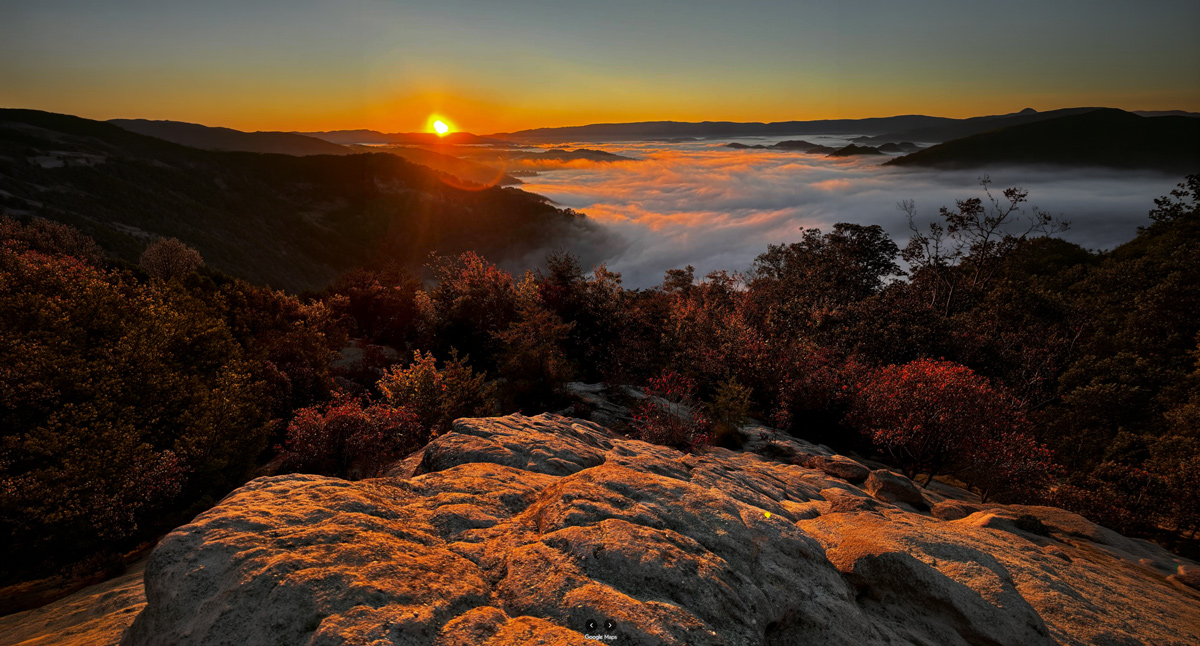
Generated from an original image created by Bonni Cheek, October 2024, maps.app.goo.gl/3zY1BcyB48p2bzAD6.
Beautiful, Grand, and Sublime
Using information gathered directly from officers and soldiers c. 1864, David Stevenson compiled a vast amount of information about the Illinois troops during the Civil War. For the Illinois 33rd, he collected their impressions of the Wilderness Road and its settlements, especially between Crab Orchard and the Cumberland Gap. At times, their impressions resemble that of Meriwether Lewis elsewhere on the Lewis and Clark Trail. Almost eerily, the soldiers thoughts give us a glimpse of what Lewis would have written when he passed through Pineville in November 1806.
Perhaps there is not a more picturesque or romantic landscape on the continent than that at Cumberland Ford. The valley of the river is narrow, running between the lofty hills on either side. The river at the ford bends at right angles, to its general course and cuts through Pine Mountain, and again bends at right angles and flows down through narrow bottoms and amid the overhanging mountains to the west. The scene at the Pine Mountain Pass is beautiful, grand, sublime. On either side the gray and bronzed cliffs tower fifteen hundred feet into the air, and seem to have been torn by some convulsion of past ages into a hundred strange, fantastic shapes; some are beautifully rounded, others are wild sharp crags, and a few like castles crown the highest peaks. This pass is about a mile long and the road winds along at the base of the cliff, on the brink of the river, which, amid huge bowlders, foams and roars as it tumbles onward in its course. The fantastic vegetation, the long leaved magnolia, the red flowering ivy, the moaning pines, the vastness, the desolation, and the silence—save the noises of nature—make the scene indescribably impressive.[2]David Stevenson, Indiana’s Roll of Honor, vol. 1 (Indianapolis: A. D. Streight, Publisher, 1864) 544, available at archive.org/details/indianasrollofho01stev.
Kentucky Tolls at Cumberland Ford
| Each wheel per carriage | 12½ cents |
| Each person above ten years | 6 cents, 2½ mills |
| Each horse or beast | 6 cents, 2½ mills |
| Each head of neat cattle | 3 cents |
| Each hog or sheep | 1 cent |
Assuming the Mandan children were above ten years of age, a horse for each person, and four pack horses, Lewis would be charged $1.44. No receipt for this expenditure is known to exist.
Notes
| ↑1 | Traveling with Meriwether Lewis to Washington City is a Mandan delegation from the Knife River Villages: Chief Sheheke, his wife Yellow Corn, and their son. Speaking Mandan and French was interpreter René Jusseaume who brought one of his wives and two children. Expedition private François Labiche was included to translate between French and English. Finally, records indicate expedition sergeant John Ordway was serving as Lewis’s assistant. |
|---|---|
| ↑2 | David Stevenson, Indiana’s Roll of Honor, vol. 1 (Indianapolis: A. D. Streight, Publisher, 1864) 544, available at archive.org/details/indianasrollofho01stev. |
Experience the Lewis and Clark Trail
The Lewis and Clark Trail Experience—our sister site at lewisandclark.travel—connects the world to people and places on the Lewis and Clark Trail.
Discover More
- The Lewis and Clark Expedition: Day by Day by Gary E. Moulton (University of Nebraska Press, 2018). The story in prose, 14 May 1804–23 September 1806.
- The Lewis and Clark Journals: An American Epic of Discovery (abridged) by Gary E. Moulton (University of Nebraska Press, 2003). Selected journal excerpts, 14 May 1804–23 September 1806.
- The Lewis and Clark Journals. by Gary E. Moulton (University of Nebraska Press, 1983–2001). The complete story in 13 volumes.
This site is provided as a public service by the
Lewis and Clark Trail Alliance
with additional funding from the following: