On this clear morning at the confluence of the Columbia and Snake rivers, the captains take lunar observations. Later, Clark is escorted about ten miles up the Columbia where he notes Native ways and salmon ecology. Lewis takes Wanapum and Yakama vocabularies, and hunters are sent out to collect sage grouse specimens.
At the Confluence
by Yellowstone Public Radio[1]Originally aired weekdays by Yellowstone Public Radio during the Bicentennial observance of 2003-2006. Narrated by Hal Hansen. Scripts by Whit Hansen and Ed Jacobson. Produced by Leni Holliman. © … Continue reading
Fishing Village at the Yakima River

© 2005 Washington State Historical Society. Used by permission.
From an island on the Columbia River, William Clark is shown the mouth of the Yakima River.
Yakima River
I took two men in a Small Canoe and assended the Columbia river 10 miles to an Island near the Stard. Shore on which two large Mat Lodges of Indians were drying Salmon . . . The number of dead Salmon on the Shores & floating in the river is incrediable to Say and at this Season they have only to collect the fish Split them open and dry them on their Scaffolds on which they have great numbers . . . . from this Island the natives showed me the enterance of a large Westerly fork which they Call Tâpetêtt at about 8 miles distant
—William Clark
Wife of Mnainak – Yakama c. 1910
Edward S. Curtis (1868–1952)
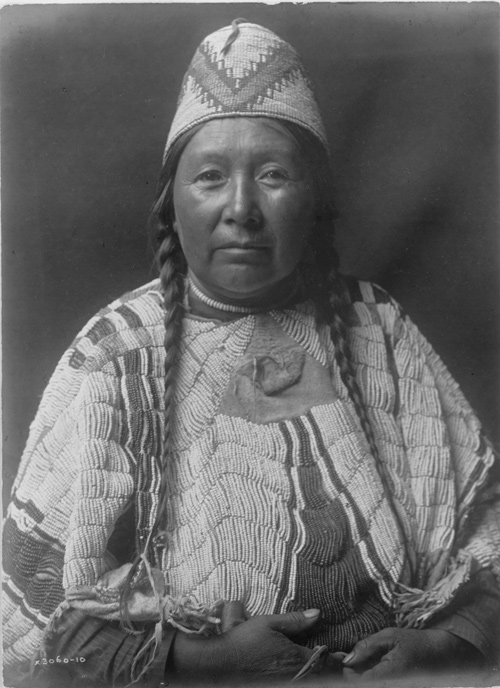
Retrieved from the Library of Congress, www.loc.gov/item/96502036.
Indian Hospitality
passed three large lodges on the Stard Side near which great number of Salmon was drying on Scaffolds one of those Mat lodges I entered found it crouded with men women and children and near the enterance of those houses I saw maney Squars engaged Splitting and drying Salmon. I was furnished with a mat to Sit on, and one man Set about prepareing me Something to eate . . . . I Smoked with those about me who Chose to Smoke which was but fiew, this being a custom those people are but little accustomed to and only Smok thro form. after eateing the boiled fish which was delicious, I Set out
—William Clark
Spawning Salmon
This river is remarkably Clear and Crouded with Salmon in maney places, I observe in assending great numbers of Salmon dead on the Shores, floating on the water and in the Bottoms which can be seen at the debth of 20 feet. the Cause of the emence numbers of dead Salmon I can’t account for
—William Clark
Tule Reed Houses
The House or Lodges of the tribes of the main Columbia river is of large mats made of rushes, Those houses are from 15 to 60 feet in length generally of an Oblong Squar form, Suported by poles on forks in the iner Side, Six feet high, the top is covered also with mats leaveing a Seperation in the whole length of about 12 or 15 inches wide, left for the purpose of admitting light and for the Smok of the fire to pass which is made in the middle of the house.—
—William Clark
Wanapum and Yakima Vocabularies
Capt. Lewis took a vocabelary of the Language of those people who call themselves So kulk [Wanapum], and also one of the language of a nation resideing on a Westerly fork of the Columbia which mouthes a fiew miles above this place who Call themselves Chim nâ pum [Yakama] Some fiew of this nation reside with the So kulks nation, Their language differ but little from either the Sokulks or the Chô-pun-nish [Nez Perce] (or pierced nose) nation which inhabit the Koskoskia [Clearwater] river and Lewis’s R
—William Clark
Male and Female Sage Grouse
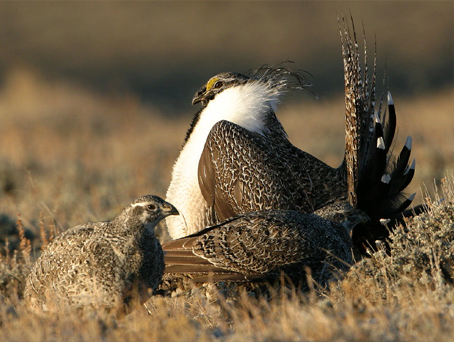
© Steve Sherman Lone Wolf Photography.
Sage Grouse Specimens
Send out Hunters to Shute the Prarie Cock [sage grouse] a large fowl which I have only Seen on this river; Several of which I have killed, they are the Size of a Small turkey, of the pheasant kind, one I killed on the water edge to day measured from the Beek to the end of the toe 2 feet 6 & ¾ Inches; from the extremities of its wings 3 feet 6 inches; the tale feathers is 13 inches long: they feed on grasshoppers and the Seed of the wild plant which is also peculiar to this river and the upper parts of the Missoury somewhat resembling the whins—.
—William Clark
Snake-Columbia Observations
a clear pleasant morning. we delay here this day for our officers to take observations &C. the natives Stole a large ax from us last night. we bought Several more dogs from them as we can git no other meat to eat, &C.
—John Ordway
Weather Diary
Day of the month Wind State of the Weather 17th S E fair the 17th 18 at the mouth of Lewis [Snake] River.
—William Clark[2]Some abbreviations have been spelled out.
Experience the Lewis and Clark Trail
The Lewis and Clark Trail Experience—our sister site at lewisandclark.travel—connects the world to people and places on the Lewis and Clark Trail.
Plan a trip related to October 17, 1805:


Snake River Confluence is a High Potential Historic Site along the Lewis and Clark National Historic Trail managed by the U.S. National Park Service. The site includes Sacajawea State Park with interpretation and a visitor’s center.
Notes
| ↑1 | Originally aired weekdays by Yellowstone Public Radio during the Bicentennial observance of 2003-2006. Narrated by Hal Hansen. Scripts by Whit Hansen and Ed Jacobson. Produced by Leni Holliman. © 2003 by Yellowstone Public Radio. |
|---|---|
| ↑2 | Some abbreviations have been spelled out. |