As the enlisted men and engagés move the boats up the Missouri below present Oacoma, South Dakota, Clark walks the shore in search of a volcano described by James Mackay. He kills a pronghorn, and Pvt. Shields kills a white-tailed jackrabbit. Lewis describes each in his natural history notes and preserves them.
Years later, Clark discusses the ‘volcano’ with Nicholas Biddle and tells him about earlier explorer John Evans and the mythic Welsh Indians.
Pronghorns and Jackrabbits
by Yellowstone Public Radio[1]Originally aired weekdays by Yellowstone Public Radio during the Bicentennial observance of 2003-2006. Narrated by Hal Hansen. Scripts by Whit Hansen and Ed Jacobson. Produced by Leni Holliman. © … Continue reading
Head of an Antelope
Karl Bodmer (1809–1893)
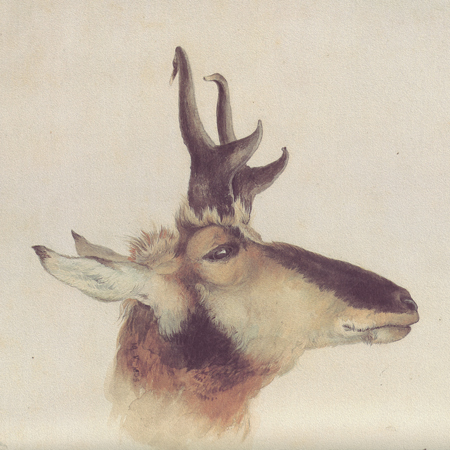
Watercolor on paper, 7¾ x 11 1/8; altered. Karl Bodmer’s America, Joslyn Art Museum & University of Nebraska Press.
Missing Volcano
I walked on Shore with a view to find an old Vulcanio, Said to be in this neighbourhood by Mr. J. McKey [James Mackay] of St. Charles. I walked on Shore the whole day without Seeing any appearance of the Villcanoe
—William Clark
After reading about this volcano, Nicholas Biddle queried William Clark in 1810, and was told about prior explorer John Evans and his search for American Indians descended from Prince Madoc of Wales.[2]Apparently, Biddle wrote extensive notes on the myth but opted not to include any of it in his 1814 edition of the expedition journals.
Evans was a man sent by a company in Wales to explore the Missouri in order to discover if as reported there were any Welsh Indians. . . . Evans was two years in the Indian country—made a map—he returned with the convn. that there were no Welsh Indians. He met with no one single word of Indian words that agreed with his own language—that there were one or two words that sounded like Welsh words but their meaning was entirely different—he believed there was no foundation for it.[3]“The Nicholas Biddle Notes” in Letters of the Lewis and Clark Expedition with Related Documents: 1783–1854, ed. Donald Jackson (Urbana: University of Illinois Press, 1978), 2:515.
Pronghorn Observations
Killed a Buck Goat [pronghorn] of this Countrey, about the hight of the Grown Deer, its body Shorter, the Horns which is not very hard and forks 2/3 up & one prong Short the other round & Sharp arched
he is more like the Antilope or Gazella of Africa than any other Species of Goat.
—William Clark
White-tailed Jackrabbit
John Shields who went on Shore with the horse killed a verry large white rabbit or haire it was as big as a Ureopian hare.— nearly all white—& of a different discription of any one ever yet Seen in the States . . . . had the Goat & rabit Stufed
—William Clark
Notes
| ↑1 | Originally aired weekdays by Yellowstone Public Radio during the Bicentennial observance of 2003-2006. Narrated by Hal Hansen. Scripts by Whit Hansen and Ed Jacobson. Produced by Leni Holliman. © 2003 by Yellowstone Public Radio. |
|---|---|
| ↑2 | Apparently, Biddle wrote extensive notes on the myth but opted not to include any of it in his 1814 edition of the expedition journals. |
| ↑3 | “The Nicholas Biddle Notes” in Letters of the Lewis and Clark Expedition with Related Documents: 1783–1854, ed. Donald Jackson (Urbana: University of Illinois Press, 1978), 2:515. |
Experience the Lewis and Clark Trail
The Lewis and Clark Trail Experience—our sister site at lewisandclark.travel—connects the world to people and places on the Lewis and Clark Trail.
This page was funded in part by the Lewis and Clark National Historic Trail, U.S. National Park Service.
Discover More
- The Lewis and Clark Expedition: Day by Day by Gary E. Moulton (University of Nebraska Press, 2018). The story in prose, 14 May 1804–23 September 1806.
- The Lewis and Clark Journals: An American Epic of Discovery (abridged) by Gary E. Moulton (University of Nebraska Press, 2003). Selected journal excerpts, 14 May 1804–23 September 1806.
- The Lewis and Clark Journals. by Gary E. Moulton (University of Nebraska Press, 1983–2001). The complete story in 13 volumes.
This site is provided as a public service by the
Lewis and Clark Trail Alliance
with additional funding from the following: