Near present Seaside, Oregon, Clark goes beach combing while the villagers look for fish stranded by the retreating tide. He returns to the Fort Clatsop construction site, where workers are falling trees and building a foundation.
Near Little Falls, Minnesota, U.S. Army explorer Zebulon Pike‘s men must drag two sleds over the prairie and a pirogue over the frozen river.
An attempt to return Arikara chief Too Né (Eagle Feather) to his home is stopped by some Kansa. Louisiana Territory Governor James Wilkinson decides to send him to Washington City.
Mouth of the Necanicum
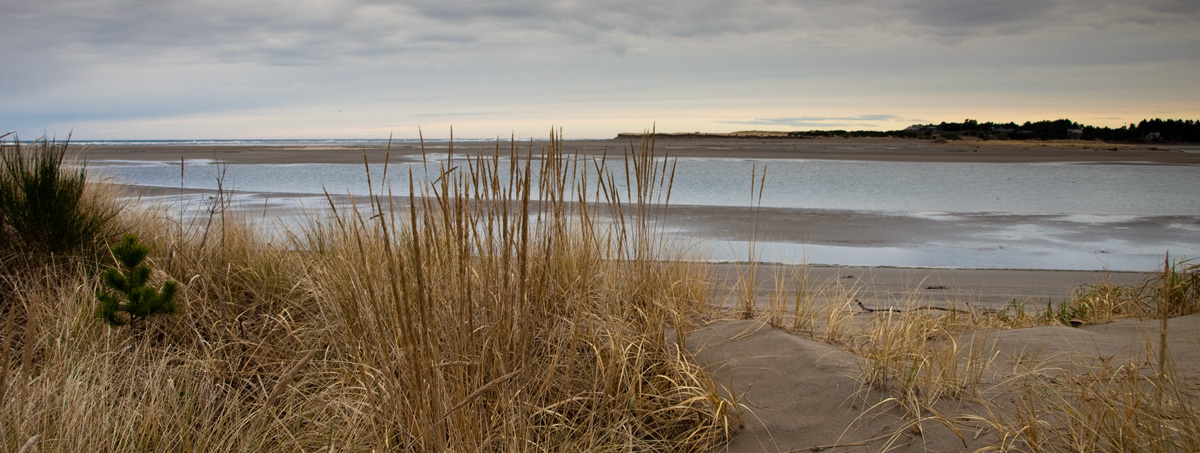
© 19 December 2010 by Kristopher K. Townsend. Permission to use granted under the Creative Commons Attribution-Share Alike 4.0 International license.
Beach Combing
a Cloudy rainey morning verry early I rose and walked on the Shore of the Sea coast and picked up Several Curious Shells. I Saw Indians walking up and down the beech . . . in Serch of fish which is frequently thrown up on Shore and left by the tide, and told me [Nicholas Biddle: in English] the “Sturgion was verry good”
—William Clark
Bartering
I attempted to purchase a Small Sea otter Skin for read beeds which I had in my pockets, they would not trade for those beeds not priseing any other Colour than Blue or White, I purchased a little of the berry bread and a fiew of their roots for which I gave Small fish hooks, which they appeared fond of—
—William Clark
Clark’s Lucky Shot
I Shot at the ducks and accidently Shot the head of one off, this Duck and brant was Carried to the house and every man Came around examined the Duck looked at the gun the Size of the ball which was 100 to the pound and Said in their own language Clouch Musket, [NB: English word Musket] wake, com ma-tax Musket which is, a good Musket do not under Stand this kind of Musket &c.
—William Clark
Fort-to-Sea Trail
The Sea Coast is about 7 miles distant Nearly West about 5 miles of the distance through a thick wood with reveens hills and Swamps the land, rich black moald 2 miles in a open wavering Sandy prarie, ridge runing parrelal to the river, Covered with Green Grass.
—William Clark
Laying a Foundation
found Capt Lewis with all the men out Cutting down trees for our huts &c.
—William ClarkIn the evening we laid the foundation of our huts.
—Patrick Gass
Weather Diary
Day of the Month Winds State of the Weather 10th N E rain a violent wind last night 6 to 9 P M. river fast with rain. Rained all day
—Meriwether Lewis[1]To assist the reader, the editor of this web page has spelled out some abbreviations.
Pike Continues
After arrangeing our sled’s and Perogue, we commenced our march—the sleds on the Prairie, and the Perogue towed by 3 men. Found it extremely difficult to get along, the snow being melted off of the Prairie in spots . . . . Distance 5 miles.
—Zebulon M. Pike[2]Donald Jackson, The Journals of Zebulon Montgomery Pike (Norman, Oklahoma: University of Oklahoma Press, 1966), 67.
Too Né’s Return Fails
St. Louis Decr. 10th 1805
Sir,
I had dispatched an order by the River dumoine to Lieut. Wilkinson, not to wait at the river Plate, but to descend the Missouri, so soon as he had taken the necessary measures, to convey the Riccara Chief to his nation—This order was however unnecessary, as the opposition of a Body of Canzes Indians . . . reduced him [the detachment officer] to returning, and he accordingly descended to the Cantonment the day before Yesterday, with the Ricarra Chief and his party in safety—
This body of Canzes after their first, very rude and unfriendly interview in which both Parties took arms, marched up the River and took Post at a difficult and narrow pass, where they decoyed two American hunters on shore who were descending the River, one of whom they killed, and the other after shooting an Indian made his escape, but unfortunately fell in with our Camp in the night, and not answering the challenge was fired upon and mortally wounded—
The Riccara and Interpreters all insisted on returning and seem happy to have got back in health—I now propose to send him to the seat of Government, and I think and I think you may expect to see him towards the end of Jany.—.
Ja: Wilkinson[3]Clarence E. Carter, The Territorial Papers of the United States (Washington, DC: United States Government Printing Office, 1948), 13:297–302, digitized by Google books.


Fort Clatsop is a High Potential Historic Site along the Lewis and Clark National Historic Trail managed by the U.S. National Park Service. The site is managed by the Lewis and Clark National and State Historic Parks.
Notes
| ↑1 | To assist the reader, the editor of this web page has spelled out some abbreviations. |
|---|---|
| ↑2 | Donald Jackson, The Journals of Zebulon Montgomery Pike (Norman, Oklahoma: University of Oklahoma Press, 1966), 67. |
| ↑3 | Clarence E. Carter, The Territorial Papers of the United States (Washington, DC: United States Government Printing Office, 1948), 13:297–302, digitized by Google books. |
| ↑4 | “The Nicholas Biddle Notes” in Letters of the Lewis and Clark Expedition with Related Documents: 1783–1854, ed. Donald Jackson (Urbana: University of Illinois Press, 1978), 2:746. |
Experience the Lewis and Clark Trail
The Lewis and Clark Trail Experience—our sister site at lewisandclark.travel—connects the world to people and places on the Lewis and Clark Trail.
This page was funded in part by the Lewis and Clark National Historic Trail, U.S. National Park Service.
Discover More
- The Lewis and Clark Expedition: Day by Day by Gary E. Moulton (University of Nebraska Press, 2018). The story in prose, 14 May 1804–23 September 1806.
- The Lewis and Clark Journals: An American Epic of Discovery (abridged) by Gary E. Moulton (University of Nebraska Press, 2003). Selected journal excerpts, 14 May 1804–23 September 1806.
- The Lewis and Clark Journals. by Gary E. Moulton (University of Nebraska Press, 1983–2001). The complete story in 13 volumes.
This site is provided as a public service by the

Lewis and Clark Trail Alliance
with additional funding from the following: