George Catlin
by William Fisk (1796–1872)
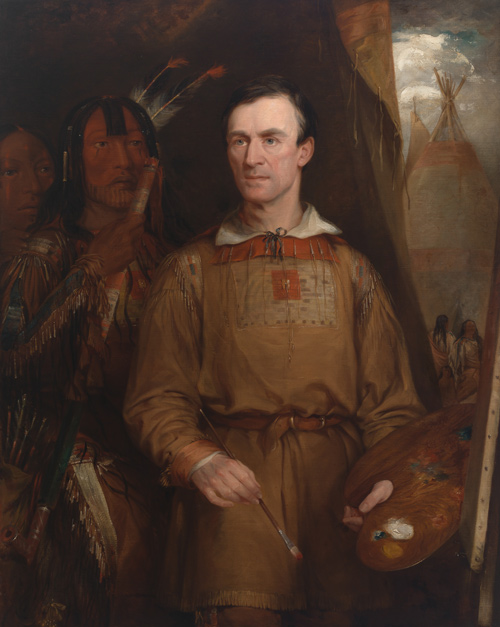
Oil on canvas, height: 1,588 mm (62.51 in); width: 1,334 mm (52.51 in). Courtesy National Portrait Gallery, Smithsonian Institution; transfer from the Smithsonian American Art Museum; gift of Miss May C. Kinney, Ernest C. Kinney and Bradford.
His curiosity sparked by Lewis and Clark artifacts displayed at in , George Catlin (1796–1872) began painting Native Americans with a trip up the Mississippi with General in 1830. He expanded his travels creating over 500 paintings. He also wrote a series of ‘letters’ of his travels, providing an early ethnographic record of many Native nations and tribes: Letters and Notes on the Manners, Customs, and Condition of the North American Indians, Volumes 1 and 2.
His curiosity sparked by Lewis and Clark artifacts displayed at Peale’s Museum in Philadelphia, George Catlin (1796–1872) began painting Native Americans with a trip up the Mississippi with General William Clark in 1830. Catlin, an artist and avid traveler, was determined to capture the essence and culture of the Native American tribes. He expanded his travels across the Great Plains, the Rocky Mountains, and the Southwest, creating over 500 paintings. These artworks vividly depicted the lives, customs, and ceremonies of various tribes, including the Mandan, Hidatsa, and The Blackfeet.
Catlin’s dedication to documenting Native American culture extended beyond his paintings. He also wrote a series of ‘letters’ chronicling his journeys, which provided an early ethnographic record of many Native nations and tribes. These letters were later compiled into a two-volume work titled Letters and Notes on the Manners, Customs, and Condition of the North American Indians. This seminal publication offered invaluable insights into the diversity and richness of Native American life during the 19th century.[1]Available at archive.org.
Through his art and writings, Catlin aimed to raise awareness about the plight of Native Americans as they faced increasing encroachment by European settlers. He hoped that his work would inspire a greater appreciation and respect for these indigenous cultures, which he believed were rapidly disappearing. Today, Catlin’s legacy lives on as his paintings and writings continue to serve as a crucial historical record and a testament to the enduring spirit of Native American tribes.[2]Brian W. Dippie, et al., George Catlin and His Indian Gallery (Smithsonian American Art Museum, W.W. Norton & Company, 2002).
Pages with Works by George Catlin
October 27, 1804
Ruptáre
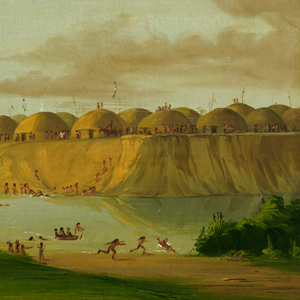
At the second Mandan village—Ruptáre—they hire free trader René Jusseaume as an interpreter. They camp opposite Mahawaha, the Awaxawi Hidatsa village at the mouth of the Knife River.
April 5, 1804
A speech for the Iowas
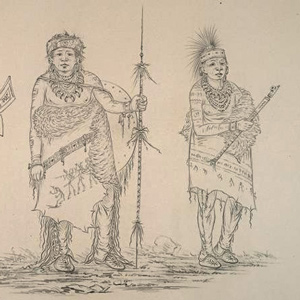
At Camp River Dubois, Clark and Lewis write speeches to inform Iowa and Yanktonai People of the Louisiana transfer of ownership. They send the speeches with Des Moines River trader Lewis Crawford along with Jefferson’s questions for Indians and vocabulary forms. They also send an invitation to visit Washington City.
January 5, 1805
The Buffalo Dance
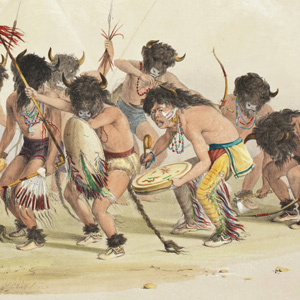
At Fort Mandan below the Knife River Villages, Clark works on his map of the west using information gathered from traders and Indians. He also describes the Mandan Nation’s Buffalo Dance ceremony.
March 2, 1805
North West Company news

At Fort Mandan, Canada-based trader François-Antoine Larocque visits with a fresh supply of trade goods and news of the death of Simon McTavish, the principal director of the North West Company.
From St. Louis, fur trader and merchant Pierre Chouteau writes President Jefferson to tell him news of the Lewis and Clark Expedition.
In Kaskaskia, Illinois, the captain’s intended peace between the Osage and their many neighbors appears to be falling apart.
December 15, 1804
Tchung-kee
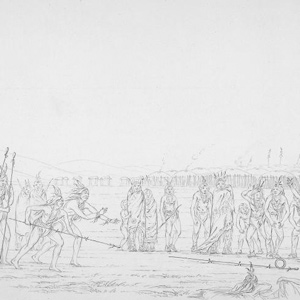
Sgt. Ordway and two others visit two Mandan villages to trade for corn. They see men playing Tchung-kee—a game involving rolling a stone and sliding sticks across a large ice field.
March 23, 1804
Kickapoo update
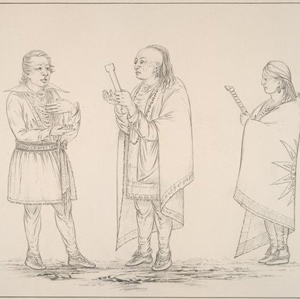
At winter camp across the Mississippi above St. Louis, the man sent up the river to check the status of a Kickapoo war party returns with a letter from François Saucier, the commander of Portage des Sioux.
Sgt. Floyd’s Memorials
Much Remembered
by Joseph A. Mussulman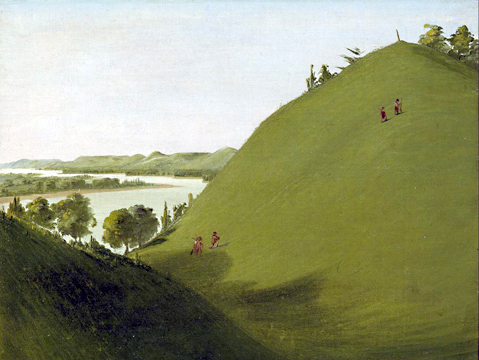
Floyd’s grave became a conspicuous point and a historic shrine on the Lewis and Clark trail almost immediately after the expedition was over. The American artist George Catlin painted Floyd’s Bluff in 1832, with the original cedar marker still in place.
April 13, 1803
Of vast importance
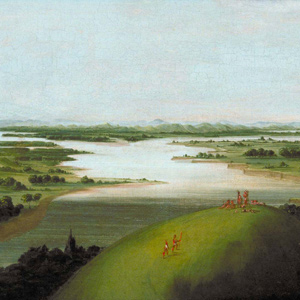
By this date in Washington City, Secretary of the Treasury Albert Gallatin asks that Meriwether Lewis include a report on the “extent & fertility” of the Missouri country stating that the destiny of this area is “of vast importance to the United States”.
December 6, 1804
Frostbitten hunters
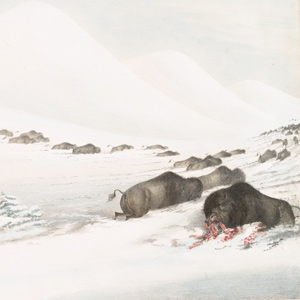
At Fort Mandan, work is delayed due to the cold, and a Mandan man visits wearing only leggings and a buffalo robe. Clark and sixteen buffalo hunters have a good day, but several men are frostbitten.
Wolves
Canis lupis
by Kenneth C. Walcheck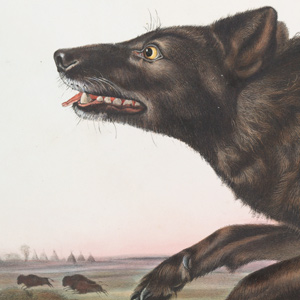
They didn’t get credit for it, but Lewis and Clark were the first to describe these wily canine predators.
February 15, 1803
Pressing Indian affairs
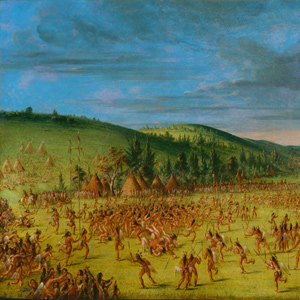 In Washington City, President Jefferson urges the War Department to negotiate for Native Nation lands in the Illinois and Mississippi Territories before France assumes control of New Orleans and Louisiana.
October 29, 1804
Mandan and Hidatsa council
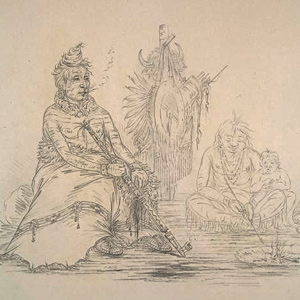
Opposite the Knife River, Mandan and Hidatsa chiefs come from each village to council with the captains. A long speech is given, and the captains ask them to smoke the pipe of peace with an Arikara chief.
April 27, 1805
Entering Montana
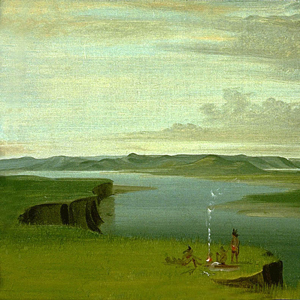
At the mouth of the Yellowstone, the captains make separate recommendations for the location of a fort or trading post. By midday, the expedition enters present Montana where they will be traveling another four months. Camp is near Snowden Bridge.
August 2, 1804
The Otoes arrive
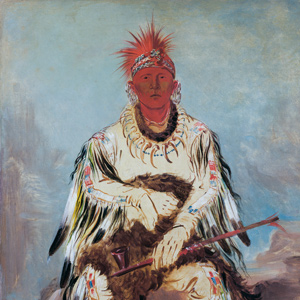
At sunset near present Fort Atkinson, Nebraska, several Otoes arrive at Council Bluff. Guns are fired, hands are shaken, and the captains exchange tobacco and food for watermelons. Lewis collects another plant specimen and examines a great egret.
Wild Horses
by Joseph A. Mussulman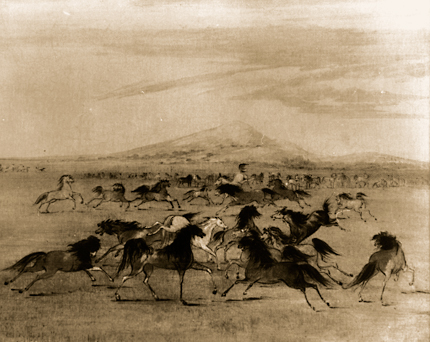
On 14 August 1805, Meriwether Lewis commented on the Shoshones’ herds: “Most of them are fine horses…. I saw several with Spanish brands on them, and some mules which they informed me that they had also obtained from the Spaniards.”
August 21, 1804
Big Sioux country
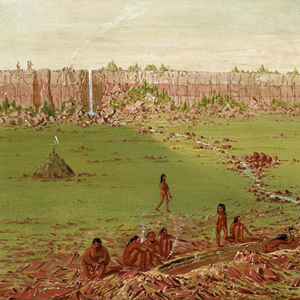
When strong winds create blowing sands, the barge’s sail must be reefed, and they must add ballast to the white pirogue to keep it on course. On board, trader Pierre Dorion informs the captains of the geography of the Big Sioux country and the Red Pipestone Quarry. At the end of the day, they camp near present Ponca, Nebraska.
In Philadelphia, the Osage delegation—previously arranged in part by Lewis and Clark and led by Pierre Chouteau—heads home.
September 9, 1804
Gangs of buffalo
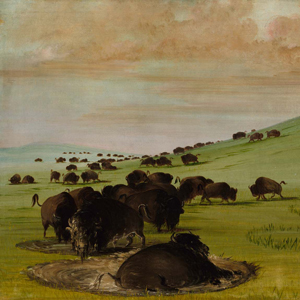
Approaching present Whetstone Bay in South Dakota, progress is slowed by countless sandbars. Clark and York hunt for pronghorn and mule deer. Finding none, Clark has York kill a bison instead.
March 18, 1804
Native amusements
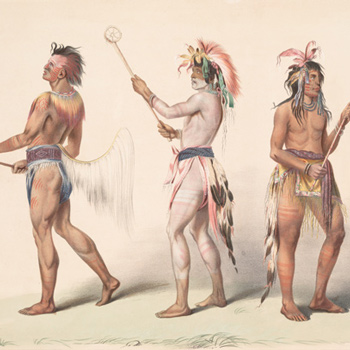
At Wood River, Illinois, the day reaches 50°—a signal that the expedition may soon be able to head up the Missouri River. Perhaps Clark finalizes the questions about Native American amusements.
December 23, 1803
Mr. Morrison's corn
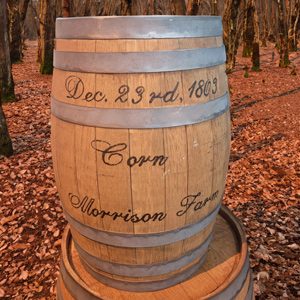
At Wood River, work continues building huts, Mr. Morrison’s corn arrives, and a Lenape Delaware man known to Clark visits. Near this date, Lewis observes the current system of slavery in Louisiana.
October 8, 1804
Arikara village Sawa-haini
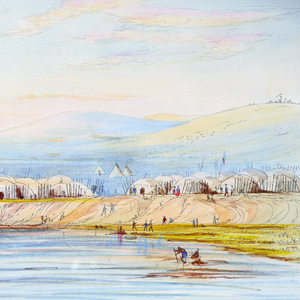
Near present Mobridge, South Dakota, Pvt. Frazer is promoted to the permanent party and assigned to Sgt. Gass. Camp is near Sawa-haini—an Arikara village where the interpreter Joseph Gravelines is found.
Notes
| ↑1 | Available at archive.org. |
|---|---|
| ↑2 | Brian W. Dippie, et al., George Catlin and His Indian Gallery (Smithsonian American Art Museum, W.W. Norton & Company, 2002). |
Experience the Lewis and Clark Trail
The Lewis and Clark Trail Experience—our sister site at lewisandclark.travel—connects the world to people and places on the Lewis and Clark Trail.
Discover More
- The Lewis and Clark Expedition: Day by Day by Gary E. Moulton (University of Nebraska Press, 2018). The story in prose, 14 May 1804–23 September 1806.
- The Lewis and Clark Journals: An American Epic of Discovery (abridged) by Gary E. Moulton (University of Nebraska Press, 2003). Selected journal excerpts, 14 May 1804–23 September 1806.
- The Lewis and Clark Journals. by Gary E. Moulton (University of Nebraska Press, 1983–2001). The complete story in 13 volumes.
This site is provided as a public service by the
Lewis and Clark Trail Alliance
with additional funding from the following: