At Fort Mandan below the Knife River Villages, the captains accuse Hidatsa interpreter Toussaint Charbonneau of acting in the interests of local fur traders and give him an ultimatum.
In Washington City, President Jefferson commissions James Wilkinson as Territorial Governor of Louisiana.
In St. Louis, Pierre Chouteau—U.S. Agent for Indian affairs west of the Mississippi River—informs Jefferson of an alliance against the Osage—a complication arising from the captains sending a delegation of Osage to Washington City.
Charbonneau Quits!
by Yellowstone Public Radio[1]Originally aired weekdays by Yellowstone Public Radio during the Bicentennial observance of 2003-2006. Narrated by Hal Hansen. Scripts by Whit Hansen and Ed Jacobson. Produced by Leni Holliman. © … Continue reading
The Travelers Meeting with Minatarre Indians (detail)
Karl Bodmer (1809–1893)
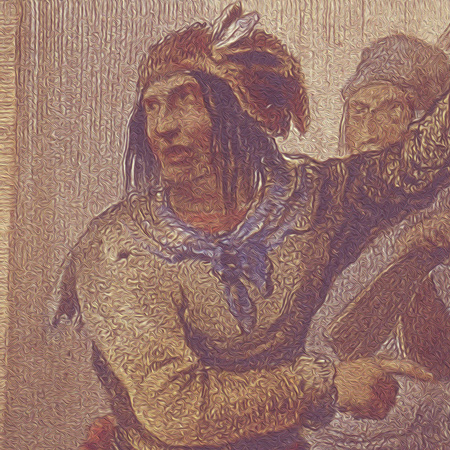
Aquatint by Alexandre Damien Manceau in Karl Bodmer’s North American Prints, Joslyn Art Museum and University of Nebraska Press, 2004. (cropped and altered)
The possibility exists, without any direct evidence, that the Metís in this figure is Toussaint Charbonneau.
Charbonneau’s Corruption
We have every reason to believe that our Menetarre [Hidatsa] interpeter [Charbonneau], (whome we intended to take with his wife, as an interpeter through his wife [Sacagawea] to the Snake [Lemhi Shoshone] Indians of which nation She is) has been Corupted by the [blank] Companeys &c. Some explenation has taken place which Clearly proves to us the fact, we give him to night to reflect and deturmin whether or not he intends to go with us under the regulations Stated.
—William Clark
Two More Pirogues
one of the perogue party who came in last night returned with provisions this morning. had orders for two more perogues to be made.
—John Ordway
Weather Diary
State of Ther. at rise
Weather wind at State of Thermt. at 4 OClock Weather at 4 Ock Wind at 4 OClock State of the River 12 [above 0] cloudy S E 26 fair after clouds N W rise 4½ in. —Meriwether Lewis[2]To assist the reader, the editor of this web page has omitted the “Day of Month 1805” column and spelled out some abbreviations.
Wilkinson’s Commission
Thomas Jefferson, President of the United States of America.
To all who shall see these presents, Greeting;
Know Ye, That reposing special Trust and Confidence in the Patriotism, Integrity, and Abilities of James Wilkinson, of Maryland, I do appoint him Governor in and over the Territory of Louisiana . . . .
TH: Jefferson[3]Clarence E. Carter, The Territorial Papers of the United States (Washington, DC: United States Government Printing Office, 1948), 13:98–99, digitized by Google books.
Warring Nations
St. Louis, 11 Mch. 1805
Sir [Thomas Jefferson]
The war against the Osages, which these nations seem to be planning with such care and determination, is fomented by whites who awaken and excite blind jealousy among them over Captain Lewis’s decision to send the Osage nation to meet with the government.
. . . . .
The government must not neglect any prudent precaution in our relations with these native nations. I feel obliged to add, Sir, that if the government reserves sole rights of commerce with these nations, it will immediately be forced to appoint many deputy agents.
. . . . .
There are no institutions on the western side to watch over or control them. . . . The choice of these agents, who could easily irritate these nations or lead them astray, would need to be entrusted to a general agent.
I will use all means of persuasion to deter the various nations from attending the proposed gathering, and I hope to have enough authority among several of them to be able to deflect them.
With the deepest respect, Sir, I have the honor of being your very humble and obedient servant.
Pre. Chouteau[4]Pierre Chouteau to Thomas Jefferson, Founders Online, National Archives, founders.archives.gov/documents/Jefferson/01-46-02-0022. [Original source: The Papers of Thomas Jefferson, vol. 46, 9 March to … Continue reading
Experience the Lewis and Clark Trail
The Lewis and Clark Trail Experience—our sister site at lewisandclark.travel—connects the world to people and places on the Lewis and Clark Trail.
Plan a trip related to March 11, 1805:


Fort Mandan is a High Potential Historic Site along the Lewis and Clark National Historic Trail managed by the U.S. National Park Service. The North Dakota Department of Parks and Recreation manages a modern reconstruction and the Lewis and Clark Interpretive Center located at US Hwy 83 and ND Hwy 200A.
Knife River Indian Villages National Historic Site is a High Potential Historic Site along the Lewis and Clark National Historic Trail managed by the U.S. National Park Service. A unit of the National Park System, the site is located at 564 County Road 37, one-half mile north of Stanton, North Dakota. It has exhibits, trails, and a visitor center.
Notes
| ↑1 | Originally aired weekdays by Yellowstone Public Radio during the Bicentennial observance of 2003-2006. Narrated by Hal Hansen. Scripts by Whit Hansen and Ed Jacobson. Produced by Leni Holliman. © 2003 by Yellowstone Public Radio. |
|---|---|
| ↑2 | To assist the reader, the editor of this web page has omitted the “Day of Month 1805” column and spelled out some abbreviations. |
| ↑3 | Clarence E. Carter, The Territorial Papers of the United States (Washington, DC: United States Government Printing Office, 1948), 13:98–99, digitized by Google books. |
| ↑4 | Pierre Chouteau to Thomas Jefferson, Founders Online, National Archives, founders.archives.gov/documents/Jefferson/01-46-02-0022. [Original source: The Papers of Thomas Jefferson, vol. 46, 9 March to 5 July 1805, ed. James P. McClure et al. (Princeton: Princeton University Press, 2022), 22–26.] |