After crossing the Embarras River near present Lawrenceville, Meriwether Lewis, Clark, and the Osage and Mandan delegates[1]For the delegations traveling with Lewis and Clark on this day, see The Osage Delegations and Sheheke’s Delegation. head southeast to Vincennes on the far shore of the Wabash River. Both George Rogers Clark and his brother William left written records of their time there.
Wabash River from Fort Knox
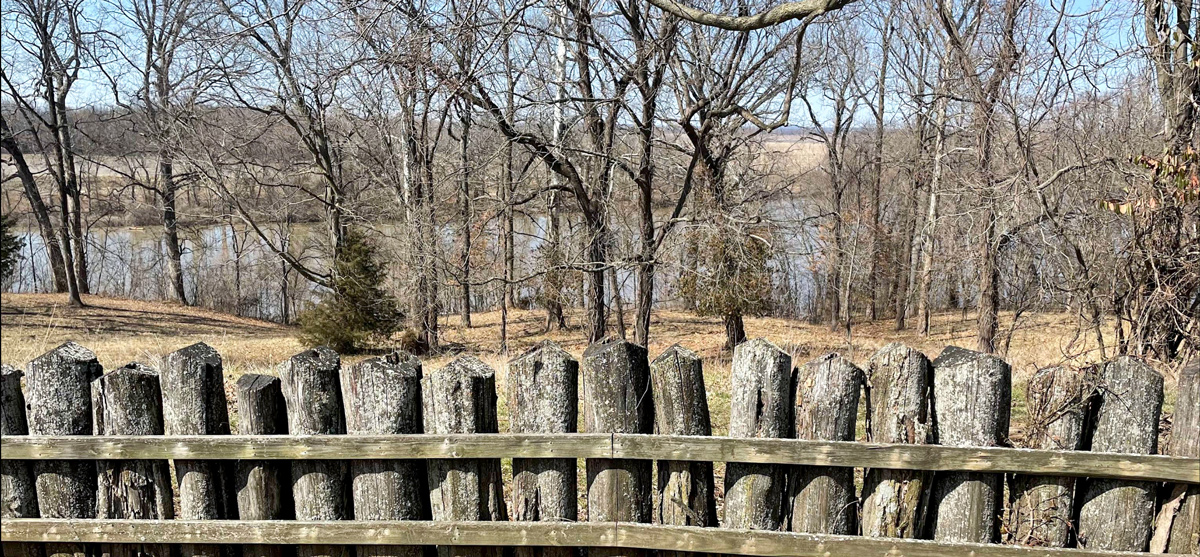
By Mike Ferris, May 2021, Google Places.
The above view of the Wabash River serves to represent what the group traveling to Washington City saw on this day. French settlers inhabited Vincennes as early as 1759 when it was called “Petit Rocher” or Little Rock. Prior, the Peeyankihšiaki [Piankeshaw] were a separate band of the Miami Nation with traditional villages at Vincennes and on the Embarras River.
Responding to an attack on a river boat, Vincennes settlers attacked the Peeyankihšiaki Embarras River Village. In turn, July 1786 saw some 450 angry Peeyankihšiaki warriors coming down the Wabash in 80 canoes. Hostilities were avoided after two days of negotiations between the warriors and French commandant J.M.P. LeGras atop the “Petit Rocher”. Fort Knox was built two years later and re-built three miles north of Vincennes in 1803.[2]“Piankeshaw”, Wikipedia, en.wikipedia.org/wiki/Piankeshaw; “Skirmishes_around_Vincennes_(1786)”, Wikipedia, en.wikipedia.org/wiki/Skirmishes_around_Vincennes_(1786); … Continue reading
Address to the Citizens of Vincennes
To the Inhabitants of Post Vincennes:
Gentlemen—Being now within two miles of your village with my army, determined to take your fort this night, and not being willing to surprise you, I take this method to request such of you as are true citizens, and willing to enjoy the liberty I bring you, to remain still in your houses, and those, if any there be, who are friends to the king, will instantly repair to the fort and join the Hair-buyer General, and fight like men. And if any such as do not go to the fort shall be discovered afterwards, they may depend on severe punishment. On the contrary, those who are true friends to liberty may depend on being well treated; and I once more request them to keep out of the streets, for every one I find in arms on my arrival I shall treat as an enemy.
—George Rogers Clark, 1779[3]General Clark’s Memoirs, in William H. English, Conquest of the Country Northwest of the River Ohio 1778–1783 and Life of Gen. George Rogers Clark (Indianapolis: The Bowen-Merill Company, … Continue reading
Beautiful Town, Delightful River
During the Northwest Indian War, Vincennes served as an assembly point for American forces. In 1791, Col. John Hardin led a detachment of Kentucky militia volunteers to help General Scott conquer the Wea settlement of Ouiatenon. Among them was a young volunteer named William Clark. In a journal of Hardin’s campaign, Clark is generally credited with writing the following description of Vincennes:
The situation at Post Vinciant is butifull but the houses is low and bilt after the french fasion I was astonished at Seeing so larg and old a Town with out any Settlement town as it contains about 400 houses and about 3000 soles on the bank of the Wabash a Delitefull River
—William Clark, 1791[4]Journal of Hardin’s Campaign, 5 Aug 1789–5 Mar 1790, William Clark Papers, Missouri Historical Society.
Notes
| ↑1 | For the delegations traveling with Lewis and Clark on this day, see The Osage Delegations and Sheheke’s Delegation. |
|---|---|
| ↑2 | “Piankeshaw”, Wikipedia, en.wikipedia.org/wiki/Piankeshaw; “Skirmishes_around_Vincennes_(1786)”, Wikipedia, en.wikipedia.org/wiki/Skirmishes_around_Vincennes_(1786); “Forts_of_Vincennes,_Indiana”, Wikipedia, en.wikipedia.org/wiki/Forts_of_Vincennes,_Indiana; Interpretive signs at Fort Knox State Historic Site. |
| ↑3 | General Clark’s Memoirs, in William H. English, Conquest of the Country Northwest of the River Ohio 1778–1783 and Life of Gen. George Rogers Clark (Indianapolis: The Bowen-Merill Company, 1897), 1:309. |
| ↑4 | Journal of Hardin’s Campaign, 5 Aug 1789–5 Mar 1790, William Clark Papers, Missouri Historical Society. |
Experience the Lewis and Clark Trail
The Lewis and Clark Trail Experience—our sister site at lewisandclark.travel—connects the world to people and places on the Lewis and Clark Trail.
Discover More
- The Lewis and Clark Expedition: Day by Day by Gary E. Moulton (University of Nebraska Press, 2018). The story in prose, 14 May 1804–23 September 1806.
- The Lewis and Clark Journals: An American Epic of Discovery (abridged) by Gary E. Moulton (University of Nebraska Press, 2003). Selected journal excerpts, 14 May 1804–23 September 1806.
- The Lewis and Clark Journals. by Gary E. Moulton (University of Nebraska Press, 1983–2001). The complete story in 13 volumes.
This site is provided as a public service by the
Lewis and Clark Trail Alliance
with additional funding from the following: