Before reaching Vincennes, the capital of the Territory of Indiana, Clark, Lewis, and Osage and Mandan delegates[1]For the delegations traveling with Lewis and Clark on this day, see The Osage Delegations and Sheheke’s Delegation. must cross the Embarras River. The river’s historic spellings—”Ambraw” and “Ombra”—mimic the French pronunciation of “embarras”—meaning “navigation obstacles” such as sawyers and logjams. For “les embarras” encountered by the Lewis and Clark Expedition, see Missouri River Hazards.
Embarras River
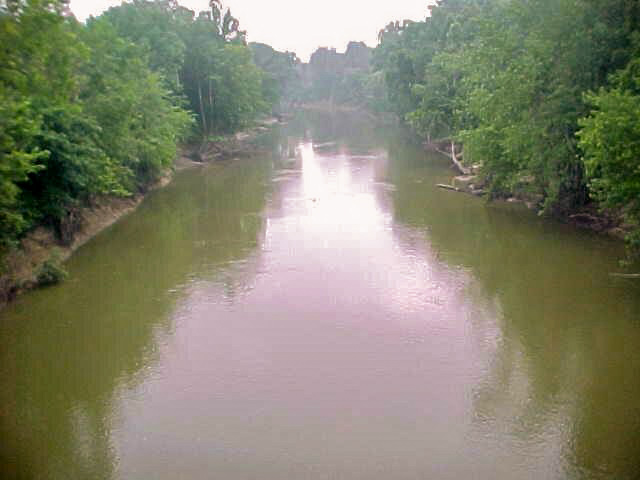
Courtesy U.S. National Oceanic and Atmospheric Administration (NOAA).
Count Volney’s Road
The Kaskaskia-Vincennes Trace near the end of the 18th-century was described by the Count of Volney:
Beyond Ombra [Embarras] we enter a Tartarian meadow,[2]Tartarian refers to Tartary—a blanket term by used by Europeans to refer to a region they knew little about—now called Central Asia. More specifically, Volney was referring to the arid plains of … Continue reading interspersed with clumps of trees, but in general flat and naked, and windy and cold in winter. In summer it is filled with tall and strong shrubs, which brush the legs of the rider in his narrow path so much, that journey out and back will wear out a pair of boots. Water is scarce, and there is danger of being bewildered, as happened to one of my fellow travellers, three years before, when, with two others, roamed about for seventeen days. Thunder, rain, gnats, and horseflies, are very troublesome in summer. Five years ago, you could not fail of meeting, in these meadows, with herds of four or five hundred buffaloes, but now there are none. The hunters and the bells of the tame cattle have driven them beyond the Mississippi, which they crossed by swimming.
—C. F. Volney[3]C. F. Volney, A View of the Soil and Climate of the United States of America, translated by C. B. Brown (Philadelphia: J. Conrad & Co., 1804), 341.
Besides being a friend to Thomas Jefferson, Constantin-François Chassebœuf de La Giraudai, comte de Volney (1757–1820) was a travel writer, philosopher, and politician. He toured America and Canada in 1795–98 and published his observations in France in 1804. It offers us a relatively detailed description of the Kaskaskia-Vincennes Trace at the turn of the century. In 1797, President John Adams accused him of being a spy intent on returning French control of Louisiana.[4]“Constantin-François Chassebœuf de La Giraudais”, Wikipedia, en.wikipedia.org/wiki/Constantin_Fran%C3%A7ois_de_Chasseb%C5%93uf,_comte_de_Volney.
Volney’s Itinerary
To better describe Lewis and Clark’s journey to Vincenne’s, Volney’s itinerary is presented here in reverse order with the nearest city or landmark added in brackets.
| Miles | Hours | |
|---|---|---|
| Kas [Kaskaskia] | ||
| To Lepronier [NW of Steelville] | 18 | 4 |
| To the Great Rib [Coulterville] | 12 | 2 |
| To the Meadow of the Hole [Oakdale] | 15 | 3 |
| To Pointe aux Fesses | 15 | 3 |
| To the three-thorned Acacia | 15 | 3 |
| To the Dam [Richview] | 12 | 3 |
| To Walnut Point [Walnut Hill] | 4.5 | 1 |
| To the Yellow bark [a tributary of Skillet Fork] | 15 | 2.5 |
| To the Coffee-pot [Skillet Fork] | 15 | 3 |
| To Great Point [SE of Salem] | 12 | 2 |
| To the Slaves gibbet [Xenia] | 15 | 2.5 |
| To the Salt spring [west of the Little Wabash River] | 15 | 3 |
| To the Yoke [east of Clay City] | 6 | 1.5 |
| To Cat River [Fox?] | 15 | 3 |
| To Elm in the meadow | 13.5 | 3 |
| To Ombra creek [Embarras River near Lawrenceville] | 13.5 | 3 |
| To Vincennes | 9 | 2[5]Volney, 340–41. |
Notes
| ↑1 | For the delegations traveling with Lewis and Clark on this day, see The Osage Delegations and Sheheke’s Delegation. |
|---|---|
| ↑2 | Tartarian refers to Tartary—a blanket term by used by Europeans to refer to a region they knew little about—now called Central Asia. More specifically, Volney was referring to the arid plains of Tartar. (“Tartary”, Wikipedia, en.wikipedia.org/wiki/Tartary. |
| ↑3 | C. F. Volney, A View of the Soil and Climate of the United States of America, translated by C. B. Brown (Philadelphia: J. Conrad & Co., 1804), 341. |
| ↑4 | “Constantin-François Chassebœuf de La Giraudais”, Wikipedia, en.wikipedia.org/wiki/Constantin_Fran%C3%A7ois_de_Chasseb%C5%93uf,_comte_de_Volney. |
| ↑5 | Volney, 340–41. |
Experience the Lewis and Clark Trail
The Lewis and Clark Trail Experience—our sister site at lewisandclark.travel—connects the world to people and places on the Lewis and Clark Trail.
Discover More
- The Lewis and Clark Expedition: Day by Day by Gary E. Moulton (University of Nebraska Press, 2018). The story in prose, 14 May 1804–23 September 1806.
- The Lewis and Clark Journals: An American Epic of Discovery (abridged) by Gary E. Moulton (University of Nebraska Press, 2003). Selected journal excerpts, 14 May 1804–23 September 1806.
- The Lewis and Clark Journals. by Gary E. Moulton (University of Nebraska Press, 1983–2001). The complete story in 13 volumes.
This site is provided as a public service by the
Lewis and Clark Trail Alliance
with additional funding from the following: