In present Middlesboro, Kentucky, Arthur Campbell meets with Meriwether Lewis and John Ordway. Campbell writes a letter of introduction to the father of American geography encouraging the use of Ordway’s journal to further the knowledge of the West.
Fern Lake and Middlesboro, Kentucky c. 1935
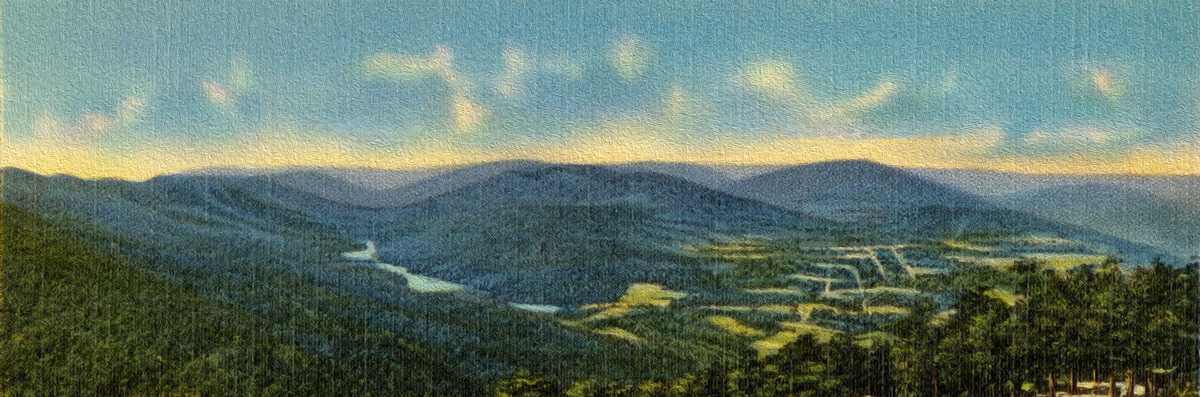
Stylized from a postcard entitled “View north from the Pinnacle, Cumberland Gap, Tenn., Va., Ky.” published by W. M. Cline Co., Chattanooga, Tennessee. Courtesy Boston Public Library Tichnor Brothers collection.
Jedidiah Morse (1761–1826)
by Samuel Morse
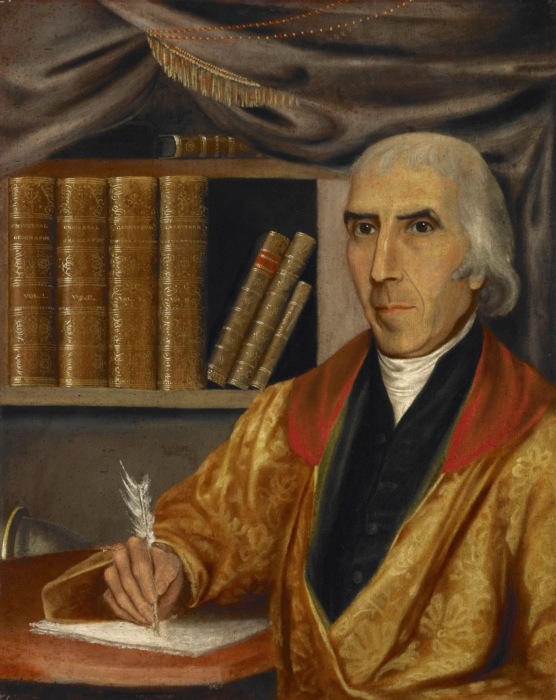
Oil on wood, 28 3/8 in. x 22 7/8 in. Courtesy of the Yale University Art Gallery, Yale University, New Haven, Connecticut.
Jedidiah Morse was the father of Samuel Finley Breese Morse, the painter of the above portrait and the inventor of the telegraph.
Introducing Ordway’s Journal
Kentucky. 20 Nov. 1806.
Rev Sir [Jedidiah Morse],
The bearer hereof being one of the party that attended Captains Lewis & Clark on their late tour up the Missouri and across to the Pacific ocean, and is in the possession of a journal kept by himself that may increase our knowledge of the western country; I have taken the liberty to advise him to apply to you for information & advice where he might make it useful to the public & at the same time be of some profit to himself. True it is that the Captains journal may be more full and correct, but as he has said that it will be at least 2 years, before his is ready for publication, in the mean time Mr. Ordway’s journal being published, it will serve as an introduction to the other larger work, and give much useful information that may be much needed, before that of the Captains can appear. Besides I understand that this journal has been examined and corrected by Lewis, and as far as it goes, gives a true statement of facts, as to the Geographical part of the journey. That which relates to animal, mineral & vegetable production, we must restrain our curiosity until the large work appears.
I am Rev Sir, being respectly your most obed Sert
Arthur Campbell[1]Arthur Campbell to Jedidiah Morse, Jedidiah Morse Papers, Box 1, folder “Correspondence 1801–1806,” Manuscripts and Archives Division of The New York Public Library cited in Kerry Oman, … Continue reading
The recipient of Campbell’s letter, Jedidiah Morse (23 August 1761–9 June 1826), was considered the father of American geography. His prior works included the 1784 school primer Geography Made Easy, the 1789 textbook American Geography, and his 1797 Universal Geography of the United States. Whether Ordway ever visited Morse remains unknown.[4]“Jedidiah Morse”, Wikipedia, en.wikipedia.org/wiki/Jedidiah_Morse.
Biographer Richard Moss describes Morse’s appearance:
From 1789 to 1819, the Reverend Jedidiah Morse was a prominent figure on the streets of Charlestown, Massachusetts. Charlestown citizens often encountered this tall, slender man making his way through the streets on soe errand. His dress singled him out as a gentleman of the old school. His powdered hair, knee-breeches, silver-buckled shoes with a high shine, and the odd gloves with the fingers cut off contrasted sharply with the dress of the day—he must have seemed like an apparition, a time traveler from an earlier age.[5]Richard J. Moss, The Life of Jedidiah Morse: A Station of Peculiar Exposure (Knoxville: University of Tennessee Press, 1995), archive.org/details/lifeofjedidiahmo0000moss/. See also William B. … Continue reading
Notes
| ↑1 | Arthur Campbell to Jedidiah Morse, Jedidiah Morse Papers, Box 1, folder “Correspondence 1801–1806,” Manuscripts and Archives Division of The New York Public Library cited in Kerry Oman, “Serendipity: A Newly Discovered Letter . . .” We Proceeded On 27, no. 4 (November 2001): 8, lewisandclark.org/wpo/pdf/vol27no4.pdf. |
|---|---|
| ↑2 | The entourage consisted of Sheheke, his wife Yellow Corn, and their son. Interpreter René Jusseaume brought one of his Mandan wives and two children. Former expedition member François Labiche also helped translate. |
| ↑3 | “Arthur Campbell (Virginia soldier)”, Wikipedia, en.wikipedia.org/wiki/Arthur_Campbell_(Virginia_soldier); John Baker, “The Almost Published Journals of the Lewis and Clark Expedition”, We Proceeded On 40 No. 1 (February 2023): 9–10, lewisandclark.org/wpo/pdf/vol49no1.pdf. |
| ↑4 | “Jedidiah Morse”, Wikipedia, en.wikipedia.org/wiki/Jedidiah_Morse. |
| ↑5 | Richard J. Moss, The Life of Jedidiah Morse: A Station of Peculiar Exposure (Knoxville: University of Tennessee Press, 1995), archive.org/details/lifeofjedidiahmo0000moss/. See also William B. Sprague, The Life of Jedidiah Morse, D.D. (New York: Anson D. F. Randolph & Company, 1874), archive.org/details/lifeofjedidiahmo00spra. |
Experience the Lewis and Clark Trail
The Lewis and Clark Trail Experience—our sister site at lewisandclark.travel—connects the world to people and places on the Lewis and Clark Trail.
Discover More
- The Lewis and Clark Expedition: Day by Day by Gary E. Moulton (University of Nebraska Press, 2018). The story in prose, 14 May 1804–23 September 1806.
- The Lewis and Clark Journals: An American Epic of Discovery (abridged) by Gary E. Moulton (University of Nebraska Press, 2003). Selected journal excerpts, 14 May 1804–23 September 1806.
- The Lewis and Clark Journals. by Gary E. Moulton (University of Nebraska Press, 1983–2001). The complete story in 13 volumes.
This site is provided as a public service by the
Lewis and Clark Trail Alliance
with additional funding from the following: