On or near this day, Lewis, Clark, Osage and Mandan delegates[1]For the delegations traveling with Lewis and Clark on this day, see The Osage Delegations and Sheheke’s Delegation. cross the often-dangerous White River and continue east along the river’s east fork.
In Washington City, President Thomas Jefferson writes to master surveyor Andrew Ellicott expressing his hope that Lewis will “bring us a treasure”—celestial observation data that will correct the latitudes of North America.
White River at Morrison’s Ferry
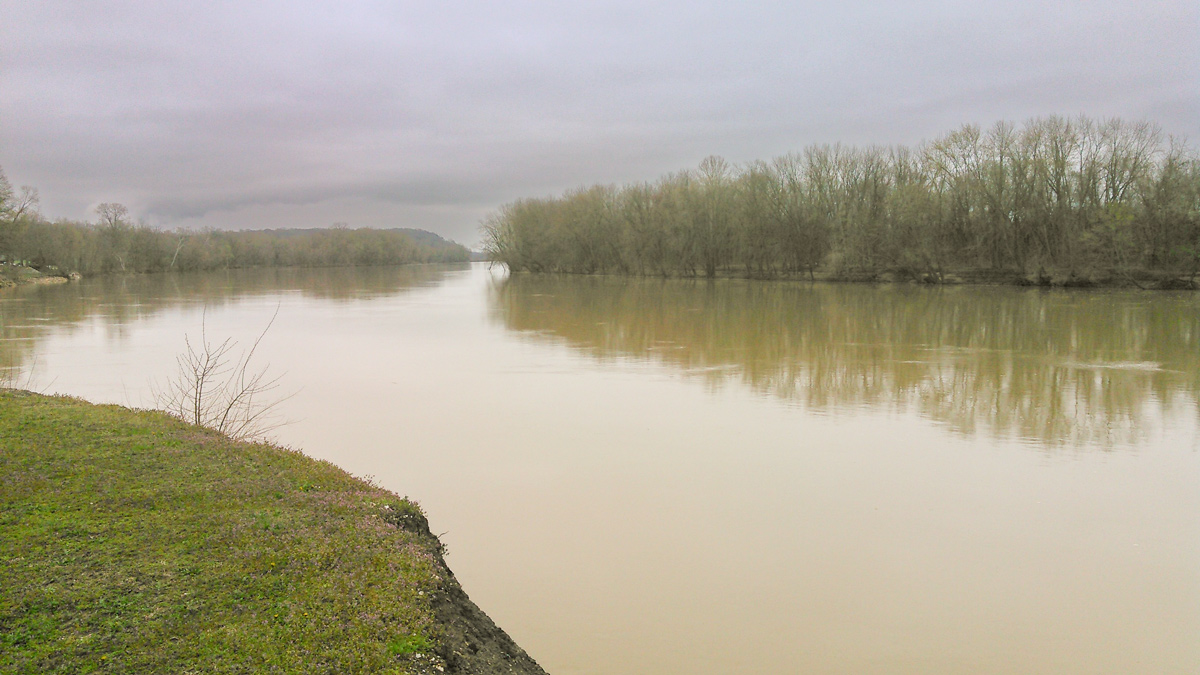
Photo by Tom Mosley, Hoosier National Forest, U.S. National Forest Service.
As early as 1796, Joshua Harbin—spelled variously Harlan, Harlin, and Harbin—provided a ferry crossing at what is now called Morrison’s Ferry six miles west of the confluence of the White River and East Fork White River.[2]George R. Wilson and Gayle Thornbrough, The Buffalo Trace (Indianapolis: Indiana Historical Society, 1946), 212; George R. Wilson, “Early Indiana Trails and Surveys”, Indiana Historical … Continue reading With a party that included about 20 horses, two women, and three children, it is likely the captains had everyone cross on the ferry here.
Clark’s Fatal Crossing
William Clark knew the inherent danger in crossing the White River. As a soldier in Charles Scott’s 1791 campaign against the Wabash Nations, he witnessed a fatal crossing:
Marched 6 Miles today Crossed the Main fork of White River 3 men & 8 or 10 Horses Drowned Much Confusion—
—Charles Scott, 12 June 1791[3]“Journal of Gen. Charles Scott’s journey, Ohio River to Louisville, May 1791”, E. G. Voorhis Memorial Collection, Missouri Historical Society, … Continue reading
Austin’s Quicksand
In 1796, merchant and mine owner Moses Austin thought the White River’s current moderate, but the quicksand shores treacherous:
At White River there is a good Boat at which you may pass at any time. . . . White River is a delightfull River . . . and I was told the Currint is moderate and the Navegation as easy as any River in the Western World. this River may be Forded in summer At the Delaware Village . . . but its attended with great Danger the whole of the River from side to side beeing a quick sand, and I was told by a Number of Gentlm. that sundry Horses was lost last Summer in attempting the forde by those unacquainted with It.
—Moses Austin, 31 December 1796[4]Wilson and Thornbrough, The Buffalo Trace, 211.
Clearwater Canoe Camp Observations
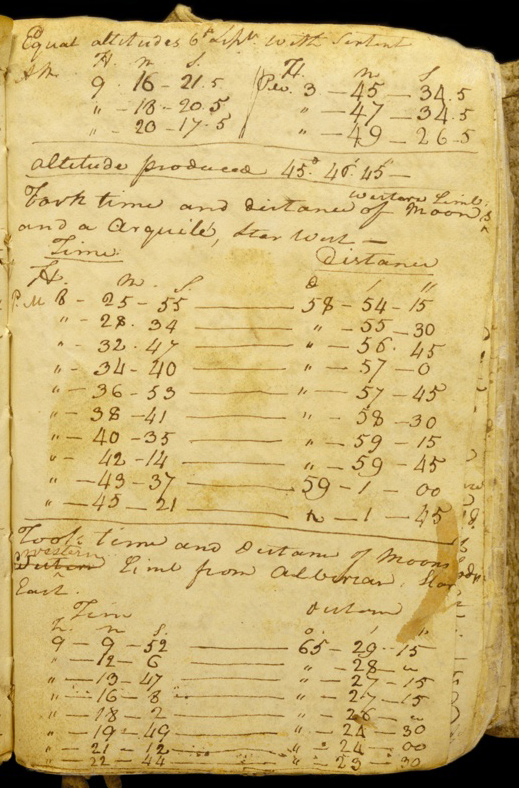
Courtesy Missouri Historical Society, mohistory.org/collections/item/A0289-20305.
Lewis’s Celestial Treasure
Washington Nov. 1. 06.
Dear Sir [Andrew Ellicott]
I thank you for the communication of your observations of the eclipse. fortune seems to have favored every other place but this with a fair view of it. this spot was covered by a dense cloud through the whole of it’s duration, & for some time before & after. I hope the great extent of the path of this eclipse round the globe, & especially thro’ our states will furnish many useful corrections of our longitudes. Capt Lewis will bring us a treasure in this way.[5]Thomas Jefferson to Andrew Ellicott, Founders Online, National Archives, founders.archives.gov/documents/Jefferson/99-01-02-4489, accessed 23 Dec 2025.
Th: Jefferson
The table of celestial observations shown in the figure were recorded by William Clark at the Clearwater River canoe camp, 6 October 1805. For more, see Clearwater Canoe Camp Observations by Robert N. Bergantino. See also Deciphering the Celestial Data by Robert N. Bergantino and Celestial Reckoning by John Logan Allen.
Notes
| ↑1 | For the delegations traveling with Lewis and Clark on this day, see The Osage Delegations and Sheheke’s Delegation. |
|---|---|
| ↑2 | George R. Wilson and Gayle Thornbrough, The Buffalo Trace (Indianapolis: Indiana Historical Society, 1946), 212; George R. Wilson, “Early Indiana Trails and Surveys”, Indiana Historical Society Publications, 6 no. 3 (1919): 350. |
| ↑3 | “Journal of Gen. Charles Scott’s journey, Ohio River to Louisville, May 1791”, E. G. Voorhis Memorial Collection, Missouri Historical Society, collections.mohistory.org/resource/1012549. For more on Scott’s campaign, see Charles Scott, 108–115, Harry M. Ward, Charles Scott and the “Spirit of ’76” (Charlottesville: University Press of Virginia, 1988), available for loan at archive.org/details/charlesscottsp00ward. |
| ↑4 | Wilson and Thornbrough, The Buffalo Trace, 211. |
| ↑5 | Thomas Jefferson to Andrew Ellicott, Founders Online, National Archives, founders.archives.gov/documents/Jefferson/99-01-02-4489, accessed 23 Dec 2025. |
Experience the Lewis and Clark Trail
The Lewis and Clark Trail Experience—our sister site at lewisandclark.travel—connects the world to people and places on the Lewis and Clark Trail.
Discover More
- The Lewis and Clark Expedition: Day by Day by Gary E. Moulton (University of Nebraska Press, 2018). The story in prose, 14 May 1804–23 September 1806.
- The Lewis and Clark Journals: An American Epic of Discovery (abridged) by Gary E. Moulton (University of Nebraska Press, 2003). Selected journal excerpts, 14 May 1804–23 September 1806.
- The Lewis and Clark Journals. by Gary E. Moulton (University of Nebraska Press, 1983–2001). The complete story in 13 volumes.
This site is provided as a public service by the
Lewis and Clark Trail Alliance
with additional funding from the following: