Moving along the present Nebraska-Iowa border, the expedition passes Water-which-Cries and Waubonsie creeks. Lead hunter George Drouillard is sick, so Sgt. Pryor and Pvt. Joseph Field hunt on shore this day. Lewis collects specimens of purple prairie clover and white prairie clover—both lost, and Clark describes the boils affecting several of the enlisted men.
A Large Yellow Wolf
by Yellowstone Public Radio[1]Originally aired weekdays by Yellowstone Public Radio during the Bicentennial observance of 2003-2006. Narrated by Hal Hansen. Scripts by Whit Hansen and Ed Jacobson. Produced by Leni Holliman. © … Continue reading
Purple Prairie Clover
Dalea purpurea
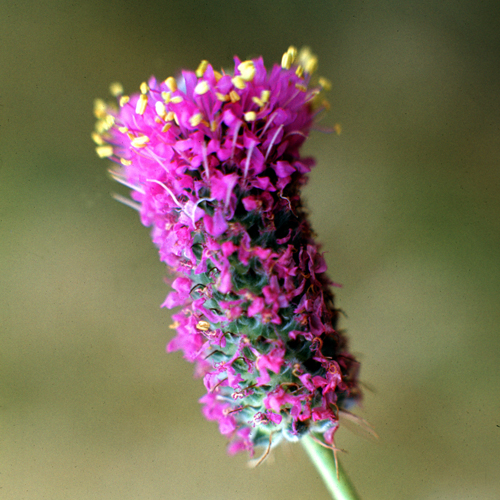
Richard Thomas, U.S. National Park Service.
Bratton’s Morning Swim
Bratten [Bratton] Swam the river to get his gun & Clothes left last night psd a large willow Isd. on the L. S.
—William Clark
Passing Water-which-Cries
passed he mouth of a Creek on the South Side Called Crys Creek it is about 35 yards wide it Comes in above Clifts oppset a willow Isd. at this Clift thare is a fine Spring on the top of this Hill is oppen prarie passed a Creek on the N. Side Called Piggen Creek
—Charles Floyd
Prairie Fire Cycle
The Soil of Those Praries appears rich but much Parched with the frequent fires—
—William Clark
Health Report
It is wothey of observation to mention that our party has been much healthier on the Voyage than parties of the Same Number is in any other Situation Tumers have been troublesom to them all
George Drewyer Sick
—William Clark
Regarding these tumors, Clark told Nicholas Biddle:
These biles were large tumours which broke out under the arms, on the legs, and, generally, in the parts most exposed to action, which sometimes became too painful to permit the men to work. After remaining some days, they disappeared without any assistance, except a poultice of the bark of the elm, or of Indian meal. This disorder, which we ascribe to the muddiness of the river water. . . .[3]Nicholas Biddle, ed., History of the Expedition Under the Command of Captains Lewis and Clark to the sources of the Missouri and thence across the Rocky Mountains and down the River Columbia to the … Continue reading
Evening Camp
From this evenings incampment a man may walk to the [Pawnee] Village on the S bank of the Platt [Platte] River in two days, and to the Otteaus [Otoes] in one day all those Indians are Situated on the South bank of the Plate River, as those Indians are now out in the praries following & Hunting the buffalow, I fear we will not See them.
—William Clark
White Prairie Clover
Dalea candida
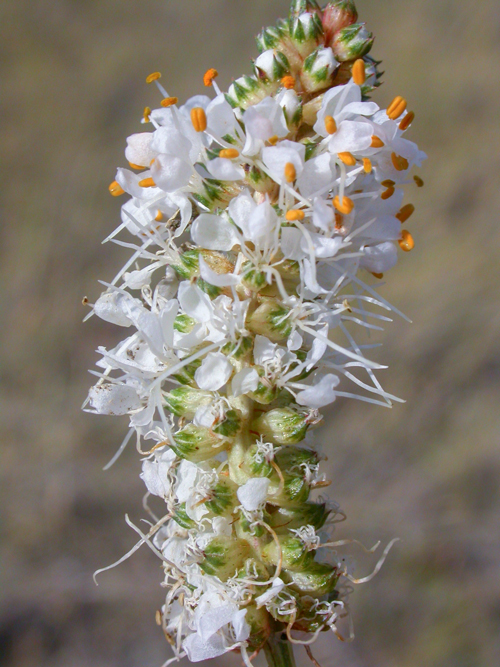
Matt Lavin, 3 August 2005. Licensed under the Creative Commons Attribution-Share Alike 2.0 Generic license.
Lost Specimen No. 15
No. 15. Was taken on the 20th of July, a pieniel plant, an inhabitant of the open praries or plains, high situations, where the grass is low . . . . it grows abot 2½ or three feet high— it is a stranger to me.—
—Meriwether Lewis
Moulton identifies this lost specimen, received by John Vaughn in 1805 (see The Donation Book), as Dalea purpurea (Petalostemon purpureum (Vent.) Rydb.), Purple Prairie Clover.[4]Gary E. Moulton, ed. Journals, “Fort Mandan Miscellany”, vol 3:456, 467.
Lost Specimen No. 16
No. 16. this is much the same as No. 15 with this difference that the blume of the conic tausel are white in stead of purple and it’s leaves single fewer and longer—
—Meriwether Lewis
Moulton identifies this lost specimen, received by John Vaughn in 1805, as Dalea candida (Petalostemon candidum (Willd.) Michx.), White Prairie Clover.[5]Ibid., vol 3:456, 468.
Experience the Lewis and Clark Trail
The Lewis and Clark Trail Experience—our sister site at lewisandclark.travel—connects the world to people and places on the Lewis and Clark Trail.
Plan a trip related to July 20, 1804:
Notes
| ↑1 | Originally aired weekdays by Yellowstone Public Radio during the Bicentennial observance of 2003-2006. Narrated by Hal Hansen. Scripts by Whit Hansen and Ed Jacobson. Produced by Leni Holliman. © 2003 by Yellowstone Public Radio. |
|---|---|
| ↑2 | William Bright, Native American Placenames of the United States (Norman: University of Oklahoma Press, 2004), 537. |
| ↑3 | Nicholas Biddle, ed., History of the Expedition Under the Command of Captains Lewis and Clark to the sources of the Missouri and thence across the Rocky Mountains and down the River Columbia to the Pacific Ocean. Performed during the years 1804–5–6. By order of the Government of the United States (New York: Bradford and Inskeep, 1814), 1:30. |
| ↑4 | Gary E. Moulton, ed. Journals, “Fort Mandan Miscellany”, vol 3:456, 467. |
| ↑5 | Ibid., vol 3:456, 468. |