The expedition sails several miles up the Missouri, but later in the day the enlisted men and engagés must clear the channel of driftwood and tow the boats. At camp near the mouth of the present Crooked River in Missouri, Lewis issues mosquito netting.
In Philadelphia, German polymath Alexander von Humboldt—returning from his Mexican and Cuban expedition—writes to Secretary of State James Madison seeking funding for another expedition.
Traveling by Horse
proceeded on passed two large Islands on the S. S. leaving J. Shields and one man [John Collins] to go by land with the horses
—William Clark
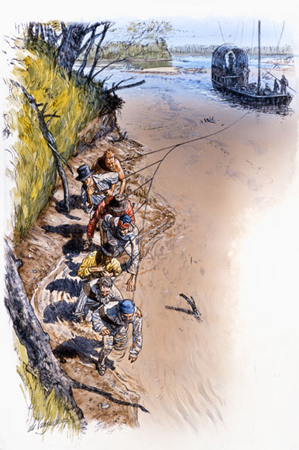
Towing the Boat
passed Several Islands & Sand bars to day at the head of one we were obliged to cleare away Driftwood to pass
in passing Some hard water round a Point of rocks on the L. S. we were obliged to take out the roape & Draw up the Boat for ½ a mile
—William Clark
Mosquito Nets
The Musquetoes are verry troublesome. we Got Musquetoes bears [mosquito netting] from Capt Lewis to sleep in
—John Ordway
Alexander von Humboldt’s Request
[Philadelphia, c. 19 June 1804]
Monsieur [James Madison],
It seems to me that I will see this beautiful country again in a few years. The route from the Missouri to the shores of the Pacific Ocean will then already be open. The lakes, Canada, and the immense basin that stretches from Pittsburgh to the mountains seen by Fidler offer a vast field for geological research. With some assistance from Your Government, a great and beautiful work could be done there.
Humboldt.[1]“Alexander von Humboldt to James Madison, [ca. 19] June 1804,” Founders Online, National Archives, founders.archives.gov/documents/Madison/02-07-02-0352 accessed 5 Dec 2025. Translated … Continue reading
From Philadelphia, Humboldt was escorted by Charles Willson Peale to see President Jefferson in Washington City. There, he supplied abundant information about New Spain (Mexico). His proposed American expedition never came to fruition, but from his detailed notes, he was able to publish many volumes on the natural history of Hispanic America. So much so, Charles Darwin would call him “the greatest scientific traveler who ever lived”.[2]Paul H. Barrett and Alain F. Corcos, “A Letter from Alexander Humboldt to Charles Darwin.” Journal of the History of Medicine and Allied Sciences, 27 (1972):161.
For Fidler’s contributions to the fur trade and the Lewis and Clark Expedition, see Peter Fidler.
Experience the Lewis and Clark Trail
The Lewis and Clark Trail Experience—our sister site at lewisandclark.travel—connects the world to people and places on the Lewis and Clark Trail.
Plan a trip related to June 19, 1804:
Notes
| ↑1 | “Alexander von Humboldt to James Madison, [ca. 19] June 1804,” Founders Online, National Archives, founders.archives.gov/documents/Madison/02-07-02-0352 accessed 5 Dec 2025. Translated from the original French by Google Translate. |
|---|---|
| ↑2 | Paul H. Barrett and Alain F. Corcos, “A Letter from Alexander Humboldt to Charles Darwin.” Journal of the History of Medicine and Allied Sciences, 27 (1972):161. |